


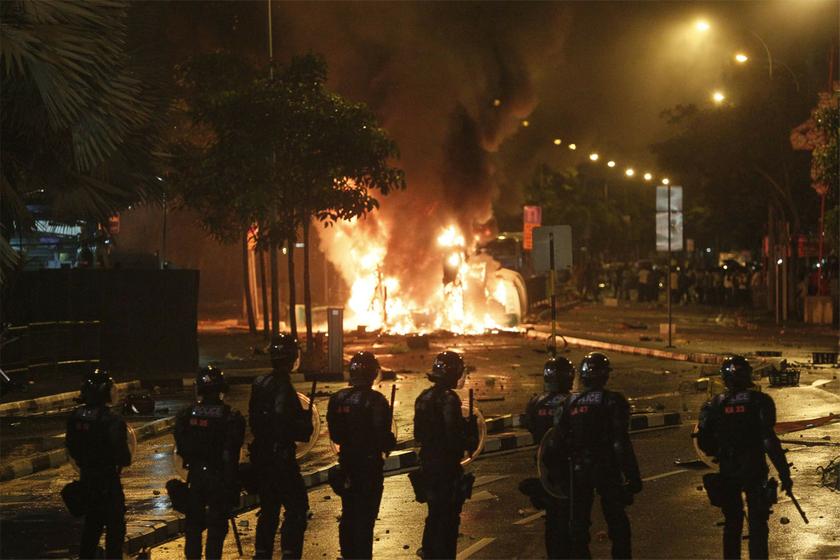


SINGAPORE, March 7 — A litany of issues foreign workers face, such as high agent fees, the fear of repatriation and tedious salary dispute procedures, were brought to the attention of the Committee of Inquiry (COI) into the Little India riot yesterday by non-government organisations (NGOs).
But the NGOs were quick to add that discontentment with working and living conditions was not what led to the riot that day — on the contrary, most foreign workers they dealt with feel that Singapore is a good country to work in.
Bernard Menon, of the Migrant Workers’ Centre (MWC), which has worked with almost 10,000 foreign workers and has reached out to over 400,000, said: “Our common (perception) is that, generally, they are happy.”
In the aftermath of the melee on Dec 8 last year, foreign workers’ frustrations with purportedly poor working and living conditions in Singapore were fingered in some quarters as the cause of the riot.
But Menon, who is executive director of Planning for the MWC, testified yesterday that most migrant workers were happy about working here, citing the good pay, Singapore’s safe environment and good treatment by their bosses.
He added that he did not notice frustration or tension building up within the community, although he noted that some foreign workers face salary disputes.
Expanding on the point, Jennie Yeow, deputy executive secretary of the Building Construction and Timber Industries Employees’ Union (BATU), noted that migrant workers turning to the Labour Court to settle such disputes could be caught in a bind, even if the judgment is in their favour.
This is because they would have to fork out close to S$800 (RM2,064) — S$270 in stamp duty to the Subordinate Courts and S$500 as deposit for a bailiff, who charges S$50 per hour — to enforce an order if his employer refuses to comply, she explained.
This prompted COI chairman G Pannir Selvam to remark that it was “a case of double whammy”, since workers have to pay to get back money they are owed.
The NGOs also pointed out that some work injuries go unreported because workers feared they would be repatriated as a result.
When Yeow proposed allowing workers to make a report and claim compensation without needing their supervisors’ aid, COI member Andrew Chua, noting that it was rather straightforward and simple to implement, asked: “Why is it not being done (yet)?”
Another problem migrant workers face is that bosses can unilaterally terminate their work permits and send them home, said Menon.
The repatriated workers could be mired in debt from the thousands of dollars they pay agents to send them here, he added.
Yesterday, the COI also heard from two foreign workers who passed by the scene of the riot. Besides supporting the NGOs’ testimony by describing to the committee why they were happy working here, they also related what they saw that night.
Kannadasan Murugan said he was upset when he saw an ambulance being torched that day and had wanted to help put out the flames.
He also repeated a point — based on what he heard that night and conversations with other workers in the days after — the COI had heard previously: The rioters were angry as “the police officers and paramedics had helped the bus driver who had run over and killed a fellow countryman”.
The other worker who took the stand, Seenuvasan Selvaraja, said that after he passed the place where Indian national Sakthivel Kumaravelu had been run over by a bus, he saw an Indian man crying in the middle of the road.
When he asked the man whether he knew the accident victim, he replied: “No, but our countryman has died.” — Today


