


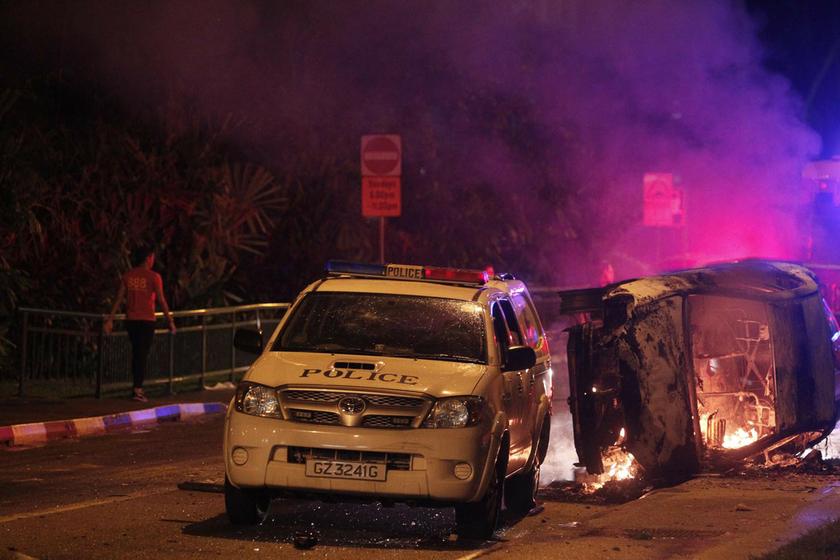


SINGAPORE, Dec 10 — More details of the events leading up to Sunday’s riot in Little India emerged yesterday, as Prime Minister Lee Hsien Loong ordered a Committee of Inquiry (COI) to look into the incident.
The Government also announced that it will impose a temporary ban this weekend on the sale and consumption of liquor in the area, noting that alcohol consumption could be a contributing factor to the large-scale violence which involved 400 rioters and injured dozens of police officers and Singapore Civil Defence Force personnel, as well as damaged public property and vehicles. Details of the COI and the alcohol ban will be announced later.
To date, 28 people, all foreigners except for one Singapore permanent resident, have been arrested for their involvement in the riot. The police said that 26 will be charged today.
The riot was triggered by a traffic accident in which Indian national Sakthivel Kumaravelu, 33, died after he was hit by a private bus.
Police investigations showed that an inebriated Sakthivel had boarded the bus, which was ferrying workers from Tekka Lane to their Avery Lodge dormitory in Jalan Papan. After noticing that Sakthivel was causing trouble on board — the construction worker had allegedly dropped his trousers at one point — the bus driver asked his assistant, who was helping to ensure the bus ran on schedule, to get the man off the bus.
Sakthivel alighted and the bus moved off. While it was turning into Race Course Road, the driver heard a thud on the side of the bus.
Sakthivel had been knocked down and was caught beneath the bus’ left rear tyre. It was not clear whether the driver got off the bus at this point or who called the police.
At around 9.40pm, about 17 minutes after receiving a call for assistance, the police and the SCDF first responders arrived at the scene where a “boisterous” crowd of male South Asians had gathered, the police said.
Outlining the sequence of events, the police said the crowd first pelted rescuers with objects and then started punching the bus assistant, a 38-year-old woman. The police and SCDF officers had to rescue the assistant and bus driver who had locked themselves in the bus. The crowd continued hitting the bus with items such as bottles, stones, dustbins, rods and concrete slabs.
The police’s Special Operations Command (SOC) arrived half an hour after they had been activated. The police said the delay was because Hampshire Road was congested with buses picking up foreign workers. SOC officers had to alight and proceed on foot. By 11.30pm, the situation was brought under control.
Why no shots were fired
The riot was quelled and no shots were fired by enforcement officers.
Explaining the rules of engagement, the police said officers are permitted to draw their firearms where there is a direct and imminent threat to their lives or personal safety.
In this instance, the officers were “very restrained” as they did not want to escalate the situation. They were focused on dispersing the crowd, the police said. It added that while officers could have fired warning shots, they decided against doing so as such a tactic might have backfired with an alcohol-fuelled mob that was unable to think rationally.
Injuries to police officers were sustained from objects thrown at them. The police said the crowd was purposely attacking uniformed personnel. It noted how a commander in plain-clothes was only pelted by the mob when he was speaking to uniformed officers, but not when he was on his own.
Speaking on Channel NewsAsia’s Talking Point programme last night, Tanglin Police Division Commander Lu Yeow Lim said the police was “perturbed” by how the crowd had attacked rescuers who were extricating Sakthivel’s body. “It appeared ... that they were targeting people in uniform, whether it was the SCDF uniform or the police uniform.”
When the police officers used shields to protect themselves, this “somehow angered” the crowd. “We are hoping at the end of the investigation we will determine the root cause of this,” he said.
The COI to be convened by the Ministry of Home Affairs will look into the factors that led to the riot, as well as how the situation was handled. In a press statement, Mr Lee said the committee will also “review the current measures to manage areas where foreign workers congregate, whether they are adequate and how they can be improved”.
Condemning the violent and criminal behaviour, Mr Lee stressed the vast majority of foreign workers here are law-abiding. “We must not allow this bad incident to tarnish our views of the foreign worker community here.”
Offering his deepest condolences to the family of Sakthivel, he also urged Singaporeans to remain calm and to continue with their daily lives.
Underlying issues to blame?
Speaking to reporters after visiting Little India with Transport Minister Lui Tuck Yew, Second Home Affairs Minister S Iswaran said the temporary alcohol ban “will give the police time to assess the situation, engage stakeholders and then decide on the appropriate next steps to be taken”.
Speaking on Talking Point, Mr Iswaran also reiterated that there was “no evidence that (the riot) was in any way related to an industrial relations matter or some kind of dispute at the workplace”.
“This was a spontaneous eruption in response to an incident on the ground ... Even if there are disputes, there are established channels and ... (foreign workers) know there are laws in place and there are ways that they can seek resolution to any grievances that they have,” he said.
On whether the riot was triggered by underlying issues affecting foreign workers here, Mr Alex Au, Vice-President of migrant workers’ welfare group Transient Workers Count Too, cautioned against reading too much into the incident “without a clearer idea of the details of what happened”.
He added: “It would still be good for the authorities to pay more attention to such grievances. Doing so would reduce whatever sense of resentment may exist, and thereby raise the threshold of the tipping point, to better prevent another incident from happening again.”
Mr Bernard Menon, Executive Director of Migrant Workers Centre, noted that workers from some parts of South Asia might be scarred by “how they were treated back home and that could have also sparked a reaction when the (police officers’) shields went up”. ― Today


