


SEPTEMBER 30 — Flash floods are no longer exceptional events in Southeast Asia.
They are becoming an increasingly familiar feature of urban life.
The latest floods in Thailand should therefore concern the whole of Asean, not merely Bangkok.
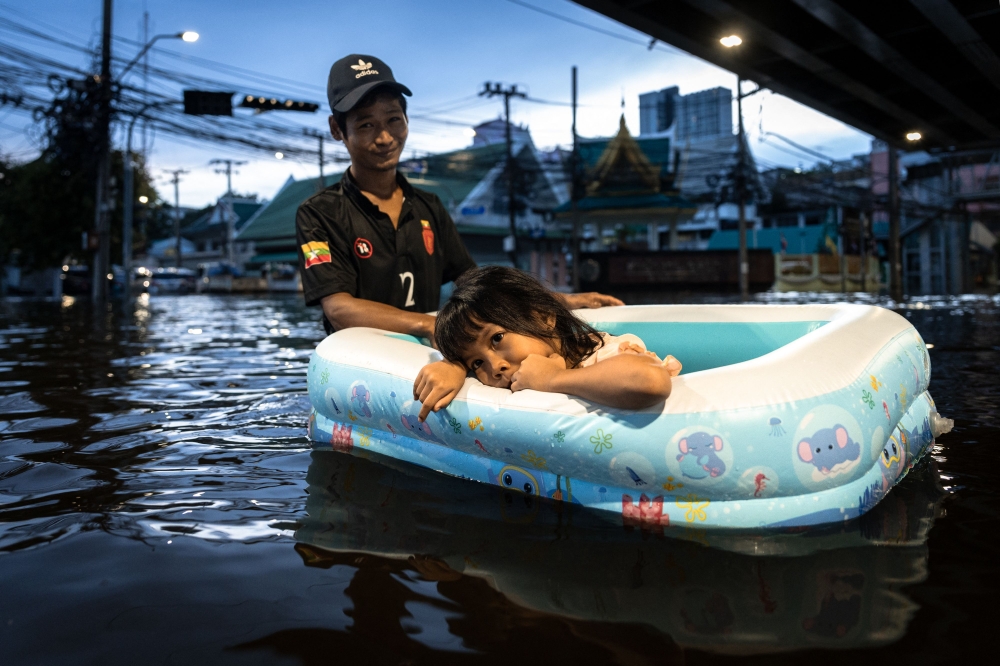
By September 29, floods across Thailand had killed at least 23 people and affected more than 2.6 million. Bangkok itself was badly hit, with approximately 700,000 people affected. All 50 districts of the capital were declared disaster zones.
The amount of rainfall was extraordinary. Bangkok received roughly 320mm of rain within two to three days — close to what the city would normally receive during the entire month of September.
But rainfall alone does not explain the problem. What Southeast Asia is confronting is an increasingly dangerous collision between extreme weather, rapid urbanisation, inadequate drainage, excessive construction and the concentration of economic activity in enormous metropolitan centres. Bangkok demonstrates this vulnerability dramatically.
The flooding disrupted roads, businesses, schools and ordinary economic life. It even affected operations surrounding Suvarnabhumi International Airport, one of Southeast Asia’s most important aviation hubs.
Thai Airways had to cancel flights while thousands of pieces of luggage accumulated because flooding prevented sufficient numbers of workers from reaching the airport.
When an urban flood can disrupt an international aviation hub, it ceases to be merely a municipal drainage problem. It becomes an issue of national and regional economic resilience.
Asean should pay attention because Bangkok is hardly unique. Kuala Lumpur, Jakarta, Manila, Singapore, Ho Chi Minh City and other rapidly expanding Southeast Asian cities confront different versions of the same challenge.
Urban development has created enormous concentrations of roads, buildings and concrete surfaces. Natural drainage areas disappear.
Rivers and canals become constrained by development. Water that once seeped gradually into the soil instead rushes rapidly towards already overloaded drainage systems. Climate change adds another layer of uncertainty.
Warmer atmospheric conditions can contribute to heavier precipitation events, making historical rainfall patterns progressively less reliable as the sole basis for designing urban infrastructure.
Bangkok’s experience is instructive. More than 300mm of rain over roughly 48 hours overwhelmed parts of its drainage system.
Experts have consequently called for infrastructure planning based increasingly on worst-case rainfall scenarios rather than historical averages.
This principle should apply throughout Asean.
Cities cannot keep constructing drainage systems designed for yesterday’s weather while experiencing tomorrow’s rainfall.
Nor can governments assume that building ever larger tunnels and drains will provide a permanent solution.
Urban resilience requires several approaches simultaneously: improved drainage, retention ponds, protected wetlands, better river management, permeable urban surfaces, more sophisticated weather forecasting and development rules that recognise where water naturally wants to flow.
The concept of the “sponge city” — designing urban areas to absorb, retain and gradually release rainwater — deserves much greater attention across Southeast Asia.
There is also an economic argument. Every flooded road prevents workers from reaching factories, offices, hotels and airports.
Every submerged commercial district damages inventories and interrupts small businesses.
Every airport disruption affects tourism, logistics and international confidence. Thailand’s present floods demonstrate precisely these cascading consequences.
For Asean, therefore, urban flooding should increasingly be understood as a form of non-traditional security.
The region has spent decades thinking about security largely through borders, military capabilities and geopolitical competition.
Yet a two-day rainstorm can immobilise parts of a capital more effectively than many conventional security threats. And unlike conventional military threats, extreme rainfall does not recognise sovereignty.
The weather systems affecting Thailand can extend towards Myanmar, Cambodia, Laos, Malaysia and elsewhere.
The present episode has already coincided with serious flooding elsewhere in mainland Southeast Asia.
Asean therefore needs to deepen cooperation in meteorological information, satellite monitoring, urban engineering, flood modelling and climate-resilient infrastructure.
Individual cities will still have to solve their own drainage problems.
But the science, technology and financing required to strengthen resilience can increasingly be shared. Bangkok should consequently be treated as another warning.
Southeast Asia’s great cities are engines of Asean’s economic rise. They concentrate people, capital, infrastructure, universities, airports and industries. But concentration creates vulnerability too.
Flash floods in major urban centres are becoming too frequent to be dismissed as freak weather events.
Asean’s cities must now be designed on the assumption that extraordinary rainfall will become less extraordinary.
The water will keep coming. The strategic question is whether Southeast Asian cities will be ready for it.
* Phar Kim Beng is professor of Asean Studies and director at the Institute of International and Asean Studies, International Islamic University Malaysia.
** This is the personal opinion of the writers or publication and does not necessarily represent the views of Malay Mail.


