


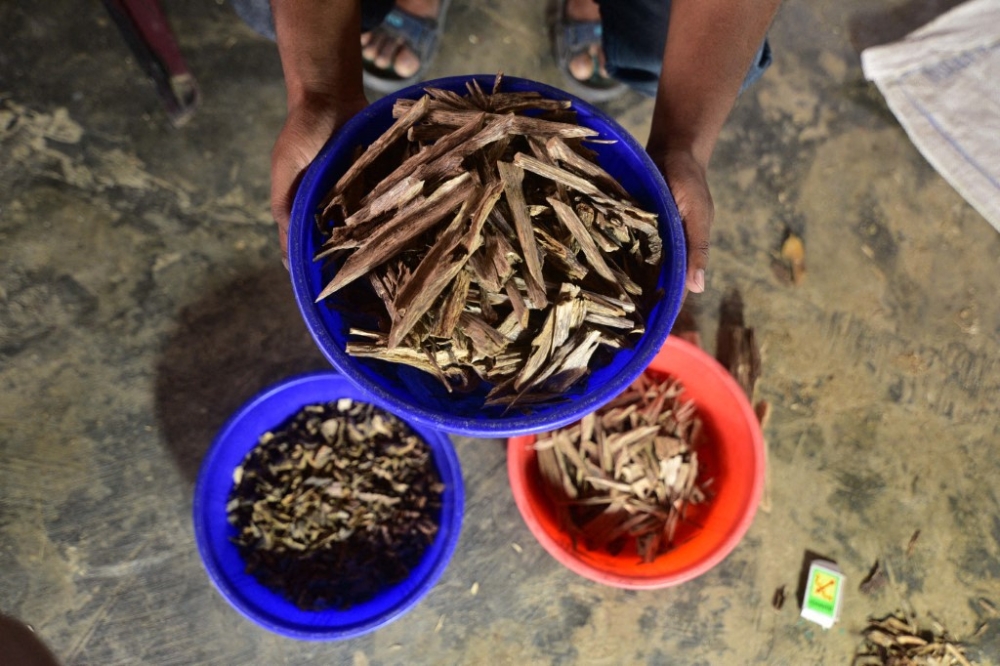
SEPTEMBER 20 — When agarwood (gaharu) is mentioned, many of us might immediately think of aromatic wood burned for its distinctive fragrance or processed into expensive perfumes and oils. Yet behind its unmistakable scent, lies economic potential that extends far beyond these traditional uses - a potential that remains largely untapped.
Agarwood is more than a valuable forest resource. With the right combination of research, technology, innovation and marketing, this natural treasure can be transformed into a diverse range of value-added products, opening new opportunities for local entrepreneurs and industries.
The karas tree, particularly Aquilaria malaccensis, is among the species associated with the production of agarwood. Its uniqueness lies in the formation of resin-rich wood that produces its distinctive aroma. This remarkable characteristic has given agarwood a long history of use, particularly in fragrances, cultural practices and traditional medicine.
Beyond fragrance
The perception that agarwood is valuable only as aromatic wood or perfume oil needs to be changed. In today’s vibrant economy, the value of a natural resource is no longer determined solely by the price of its raw material. More importantly, value lies in how effectively that resource can be converted into marketable, value-added products.
This is where innovation becomes essential.
Rather than simply selling natural resources in their raw form, local industries need to move proactively into downstream product development, research and development (R&D), branding and marketing. The greater our ability to create value from local resources, the greater their potential contribution to industry and the national economy.
Technological advances are also opening new possibilities for the agarwood industry. Scientific methods can now be used to evaluate the quality of agarwood and its oil, including analyses of their composition and chemical characteristics. Such developments demonstrate that agarwood should no longer be viewed solely as part of a traditional industry. It has considerable potential to develop into a knowledge-driven industry supported by research, science and technology.
This view is shared by Aminudin Md Hafidzin, an entrepreneur and researcher actively involved in agarwood-related research. The participation of industry players in research is particularly important because the future of the sector will depend on their ability to move beyond supplying raw materials towards creating commercially valuable innovations.
Unlocking opportunities for local industry
Undeniably, Malaysia has an advantage. Agarwood is not an unfamiliar resource in this country. Yet the availability of a valuable natural resource alone does not guarantee the success of an industry. The real question, therefore, is how Malaysia can unlock the full potential of agarwood by transforming this natural treasure into innovative, high-value products that command strong brand recognition and sustainable market demand.
This is the challenge facing local industry.
Among the local industry players exploring the commercial potential of agarwood-based products is Malga Industries Sdn Bhd, a Bumiputera company with extensive experience in agarwood-related research. One of the company’s latest innovations is Malga Gold Plus, a product formulated from premium-grade distilled agarwood water extracted from agarwood trees and developed for its potential health-related applications.
What is particularly significant is not simply the creation of a new product, but how research and innovation can transform agarwood from a valuable natural resource into high-value downstream products with strong commercial potential. It demonstrates that the value of agarwood need not end with the sale of raw wood or the distillation of oil. Through innovation, agarwood can be brought closer to consumers through the development of new products and applications. According to Bukhari Rusli, Marketing Manager of Malga Gold Plus, the company’s various research and market development initiatives indicate that downstream agarwood products have room to grow beyond the resource’s conventional uses.
Such developments matter to Malaysia’s local industries. The country should not allow the value of its natural resources to end at the raw-material stage while greater economic returns from processing, innovation, branding and marketing are captured elsewhere.
From natural resource to marketable brand
The next challenge is the market.
Creating an innovative product is only part of the journey. A product must also earn consumer confidence and market acceptance. Today’s consumers have unprecedented access to information. Before making a purchase, they compare products and prices, read the experiences of other consumers and seek information through various platforms. Therefore, companies developing agarwood-based products must therefore understand more than the technical characteristics of their products. They must also understand the people who buy and use them. These are important questions for the future of the industry.
This is where market research becomes an important bridge between agarwood innovation and the consumer. The potential of agarwood does not depend solely on the uniqueness of the resource or the novelty of the products developed from it. It also depends on whether those products meet consumer needs and gain market acceptance.
Decisions about developing and marketing agarwood-based products should therefore not be based on assumptions alone. Consumer data and feedback can help businesses better understand market acceptance, satisfaction and trust, while identifying more effective marketing strategies.
Collaboration between the agarwood industry and academic researchers can also become an important catalyst for the sector’s development. Researchers in marketing and consumer behaviour, for example, can help businesses better understand their markets, while expertise in science and technology can support further research and product development. When academic research expertise is combined with the practical knowledge and experience of industry players, agarwood can become more than an object of study. It can provide the foundation for commercially viable innovations that respond to genuine consumer needs.
It is this synergy between research, industry and the market that can help ensure Malaysian agarwood is recognised not merely as a valuable natural resource, but also as the foundation for competitive local products and brands.
Building a Malaysian agarwood brand
It is time to view agarwood from a much broader perspective.
The question should no longer be simply how much a kilogramme of agarwood is worth or how expensive its oil can be. The bigger question is how Malaysia can develop the entire agarwood value chain; from cultivation and resource production to research, processing, product development, branding and marketing. We have the natural resources. We have researchers. We also have entrepreneurs and local companies willing to explore new opportunities. What is needed is an ecosystem capable of bringing these strengths together.
If Malaysia can combine its natural resources with research, technology, entrepreneurial creativity and a deeper understanding of consumers, agarwood has the potential to become part of the country’s high-value product industry.
The efforts of local companies such as Malga Industries Sdn Bhd to explore the development of agarwood-based products demonstrate that opportunities for innovation do exist. To take the industry further, however, stronger collaboration among growers, businesses, universities, researchers and relevant agencies will be essential.
Malaysia should aspire to be more than simply a country blessed with agarwood resources. The greater ambition should be to build Malaysian knowledge, innovation, products and agarwood brands capable of creating value for the national economy and competing in wider markets. Agarwood has long been treasured for its fragrance. The challenge now is to ensure that its fragrance carries with it the name of Malaysian innovation to the world.
* Professor Dr Nor Azila Mohd Noor is attached to the School of Business Management, Universiti Utara Malaysia.
** This is the personal opinion of the writer or publication and does not necessarily represent the views of Malay Mail.


