















SEPTEMBER 10 — Electric vehicles (EVs) are gaining ground among Malaysian consumers. Once seen as expensive cars for a niche market, EVs are now available across a wider range of prices. Greater choice, government incentives, lower running costs and growing environmental awareness have made them increasingly attractive for everyday use.
This shift is evident in the rapid growth of EV registrations. Malaysia registered 44,813 EVs in 2025, up 105.7 per cent from 21,789 units the year before. More than doubling in a single year shows how quickly consumer acceptance is growing.
That progress is encouraging. But the rise in EVs must be matched by public chargers that are sufficient, accessible and reliable. Otherwise, the benefits of electric mobility risk being overshadowed by worries about finding a charger, long waits and the difficulty of navigating different charging networks.
The question is whether Malaysia’s public charging infrastructure is expanding as quickly as its EV market. Current figures suggest that the two are still moving at very different speeds.
EV growth is outpacing charger growth
At the end of 2024, Malaysia had about 3,600 public charging points. By September 30, 2025, the number had risen to 5,149, an increase of roughly 43 per cent. EV registrations, therefore, grew at more than twice the pace of public charging infrastructure.
By May 31, 2026, the number of public chargers had reached 6,416, comprising 2,143 direct-current (DC) chargers and 4,273 alternating-current (AC) chargers. This is welcome progress, but it remains far short of the government’s target of 30,000 charging points by the end of 2030.
Malaysia still needs another 23,584 chargers. On average, about 429 new public chargers would have to be installed every month from June 2026 to December 2030 to meet the target.
The limited number and uneven distribution of chargers, particularly along some highways, in rural areas and on less-served travel routes, can unsettle existing users and weaken the confidence of consumers considering an EV purchase.
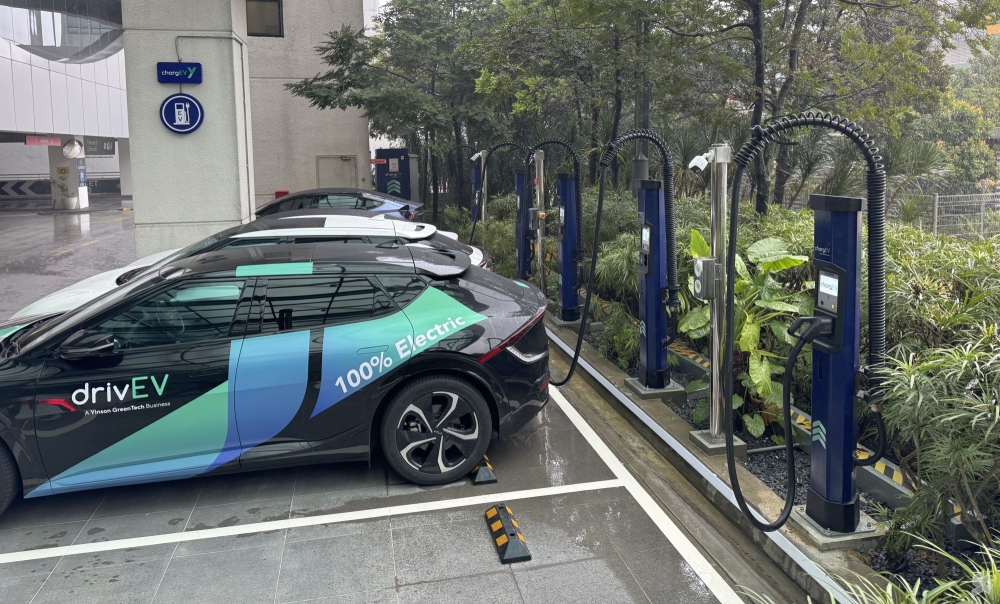
Only two chargers at some rest stops
At some highway rest and service areas, public charging is still limited to only two chargers. That is clearly inadequate on busy routes, especially during festive seasons, school holidays and public holidays when highway traffic surges.
If several EVs arrive at about the same time, drivers must wait because charging takes longer than filling a petrol tank. If one of the two chargers is out of service, the site’s capacity is immediately cut in half.
This does not only worry EV owners travelling long distances. It also shapes the perceptions of prospective buyers. They may be attracted by an EV’s technology, comfort and potential savings, yet hesitate when they imagine queuing for a long time or being unable to charge during a journey home.
Many operators and too many obstacles
The shortage is compounded by a fragmented user experience. Malaysia has more than 10 charging operators or networks, including ChargeSini, Gentari, chargEV, JomCharge, TNB Electron, Shell Recharge, ParkEasy, Tesla, EVPower and DC Handal.
More operators are, in principle, good for competition and consumer choice. In practice, however, each network may have a different app, registration process, pricing structure and payment method.
Drivers must do more than locate an available charger. They have to make sure they have downloaded the correct app, that their account remains active, that their payment method is accepted and that the internet connection works. When a charger is faulty, availability information is inaccurate or payment fails, an already scarce facility becomes even harder to use.
This is charging friction: every avoidable obstacle that makes charging more difficult than it needs to be.
EV discussions have long focused on range anxiety, or the fear that the battery will run out before the vehicle reaches its destination. As driving ranges improve, the nature of that anxiety is changing. Drivers now ask whether a charger will be available, how long they will have to wait, whether it will work, which app they need and whom they should contact if payment fails.
Malaysia is therefore facing two connected problems. There are still too few chargers, and their distribution is uneven. At the same time, some existing chargers do not deliver a simple, consistent and dependable experience. Both problems require attention.
A proposal for a single integrated EV-charging app has been discussed. The intention is sound, but the solution should not end with yet another app. If users must still register, enter payment details and depend entirely on an internet connection, a new app may simply add another layer to an already complicated system.
What matters more is allowing drivers to charge without being forced to join a network. Petrol drivers do not download a separate app for every fuel company before filling up. EV drivers should likewise be able to stop, pay by card, contactless payment or DuitNow QR, charge and continue their journey.
Operator apps can remain useful for discounts, rewards, reservations and usage records. They should not, however, be the only gateway to a basic charging service.
What other countries are doing
Malaysia is not alone in confronting these issues. The European Union has a much larger market with numerous operators. Under its Alternative Fuels Infrastructure Regulation, consumers must be able to charge without opening an account or entering into a contract with an operator.
New public chargers in the EU must accept widely used electronic payment methods. Prices must be clearly displayed before charging begins, while real-time information such as operational status, availability and price must be accessible for use by navigation services.
The United Kingdom requires rapid-charging networks to achieve average annual reliability of 99 per cent. Operators must also provide contactless payment at specified chargers, cross-network roaming, transparent prices, open data and a 24-hour helpline.
The United States links service quality to government funding. Federally funded chargers must achieve annual uptime above 97 per cent, accept card payments without requiring membership, and make current prices and charger status available to third-party applications.
Singapore uses a licensing approach. Operators serving the public must be licensed and comply with requirements on reliability, maintenance and data sharing. This makes accountability clearer when a service fails.
Who should pay for public chargers
Adding 23,584 public chargers in less than five years will require substantial funding. The government has acknowledged that it faces constraints in financing a large-scale charging network of the kind developed in China.
In August 2026, the government said it was considering a levy on every EV sold, with the proceeds channelled into a dedicated fund for public chargers. The proposal followed an estimated RM3.3 billion in tax revenue forgone through EV incentives from 2022 to 2025, while investment in charging facilities remained below expectations.
A dedicated fund has a reasonable basis, especially for chargers in rural areas, high-rise housing and routes that are commercially less attractive. The difficult question is whether it is fair to place that burden on prospective EV buyers.
EV owners will benefit from a wider network. Yet the long-term financial gains from charging assets largely accrue to the operators that own or manage them, collect payment for every session and build income-generating infrastructure.
A buyer may have to pay a levy when purchasing an EV and then pay again each time a public charger is used. Consumers would shoulder part of the development cost without owning the asset or sharing in its returns. That risks creating a double burden.
If the levy raises the purchase price, it may also discourage middle-income households that are only beginning to consider switching to electric mobility. The government could raise money for chargers while simultaneously weakening EV demand, undermining efforts to accelerate the adoption of low-carbon transport.
Funding is not the only obstacle. Operators also face lengthy approvals, electricity-supply requirements, grid upgrades and coordination among local authorities, landowners, highway operators and government agencies. A levy will not necessarily speed up installation if these operational bottlenecks remain unresolved.
Responsibility for expanding the network should instead be shared among those who benefit from the growth of the EV market. Vehicle manufacturers and importers, charging operators, energy companies, highway concessionaires, shopping centres, property developers and the government can contribute through public-private partnerships, green financing, matching grants and targeted incentives.
If a levy is introduced, the money should go into a transparent, auditable fund. Consumers should be able to see how much has been collected, where the funded chargers are located and when they will be delivered. Levy payers should also receive a tangible benefit, such as charging credits or preferential rates.
Consumers should not be asked to finance a commercial asset and then pay the full price to use that same asset without receiving anything in return. Those who enjoy the long-term profits should carry a proportionate share of the financing.
Public charging as a business opportunity
The shortage of public chargers should not be treated solely as a government problem. The wide gap between demand and supply also signals a business opportunity.
Every additional EV creates recurring demand for charging, particularly among residents of high-rise buildings, drivers without access to home charging and those who travel long distances frequently.
Any organisation with commercial activities could consider public EV charging as a new line of business. This opportunity should not be reserved for large corporations. Small and medium-sized enterprises, cooperatives, social enterprises and organisations with commercial arms can also participate in this growing market.
They do not necessarily need in-house technical expertise. An organisation could provide capital and a suitable site, then partner with a licensed charging operator to handle installation, maintenance, payment systems and daily operations. Campuses, hospitals, hotels, shopping centres, supermarkets, high-rise residential areas and travel stops may all offer viable demand.
Because drivers must wait while their vehicles charge, operators can improve the experience with simple amenities such as food and drink vending machines, sheltered seating, toilets and internet access. Vending machines can also generate supplementary income without the operating cost of a full retail outlet.
Charging stations in suitable and safe locations could also incorporate digital advertising screens. In addition to charging information, these screens could carry paid advertising from local businesses, vehicle manufacturers, insurers, hotels or nearby shopping centres. Advertising revenue could supplement charging fees.
The opportunity still requires careful evaluation because returns will vary by location. Commercial viability depends on traffic, utilisation, electricity prices, site rental, grid-connection costs, maintenance and financing. At the right location and with sound management, however, a public charger can become a long-term asset that generates recurring revenue.
The government can broaden participation by offering sites at reasonable rates, matching grants, green financing, tax incentives and faster approvals. Wider competition can accelerate network growth, give consumers more choice and reduce the risk of the market being dominated by only a few large operators.
Rather than placing the primary burden on EV buyers through a levy, Malaysia should open this opportunity to organisations prepared to invest and assume the commercial risk.
Malaysia must build more and build better
Malaysia can adopt several measures already used elsewhere. Minimum numbers of rapid chargers at highway rest and service areas should be set according to traffic volumes. Strategic locations on major highways should not depend on only one or two units, and extra capacity should be planned for festive-season peaks.
Every public charger should allow ad hoc charging without account registration. Direct payment by card, contactless methods or DuitNow QR should be available. Cross-network roaming should also be expanded so that one account can work across several networks.
The government should set a reliability target of between 97 and 99 per cent for rapid chargers. Operators should publish uptime, average repair time and payment-success rates. A charger cannot be considered operational merely because its screen is lit; its payment system must work and electricity must actually flow to the vehicle.
Information on charger locations, prices, speeds, faults and availability should be made accessible in a standardised format. It could then be integrated into Google Maps, Waze and in-car navigation systems, allowing drivers to know the true status of a charger before leaving their route.
The target of 30,000 charging points by 2030 should not be Malaysia’s only measure of success. The country does not merely need more chargers. They must be in the right places, consistently operational and easy to use.
Only when drivers can stop, pay, charge and continue their journey without worrying about multiple apps, accounts and payment methods can Malaysia claim to have a mature EV ecosystem.
There is also room to explore a cooperative model. EV owners could voluntarily pool capital to develop public chargers and share in the long-term returns. If governed transparently and professionally, such a model could create value for both users and the business itself.
Ultimately, progress in electric mobility cannot be measured only by the sophistication of the vehicles or the number of chargers installed. The charging experience and the way infrastructure is financed must advance together, with benefits shared fairly among all stakeholders.
*Dr Azanin Ahmad is a senior lecturer at Universiti Utara Malaysia
* This is the personal opinion of the writers or publication and does not necessarily represent the views of Malay Mail.