















SEPTEMBER 10 — Asean is not at war all across the region, invariably, between member states.
This has been the case since 1979. There are border conflicts but no wars between main capitals.
Yet Southeast Asia cannot assume that the absence of war means the absence of insecurity.
Indeed, the string of disasters and emergencies across maritime Southeast Asia in recent days should serve as a warning.
A fiery maritime incident near Palawan, volcanic eruptions at Anak Krakatau, forest and peatland fires, and the return of transboundary haze all point towards the delicate nature of the region.
None constitutes a war. None involves invading armies. None requires missiles or fighter aircraft.
Yet each can kill, disrupt transportation, damage livelihoods, affect public health and spill across national borders. This is the paradox Asean must understand.
Southeast Asia has been remarkably successful in preventing major wars among its member states. Analysts in Norway and Sweden refer it as “East Asian Peace.”
But the region remains exposed to another category of insecurity: natural disasters, environmental degradation, industrial and transportation accidents, extreme weather and geological instability.
The latest maritime incident near Palawan, reported by global media, illustrates one dimension of the problem.
The Philippines, like Indonesia, is an archipelagic country.
Ferries and other vessels are not peripheral forms of transportation.
They are indispensable arteries connecting islands, communities, tourism centres and local economies.
When a vessel catches fire at sea, therefore, the consequences are not merely a matter for the shipping company concerned.
They raise wider questions about maritime safety, emergency communications and the capacity of different agencies to coordinate search-and-rescue operations quickly.
Apparently ferry fires are rather common in the Philippines. Asean is, after all, overwhelmingly maritime. Indonesia and the Philippines are two of the largest archipelagic EXclusive Economic Zones (EEZs) in the world. Both are earthquakes prone.
From the Strait of Malacca to the South China Sea, from the Sulu and Celebes Seas to the waters surrounding Indonesia and the Philippines, millions of Southeast Asians depend upon maritime transportation every day.
A maritime accident in the Philippines again is therefore another reminder that human security in Asean begins with the safety of ordinary people.
Then there is Anak Krakatau. Here, some perspective is necessary.
The recent eruptions have become less intense compared with the extraordinary continuous eruptive episode earlier in September.
Indonesian geological authorities reported that the sustained eruption had ended and that subsequent activity had generally returned to shorter and more intermittent eruptions.
This is reassuring.
There is no reason to exaggerate the present situation or suggest that Southeast Asia is confronting an imminent repetition of the catastrophic Krakatau eruption of 1883.
Yet Anak Krakatau remains active and under close observation. The easing of its eruptions does not eliminate the larger lesson.
A volcano does not have to produce a catastrophic eruption before it can disrupt a modern economy.
Volcanic ash can interfere with aviation. Exclusion zones can affect maritime movements. Tourism can suffer. Transportation networks can be disrupted.
Communities surrounding the Sunda Strait can become anxious long before an eruption approaches the magnitude of a historical catastrophe.
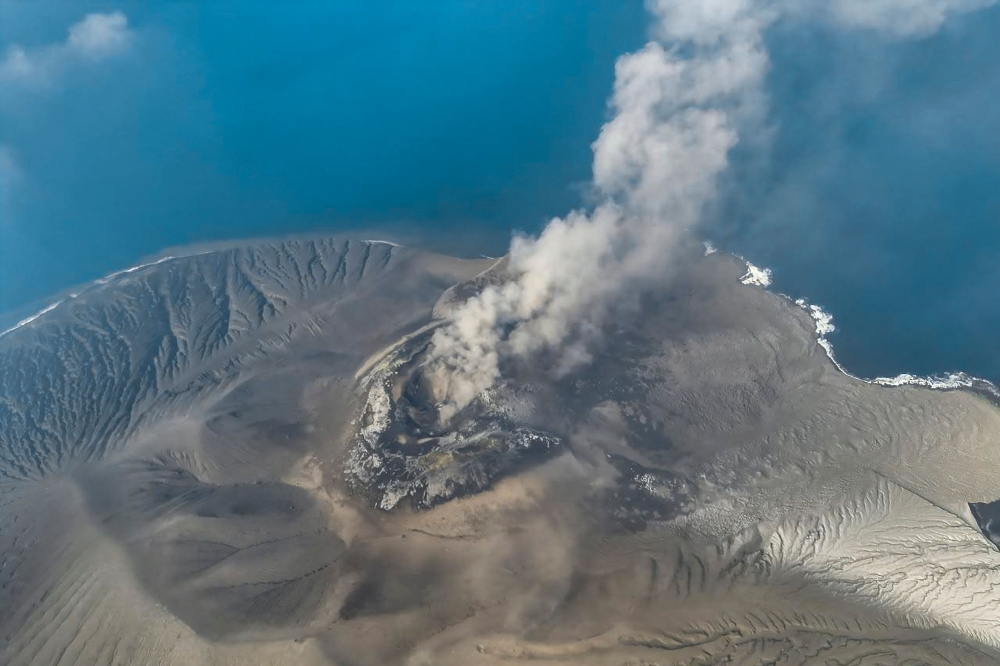
Indeed, Anak Krakatau is important precisely because it demonstrates the vulnerability of modern Southeast Asia.
The more interconnected Asean becomes, the easier it is for a geographically localised disaster to produce consequences beyond its immediate location.
Then comes the haze.
This is perhaps the most familiar Asean environmental problem of all.
Forest and peatland fires can begin within national borders, but smoke recognises none of them.
The “Carbon Bombs” unleased by the forest fires in Indonesia are invariably devastating to all----as valiant efforts are made to douse them out in Kalimantan.
Winds can carry particulate pollution across Indonesia, Malaysia, Singapore, Brunei and, depending on atmospheric conditions, towards parts of the Philippines.
Thus, a fire in Kalimantan or Sumatra can become a health concern hundreds or even thousands of kilometres away.
Schools may be affected. Flights can be disrupted. Outdoor economic activities can decline. Hospitals can experience increases in respiratory cases.
Tourism can suffer precisely when governments are attempting to strengthen regional travel.
The haze consequently demonstrates one of the central realities of Asean: ecological interdependence is just as real as economic interdependence.
Asean cannot integrate its economies while imagining that environmental problems will remain confined behind national borders.
The same applies to floods, earthquakes, typhoons, volcanic eruptions, droughts and tsunamis.
Southeast Asia sits within one of the most geologically and climatically active regions on Earth. Indonesia and the Philippines lie along the Pacific Ring of Fire.
The region straddles major tectonic systems. Its densely populated coastlines face the consequences of rising seas and extreme weather.
Typhoons regularly strike Vietnam too.
Flooding affects Thailand, Malaysia, Indonesia and other member states.
Drought can undermine agriculture across the Mekong region.
Earthquakes can devastate communities without warning.
The danger is therefore not any single disaster.
It is the string of disasters.
One event may be manageable. Two occurring simultaneously place greater pressure on governments.
Several different emergencies occurring across the region can begin stretching civil-defence agencies, hospitals, aviation systems, maritime authorities and humanitarian organisations at the same time.
This is where Asean must begin thinking differently about security.
For decades, Southeast Asian security has understandably been discussed through the language of war and geopolitics: the South China Sea, US-China rivalry, Myanmar, military modernisation and competing strategic alignments.
These remain important.
But there is another security map underneath the geopolitical one.
It is a map of volcanoes, fault lines, typhoon corridors, peatlands, rivers, coastlines and heavily travelled seas.
Asean needs both maps.
The region’s great achievement since 1967 has been the avoidance of major interstate war among its members. This should never be underestimated.
In a world again experiencing wars in Eastern Europe and West Asia, Southeast Asia’s relative peace is an enormous strategic asset.
Yet peace alone cannot protect Asean from man made or natural disaster.
Asean therefore needs deeper practical cooperation on disaster preparedness and resilience.
Real-time information on earthquakes, volcanic activity, forest fires, extreme weather and maritime emergencies should move rapidly between member states.
Maritime search-and-rescue coordination must improve.
Emergency supplies should be positioned strategically. Satellite monitoring of fires, storms and volcanic ash should be shared quickly.
Civil-defence agencies should be able to communicate across borders without unnecessary bureaucratic delays.
Joint disaster-response exercises should become as routine as military exercises.
Whether it is by Five Powers Defense Agreement (FPDA) or Asean Defense Ministers Plus Arrangements (ADDMs).
This does not mean Asean should become alarmist. Quite the contrary.
The decreasing intensity of Anak Krakatau demonstrates why sober assessment is essential.
When risks decline, Asean should admit it. When risks increase, Asean must react quickly. There are more than 20 typhoons to buffet the Philippines a year, for instance.
Preparedness requires neither panic nor complacency.
What matters is recognising that the absence of war does not guarantee the absence of strategic shocks or recurring accidents.
Invariably, even the Asean Humanitarian Assistance (AHA) is in the main toothless.
Thus, a burning vessel, with hundreds missing, near Palawan can remind Asean about maritime safety.
Anak Krakatau, even as its eruptions become less intense, reminds the region about geological vulnerability.
The haze reminds Asean that environmental consequences cannot be stopped at immigration checkpoints.
Floods, earthquakes and extreme weather repeatedly demonstrate the same principle.
Asean therefore enters the final quarter of 2026 with an unusual contradiction.
There are no major wars between its member states except border skirmishes between Cambodia and Thailand in 2025.
But there is a string of disasters and emergencies reminding Southeast Asia just how delicate its geography remains.
The region must consequently resist defining security exclusively through armies, navies and geopolitical competition.
More likely than not, insecurity comes from beneath the earth.
On other occasions, it descends from the atmosphere. As the Nepali incident near the Himalaya shows, just as fatally, natural disaster can flow downstream.
Currently, it drifts across borders as haze. And sometimes it erupts unexpectedly as fire on the waters surrounding an archipelagic region.
No wars in Asean is an achievement. But no wars does not mean no dangers.
The string of disasters confronting Southeast Asia is a warning that Asean’s next great test may not be preventing its members from fighting one another.
It may be learning how to protect more than 680 million Southeast Asians from increasingly interconnected disasters that no single Asean country can manage entirely on its own.
*Phar Kim Beng, PhD is the Professor of Asean Studies at International Islamic University of Malaysia and Director of Institute of International and Asean Studies (IINTAS).
** This is the personal opinion of the writers or publication and does not necessarily represent the views ofMalay Mail.