


SEPTEMBER 9 — The final quarter of 2026 is shaping up to be considerably more difficult than many governments had hoped.
Brent crude has broken above US$100 a barrel. The conflict between the United States and Iran remains unresolved. The Strait of Hormuz continues to be the critical pressure point in the global energy system.
Meanwhile, across several Western democracies, the politics of national identity, immigration and economic grievance are strengthening parties and movements of the far right.
These may appear to be three separate developments. They are not.
For Asean, they represent three interconnected pressures: the return of inflationary anxiety, the persistence of geopolitical instability in West Asia and the expansion of increasingly polarised identity politics across the international system.
Asean will have to navigate all three simultaneously.
The most immediate challenge is inflation.
When Brent crosses US$100 a barrel, the consequences do not remain confined to petrol stations. Energy is embedded throughout modern economies.
Higher crude prices increase transportation and logistics costs. Aviation becomes more expensive. Electricity generation can face additional pressure in economies dependent on imported fuels.
Fertiliser, petrochemicals, plastics and manufacturing costs can rise. Eventually, some portion of these increases works its way through supply chains into consumer prices.
The danger therefore lies not simply in expensive oil.
It lies in the possibility that another energy shock will arrive precisely when the global economy has yet to develop complete immunity against the inflationary disruptions of the first half of this decade.
This presents central banks with an uncomfortable dilemma.
If inflation accelerates again, monetary authorities may have less room to reduce interest rates. In the United States, renewed inflation could even intensify arguments for tighter monetary policy.
Higher American rates would reverberate far beyond the United States through currencies, capital movements, borrowing costs and financial markets.
Asean cannot insulate itself completely from such developments.
Indonesia, Thailand, the Philippines, Vietnam, Singapore and Malaysia participate deeply in international trade and finance.
A stronger dollar combined with expensive energy can place pressure on currencies and increase the domestic cost of imports.
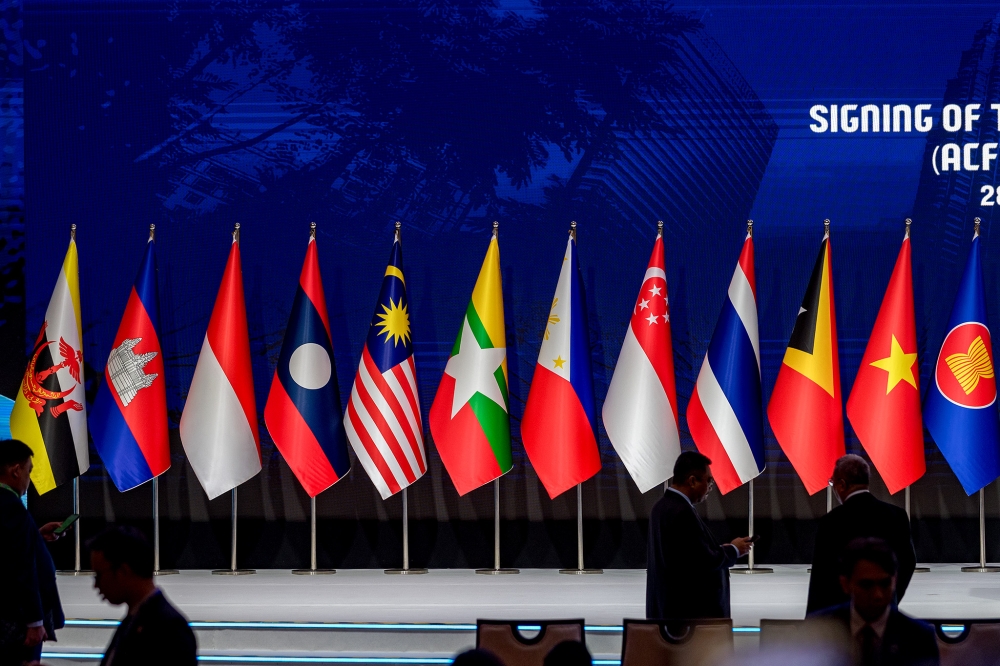
Malaysia possesses some protection through its energy resources and existing mechanisms for managing domestic fuel costs.
But even Malaysia cannot escape the secondary consequences of prolonged international energy turbulence.
The second anxiety is geopolitical.
The continuing confrontation involving Iran has become more than another episode of Middle Eastern instability. Its importance derives from geography.
The Strait of Hormuz remains one of the world’s most consequential maritime arteries.
A substantial share of internationally traded petroleum and liquefied natural gas must pass through this narrow passage.
Iran therefore possesses leverage even when it cannot achieve outright military superiority against the United States.
Washington, conversely, possesses enormous financial, military and technological capabilities to place pressure on Tehran.
The result is an imbrogliotic situation in which neither side can easily impose its preferred outcome without accepting potentially enormous costs.
Iran needs energy revenues.
The United States wants to constrain Tehran’s ability to convert those revenues into strategic power.
Yet the more unstable the Strait of Hormuz becomes, the greater the damage inflicted upon countries that have nothing whatsoever to do with the original confrontation.
Asean belongs squarely in this category.
The region depends upon open sea lanes stretching from the Persian Gulf and Indian Ocean through the Strait of Malacca into the South China Sea and wider Pacific.
Energy security in West Asia is therefore inseparable from economic security in Southeast Asia.
Asean should consequently continue supporting diplomatic efforts aimed at restoring the normal movement of commercial shipping through Hormuz. This is not taking Iran’s side or America’s side.
It is defending the fundamental Asean interest in keeping the arteries of international commerce open.
But there is a third pressure that may prove more politically complicated.
Economic insecurity has historically created fertile conditions for identity politics.
When households feel squeezed by food, housing, transportation and energy costs, political arguments frequently become less technocratic and more emotional.
Questions about wages can become arguments about immigration. Debates about industrial competitiveness can become accusations against foreigners.
Economic uncertainty can strengthen political movements promising protection through nationalism, borders and increasingly restrictive definitions of national identity.
The strengthening of far-right politics in parts of Europe should therefore be watched carefully from Southeast Asia.
Asean should not assume that these political currents are geographically confined.
Identity politics travels.
Social media accelerates it. Artificial intelligence can magnify it.
Disinformation can weaponise it. Economic hardship provides fertile terrain in which it can grow.
Southeast Asia itself contains extraordinary ethnic, religious, linguistic and political diversity.
The region’s stability has depended partly upon the ability of governments and societies to prevent those differences from becoming permanently zero-sum.
That achievement cannot be taken for granted.
A prolonged period of high living costs combined with slower global growth would inevitably place greater pressure on governments.
Under such circumstances, political entrepreneurs may discover that mobilising identity is easier than explaining complicated international economic conditions.
This is precisely what Asean must resist.
The difficult final quarter of 2026 therefore requires more than conventional economic management.
Asean needs strategic sobriety.
Governments must contain inflation without unnecessarily suppressing growth.
They must protect vulnerable households without allowing fiscal commitments to become permanently unsustainable. They must diversify energy sources and accelerate regional energy cooperation, including the Asean Power Grid.
At the same time, Asean diplomacy must continue supporting de-escalation in West Asia and the restoration of predictable commercial navigation through the Strait of Hormuz.
Most importantly, Asean governments must avoid allowing external economic shocks to become internal political fractures.
The three pressures are connected.
War creates uncertainty. Uncertainty raises energy costs. Higher energy costs feed inflation. Inflation weakens household confidence. Economic frustration can then be redirected towards ethnic, religious, migrant or ideological targets.
That is how an external geopolitical crisis can eventually become a domestic political problem thousands of kilometres away.
Asean has survived many crises because it understands that stability is not created by eliminating every disagreement. It is created by preventing disagreements from cascading into something larger.
The end of 2026 may test that instinct again.
The danger is not merely that Brent has crossed US$100.
It is that expensive energy, an unresolved Iranian imbroglio and increasingly strident identity politics are beginning to reinforce one another.
Asean cannot determine what Washington and Tehran ultimately decide. Nor can it determine the political direction of Europe or the United States.
But Asean can determine how resilient Southeast Asia will be when these external pressures arrive.
The final quarter of 2026 is looming as a difficult one. Asean should prepare accordingly—not with alarm, but with economic discipline, diplomatic persistence and an unambiguous refusal to allow identity politics to turn international turbulence into regional division.
*Phar Kim Beng, PhD is the Professor of Asean Studies at International Islamic University of Malaysia and Director of Institute of International and Asean Studies (IINTAS).
** This is the personal opinion of the writers or publication and does not necessarily represent the views ofMalay Mail.


