


SEPTEMBER 4 — Malaysia’s partnership with Brics should be understood through a simple principle: grow with all, align blindly with none. Invariably, focus on Asean first.
Malaysia officially became a Brics partner country on January 1, 2025.
This gives Kuala Lumpur access to the grouping’s meetings and cooperative initiatives without making Malaysia a full member or binding it to every Brics position.
It is a flexible arrangement suited to Malaysia’s tradition of non-alignment and pragmatic economic diplomacy.
Partnership need not be Malaysia’s final destination.
It can serve as a period of preparation, evaluation and institutional familiarisation.
As and when Malaysia determines that full membership serves its national interests, it can take the next step.
Indonesia provides a relevant example. Jakarta initially held back while assessing the implications of joining.
Following its presidential transition, it decided to proceed and formally became a full Brics member in January 2025.
Malaysia can adopt an equally deliberate approach: cooperate first, measure the benefits and obligations, then become a member when the strategic conditions are right.
Meanwhile, Malaysia must drive the intra regional trade of Asean beyond 23 percent to hit 60 or 70 percent not unlike the European Union (EU).
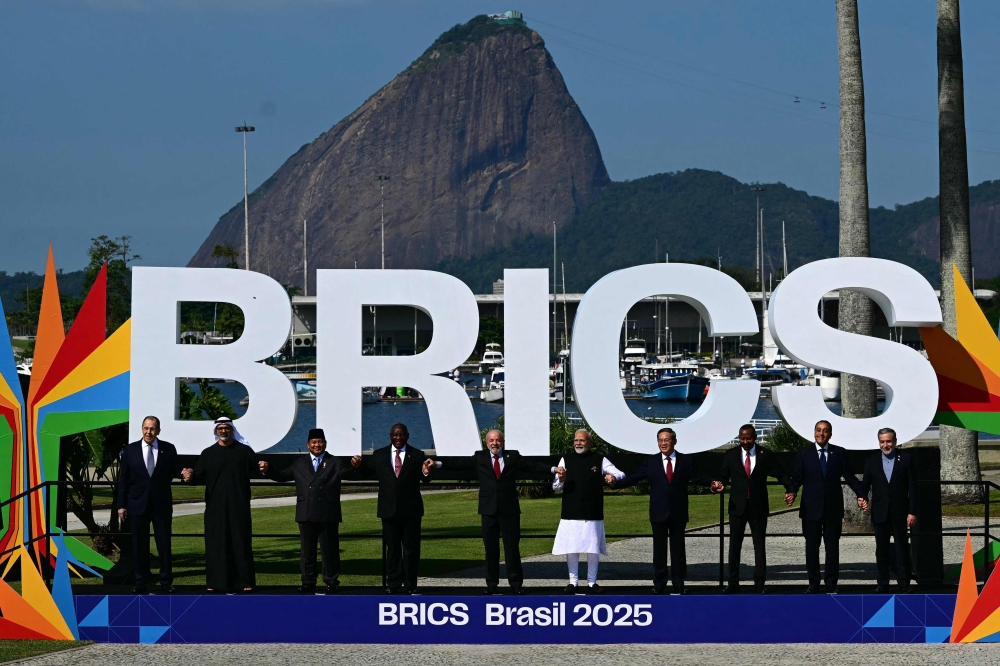
For now, Brics is no longer merely an acronym describing Brazil, Russia, India, China and South Africa.
Its enlargement reflects the increasing weight and confidence of the Global South.
The original Brics economies already account for a substantially larger share of world output than they did in 2000.
Expanded cooperation now reaches across Asia, Africa, West Asia and Latin America. Malaysia cannot afford to ignore this transformation.
Yet Malaysia’s engagement must not be portrayed as a turn against the United States, Europe or Japan. Nor should it weaken Malaysia’s commitment to Asean.
Such binary thinking belongs to an older geopolitical age.
Malaysia’s economy has grown precisely because it trades, invests and cooperates across political divides.
China is Malaysia’s largest trading partner at more than USD 82 Billion a year.
The United States remains an indispensable market and investor, especially in electrical and electronic products.
Japan has contributed enormously to Malaysia’s industrialisation, while the European Union continues to matter in trade, technology and standards.
India, meanwhile, is becoming an increasingly important economic and strategic partner.
Malaysia’s objective should therefore be diversification, not substitution.
Brics should add another pillar to Malaysian economic diplomacy rather than replace existing ones.
The immediate opportunity lies in expanding Malaysian access to emerging markets.
Brazil offers possibilities in agriculture, aerospace, renewable energy and semiconductors.
India presents openings in digital technology, pharmaceuticals, education and services.
China remains central to manufacturing, trade and infrastructure.
South Africa can serve as a bridge into Africa, while the enlarged grouping opens further connections with West Africa too.
The latter is critical to the energy security of Malaysia as Petronas source for more energy supplies from Russia too.
Participation must produce multi decades contracts, investments, research partnerships and better employment.
Diplomatic attendance without measurable economic outcomes would reduce Brics partnership to ceremony.
The New Development Bank may offer another avenue for cooperation, particularly in sustainable infrastructure and green transition.
However, Brics partnership does not automatically confer membership in the bank.
Any Malaysian involvement must proceed through proper negotiations and rigorous assessments of costs, governance and national priorities.
Its efforts to increase local-currency financing could help reduce exchange-rate risks when structured prudently.
Asean must nevertheless remain Malaysia’s strategic anchor especially when it is respected by Asean.
Brics is geographically dispersed and politically diverse. Asean, by contrast, is Malaysia’s immediate neighbourhood, production base and first line of diplomatic security.
Kuala Lumpur should promote stronger Asean–Brics institutional linkages rather than allow the two platforms to be treated as competitors.
Malaysia can act as a bridge in supply-chain resilience, food and energy security, climate finance, digital infrastructure and small-business development.
India’s 2026 Brics chairship, organised around resilience, innovation, cooperation and sustainability, offers a practical opening.
Brics contains internal differences. India and China have strategic tensions, while Russia remains embroiled in confrontation with the West.
Malaysia should cooperate issue by issue rather than adopt bloc discipline.
Malaysia does not have to choose between East and West or between the Global North and Global South.
It must strengthen its relations with all.
Partner status gives the Malaysia room to learn and contribute.
Full membership can follow when Malaysia is ready, just as Indonesia eventually made that decision. The purpose is not to enter another geopolitical camp, but to widen Malaysia’s room to grow.
* Phar Kim Beng, PhD is the Professor of Asean Studies at International Islamic University of Malaysia and Director of Institute of International and Asean Studies (IINTAS).
** This is the personal opinion of the writers or publication and does not necessarily represent the views of Malay Mail.


