


AUGUST 14 — Much of the discussion ahead of DAP’s congress this Sunday has focused on one question.
Should the party remain in government or withdraw?
Some see withdrawal as a necessary signal that DAP can no longer defend the slow pace of reform.
Others argue that DAP should remain, use the influence it still has from within the government.
There is also the view of what leaving the Cabinet would actually achieve if DAP continues to support Anwar Ibrahim.
On August 16, 4,264 delegates from 1,704 branches will vote and make a decision.
These are important questions. But these are not the only ones worth asking.
Far less attention has been paid to what has happened inside DAP itself during its transition from a party built overwhelmingly in opposition to one whose senior leadership now sits in the government.
While everyone is asking whether DAP should remain in government, perhaps we should also ask what years in government have done to the distribution of power inside DAP.
For years, one of the easiest criticisms levelled against the party was that too much influence revolved around the Lim family.
Lim Kit Siang was its defining personality for decades. Lim Guan Eng later became secretary-general, Penang chief minister, finance minister and national chairman.
The gradual transition began in 2022. Lim Kit Siang retired from frontline politics and Anthony Loke succeeded Lim Guan Eng as secretary-general.
Yet Guan Eng remained national chairman, while Lim Hui Ying, Kit Siang’s daughter, was elected 15th to the CEC.
The Lim family therefore remained present within the party leadership, but the organisational authority was beginning to shift.
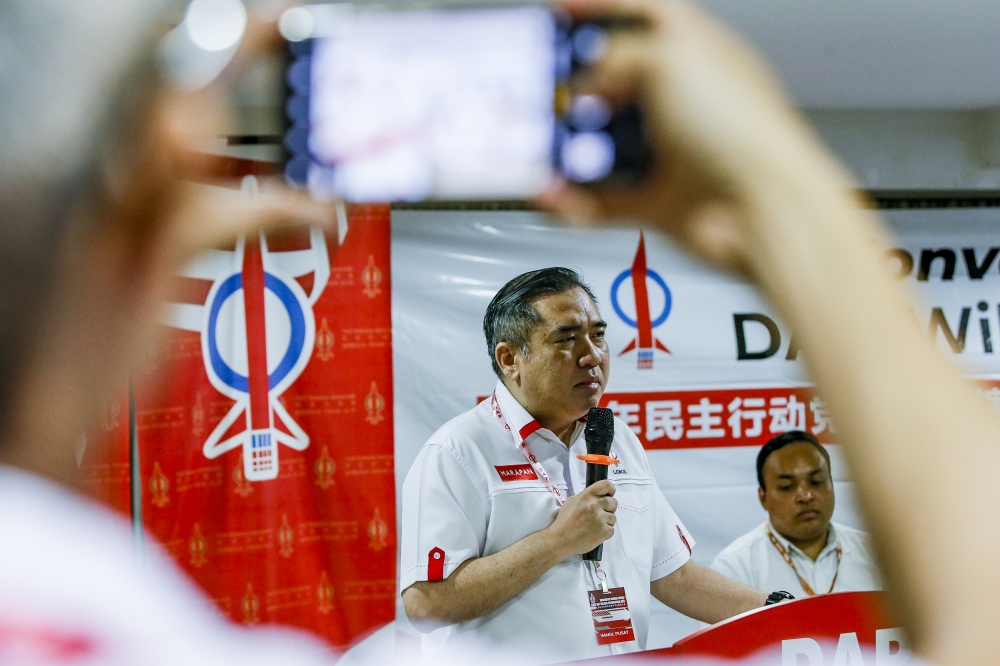
The 2025 CEC election made that shift much clearer. Gobind Singh Deo topped the poll, Loke retained the secretary-generalship and Nga Kor Ming became deputy chairman.
Guan Eng fell to 26th, while Hui Ying narrowly missed the elected 30 before later being co-opted into the CEC.
By then, it was difficult to argue that DAP remained organised around the Lim family in quite the way it once was.
That should have opened another question. Did power actually become more dispersed or was it simply reconfigured around a different set of actors?
Look at the present CEC. It is DAP’s highest decision-making body, responsible for setting the party’s direction and policies.
A striking number of those occupying its most important positions are also government office-holders. Loke is secretary-general and transport minister. Gobind is national chairman and a minister. Nga is deputy chairman and a minister. Steven Sim is a deputy secretary-general and a minister. Teo Nie Ching is a national vice-chair and a deputy minister. Hannah Yeoh, another deputy secretary-general, is also in the Cabinet. Other CEC members occupy deputy ministerial or significant state positions.
Of course politicians seek office. DAP fought for decades precisely because it wanted the opportunity to govern.
Now, DAP has 40 MPs in the parliament. Government office does not merely give a politician administrative responsibility. It also brings visibility, networks, resources and influence.
When those holding the strongest positions inside government also occupy the strongest positions inside the party as well, the two sources of authority might begin to reinforce each other.
Who inside DAP can credibly say that a compromise has gone too far?
Who can challenge the governing consensus without also having to defend their own place within it?
And whose disagreement carries enough weight to matter?
This is why Sunday’s vote matters, but perhaps not for the reason most attention has focused on.
The choice is being framed as whether DAP stays in government or leaves. Yet either outcome may not fundamentally shake Anwar Ibrahim’s government, since DAP has already made clear that it will continue supporting the administration until the GE16; unless, of course, there is another political twist.
But beyond stay or leave, there is a more critical question that Sunday’s vote brings into view.
The delegates are not only deciding whether the party should remain in government. They are also deciding what type of relationship DAP should have with executive power.
Should its senior leaders continue exercising that power directly, or should the party create some distance from a government it still intends to support?
And, beyond Sunday, the harder question remains. Who inside DAP actually has the political weight to shape the party’s direction?
How much of that influence comes from formal office, government position, organisational networks, or older centres of authority that may still matter even after leadership transitions?
And, whose voice ultimately carries weight when difficult choices have to be made?
* Khoo Ying Hooi, PhD is associate professor at Universiti Malaya.
** This is the personal opinion of the writer or publication and does not necessarily represent the views of Malay Mail.


