


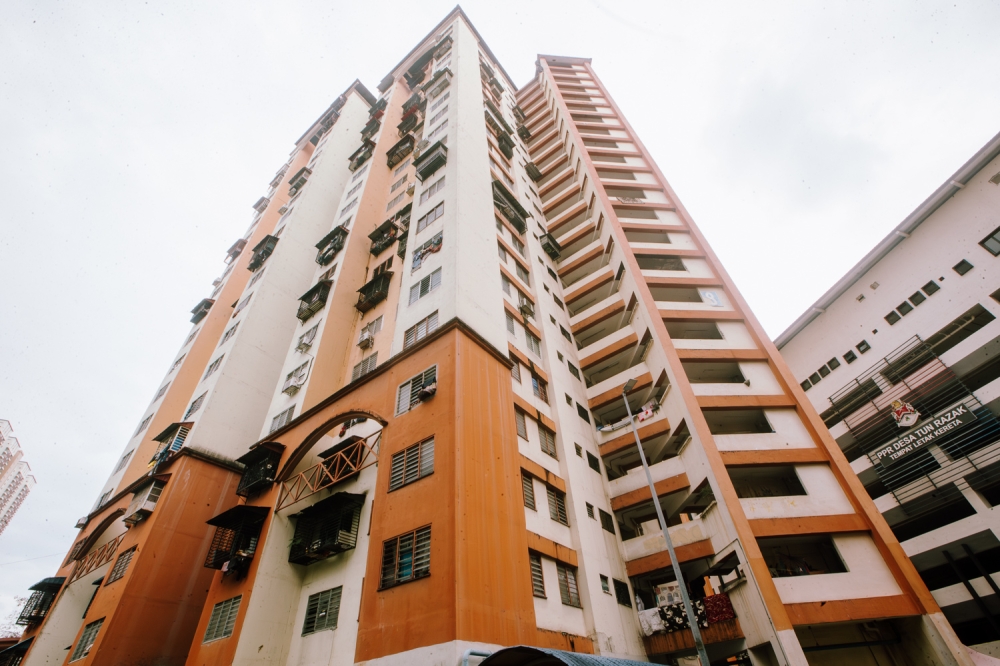
AUGUST 14 — For years, researchers, government agencies and civil society organisations have studied the challenges faced by communities living in Malaysia's Projek Perumahan Rakyat (PPR). We know about the broken lifts and ageing buildings. We have data on household incomes, health, education, sanitation, safety and social wellbeing. Researchers have conducted surveys, interviews and community-based studies, while residents themselves have repeatedly spoken about the conditions in which they live.
Yet many of the same problems remain.
I was reminded of this recently when I attended a roundtable discussion on the challenges faced by PPR communities organised by Persatuan Sains Sosial Malaysia (PSSM). Listening to researchers and practitioners from different fields, it became increasingly clear that our problem is not necessarily that we do not know enough. It is that much of what we know remains fragmented across institutions, disciplines and sectors.
A housing agency may look at a PPR community and see maintenance problems. A health agency may see disease or poor sanitation. A social agency may identify vulnerable households, while an urban planner notices deficiencies in the built environment and an economist sees economic insecurity.
The resident, however, does not experience life in those categories. A broken lift is not simply a maintenance issue when an older resident cannot easily leave the building. Poor waste management does not remain an environmental problem when it attracts pests and creates health risks. An unsafe common area affects not only security but also whether children can play outside and neighbours feel comfortable spending time together. For a family already struggling financially, each additional problem makes the others more difficult to manage.
What institutions separate into different portfolios is experienced by residents as one life. This becomes especially important when we look at what the existing evidence is already telling us. Research presented at the roundtable showed that 61 per cent of residents across 10 PPR communities in the Klang Valley had lived in the same homes for between 10 and 30 years. For many families, therefore, PPR housing is not a temporary stage before moving elsewhere. It is home.
More than 70 per cent were also found to be vulnerable to economic shocks, while 75 per cent reported that their stress had either not improved or had worsened since the Covid-19 pandemic. Seen separately, these are statistics about housing, economics and wellbeing. Seen together, they begin to describe the environment in which families are trying to build their lives.
My own work as a scientist has shown me why connecting these different forms of knowledge matters. Residents often notice changes long before those changes appear in a dataset. They speak about overflowing waste, increasing numbers of pests or deteriorating environmental conditions because these are things they encounter every day.
Those observations can become important starting points for scientific investigation. In our research involving 394 residents from 19 public housing schemes in the Klang Valley, we investigated intestinal parasitic infections together with associated behavioural and environmental factors. The findings provided biological evidence of a health burden connected to the environments in which people live, with wider public health consequences.
This is why lived experience and scientific evidence should not be treated as competing forms of knowledge. A resident describing what is happening around her home is not offering something less valuable than a researcher presenting a dataset. She may instead be pointing us towards the question that needs to be investigated. Science can then help us understand its scale, causes and consequences.
The difficulty begins when those pieces of knowledge never meet. This is what makes Think City's From Roof to Resilience: A Social Assessment of Malaysia's Public Housing a useful contribution to the conversation. Drawing on the lived realities of 2,884 households across 10 public housing sites, the assessment examines public housing through multiple lenses rather than treating housing as simply a question of buildings.
Such an approach creates room for knowledge from fields as different as parasitology, social anthropology and urban planning to sit alongside socioeconomic evidence and, importantly, what communities themselves are saying. The question then becomes less about which discipline has the best explanation and more about how these perspectives can help us understand the relationships between the problems residents experience.
This also gives weight to the report's recommendation for a high-level task force reporting to the Prime Minister, with stronger coordination across agencies and stakeholders and a long-term roadmap for transforming public housing towards 2057, when Malaysia marks 100 years of independence.
For such a task force to make a difference, however, it cannot simply become another administrative layer. It would need to bring together housing, health, local government, social protection, education, urban planning, environmental management, researchers and civil society. Most importantly, PPR residents themselves must have a meaningful place in that conversation.
Its task should begin not with commissioning yet another study, but with asking what we already know, where that knowledge sits, what remains missing and why so much of the evidence collected over the years has struggled to translate into coordinated action.
There will, of course, always be a need for new research. Communities change, new challenges emerge and policies must respond to changing circumstances. But another report sitting on another institutional shelf will accomplish little if the knowledge inside it remains disconnected from everything else we know.
PPR residents have been describing their realities for years. Social scientists have documented their experiences. Scientists have measured some of the health and environmental consequences. Government agencies hold administrative data that reveal other parts of the picture. None of these perspectives is sufficient on its own, but together they can show us something much closer to the whole.
Perhaps the first step towards better public housing, then, is not another solution designed from within another silo. It is learning to listen across those silos, and recognising that the lives of PPR residents were never divided into them in the first place.
* Prof Dr Siti Nursheena Mohd Zain is deputy executive director (Research, Innovation and Development) at the Institute of Public Policy and Management (Inpuma), Universiti Malaya, and may be reached at [email protected].
** This is the personal opinion of the writer or publication and does not necessarily represent the views of Malay Mail.


