


AUGUST 9 — This article began with a conversation with a friend. There are days when I understand why people say they want nothing to do with politics.
They are tired of the drama, the betrayals, the endless cycle of promises and disappointments. They want a peaceful life. They want to work, love, raise their children, read, travel, enjoy good times with friends, and not have to think about politicians.
The problem is that politics does not respect that wish.
You can decide not to follow politics. You can stop reading the news. You can refuse to argue about elections, parties or politicians.
You can tell yourself that life goes on regardless, and in many ways it does. But stepping away from politics does not mean politics has stepped away from you.
Decisions are still being made, rules are still being written, boundaries are still being drawn, with or without your attention.
You may choose not to enter the political world, but you are already living inside one. Even leaving the country does not quite solve it. You simply move from one political reality into another.
We like to speak of politics as though it happens somewhere else, in Parliament, in party headquarters, during election campaigns, in the speeches of people whose faces appear every day on television, podcasts and social media.
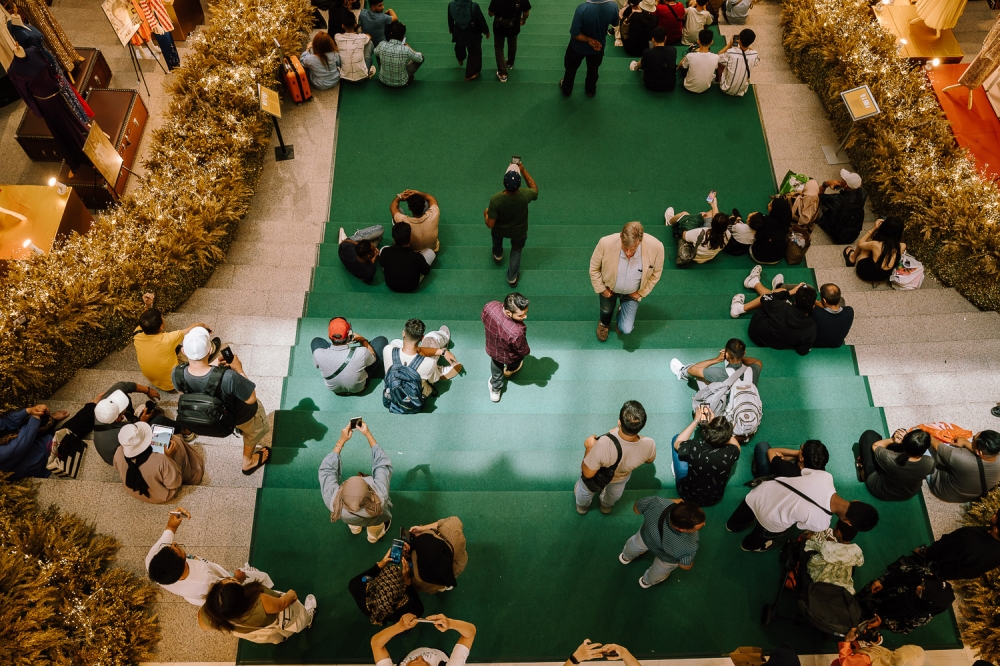
But Malaysian politics has travelled much further than that. We find it at the dinner table, in casual conversations with friends and colleagues, or even when we speak with strangers.
It lives in questions about race, religion, royalty, language and belonging that are never quite allowed to become just ordinary questions.
For many Malaysians, political instinct is learned very young. You learn what can be said openly and what requires a softer voice.
You learn that certain historical events are discussed with great caution, sometimes not because people know too little, but because everyone knows how much meaning has accumulated around them.
You learn that there are subjects on which disagreement is treated not simply as disagreement, but as provocation, disrespect, disloyalty or danger. That is politics too.
In fact, I sometimes think the deepest form of political power is not the power to make people speak. It is the power to make them stop themselves before speaking.
There is a familiar Malaysian sentence: better not. Better not say too much. Better not touch that issue. Better not ask that question. Better not be seen as too political. Better not jeopardise your position. Better not make trouble.
It sounds harmless. Sensible, even. Sometimes it genuinely is sensible.
People have jobs to protect, families to care for, institutions to navigate. Silence can be a form of survival.
I have never believed that everyone must be brave in the same way, or that speaking is always morally superior to keeping quiet.
But there is another side to this. When “better not” becomes so common, power no longer has to work very hard.
This is what troubles me about the idea that silence is neutral. Silence is not always agreement, but neither is it always empty.
In some circumstances, silence becomes part of the environment that allows power to continue untouched.
An institution does not need everyone to believe in its decisions. Sometimes it only needs enough people to conclude that objecting is pointless, inconvenient or dangerous.
Malaysia has lived with this tension for a long time. We have changed governments. We have experienced political upheaval that once seemed almost impossible.
Since 2018, governments have changed with a frequency that would once have been unimaginable. We have watched old coalitions collapse, new coalitions appear, and the “marriages” and “divorces” of old enemies and new allies.
Reform has become a common language of government. Yet some habits of political life are much harder to dislodge than governments.
That is perhaps one of the uncomfortable truths we do not talk about enough. Changing who governs is not the same as changing how power works.
We have seen this before, and perhaps that is what makes it so frustrating.
A new coalition can inherit old ways of governing. A reformist government can learn to enjoy the same tools it once criticised. Institutions can speak differently while behaving much the same.
Politicians who once demanded openness may discover, once in power, the attractions of control. Those who once complained of being silenced may become less enthusiastic about dissent when the dissent is directed at them.
None of this is new to us. We have watched the same pattern repeat itself under different governments. Power has a remarkable ability to make hypocrisy feel reasonable.
People learn to live with this too. We know when to speak, when to hold back, when to push, and when it feels safer to leave things alone.
After a while, we may not even notice ourselves doing it. What begins as caution can slowly become habit, and habit is much harder to recognise as political.
This is how politics enters our lives. Which is why I have very little patience for the claim of being “apolitical.”
You may dislike politics, avoid political conversations, refuse to vote, refuse to protest, even insist that none of it has anything to do with you.
But that does not place you outside politics. It only means you have chosen not to engage with a world that is still making decisions around you, about you, and sometimes for you.
Privilege does not take you out of politics either. It may give you more room, more choices, more protection, but you are still living under the same laws, institutions and political decisions.
You may feel the consequences less sharply, but you are not outside them.
Politics can still shape where you live, what you can say, how secure your work is, what happens to your children, and how much freedom you really have when circumstances change.
For others, that pressure is simply more immediate. Politics can be a permit that is refused, a scholarship that never becomes possible, a law that is not applied equally, a book that cannot be discussed openly, a job that suddenly feels insecure, or an opportunity that disappears.
The difference is not that some people live inside politics and others do not. We all do. Some just have more protection from its consequences than others.
We become outraged, then exhausted. We become disappointed, then cynical. Eventually, we expect less. We blame the politicians, call them corrupt, incompetent, and tell ourselves they are all the same.
Sometimes they deserve every bit of that anger. But blaming them can also become too easy.
It allows us to believe the problem sits entirely with them, while we slowly get used to the same behaviour, the same excuses and the same disappointments.
We lower the bar and call it realism. We stop asking whether something is right and start asking whether anything better is even possible.
Because power does not always need our loyalty. Sometimes our exhaustion is enough.
So yes, I understand the desire to be left alone by politics. I feel it too. There are moments when I would rather think about music, love, travel, friendship, anything but another political betrayal or another argument about who said what.
But politics is not interested in our fatigue. You may turn away from it. You may refuse to name it. You may even convince yourself that you have escaped it.
Politics always has a way of finding you again. And often, by the time it does, it has already decided more about your life than you realised.
* Khoo Ying Hooi, PhD is an associate professor at Universiti Malaya.
** This is the personal opinion of the writer or publication and does not necessarily represent the views of Malay Mail.


