


JULY 27 — Military planners have long used the concept of “rolling thunder” to describe a sustained sequence of operations designed to achieve strategic objectives over time rather than through one decisive engagement.
While elections are, of course, democratic exercises rather than military campaigns, the succession of state elections in Johor, Negeri Sembilan and potentially Malacca invites a similar strategic interpretation.
Viewed collectively, these elections are more than isolated contests.
They represent a sequential political strategy through which Umno and a Hadi Awang-led PAS seek to address their respective weaknesses while gradually building momentum towards the next general election.
For Umno, the challenge has been recovering public confidence after years of internal divisions, corruption scandals and electoral setbacks.
Although it remains one of Malaysia’s oldest and most experienced political parties, its dominance can no longer be taken for granted.
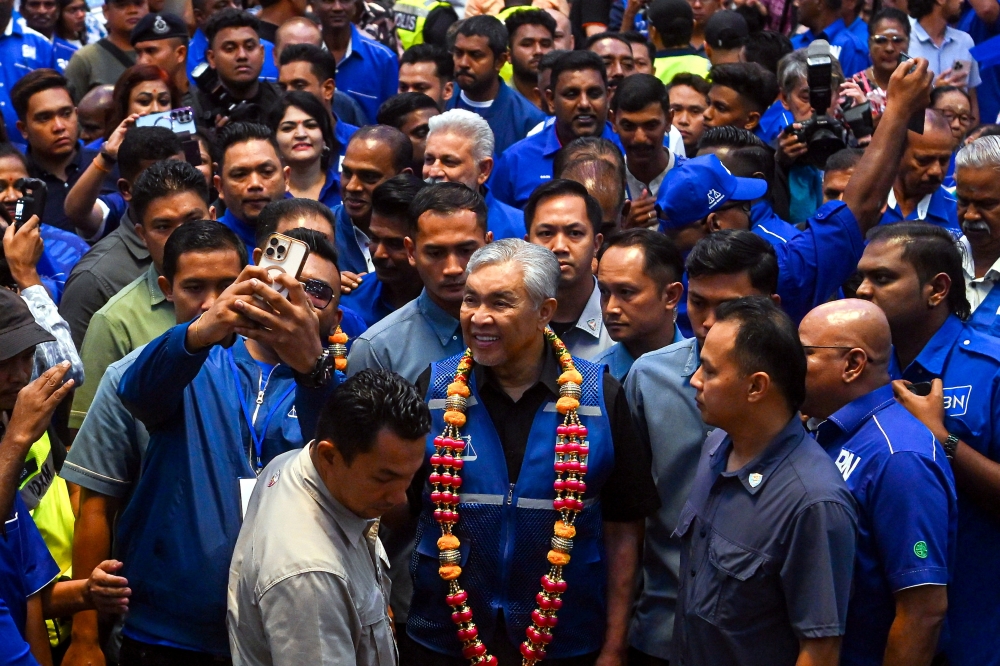
Every electoral victory therefore becomes an opportunity to rebuild organisational confidence, strengthen grassroots morale and convince voters that it remains nationally relevant.
PAS confronts a different limitation.
Despite its growing electoral strength among segments of the Malay electorate, PAS has historically found it difficult to expand its appeal across Malaysia’s multiethnic society.
Its strongest performances have generally been concentrated in the northern and east coast states, while support among many urban, non-Malay and East Malaysian voters has remained considerably more limited.
Cooperation between Umno and PAS therefore offers potential strategic benefits for both parties.
Umno gains access to PAS’ disciplined grassroots machinery and committed supporters, while PAS benefits from Umno’s wider organisational experience, administrative networks and historical reach into areas where PAS alone has struggled to compete effectively.
Johor demonstrated one possible dimension of this cooperation.
Long regarded as Umno’s traditional fortress, Johor provided an opportunity to test whether electoral collaboration could produce tangible political gains.
Whether one agrees with the political direction or not, the outcome inevitably strengthened confidence among supporters that further cooperation might be electorally rewarding.
Attention has now shifted to Negeri Sembilan.
Unlike Johor, Negeri Sembilan presents a different political landscape. Its electorate is more competitive, more mixed and historically more fluid.
Success here would therefore represent a stronger indication that cooperation between Umno and PAS can travel beyond one state’s unique political circumstances.
Failure, however, would suggest that Johor may have been an exception rather than the beginning of a broader political realignment.
Should cooperation continue into Malacca, the political experiment would become even more significant.
Three successive state elections would allow both parties to refine campaign messaging, improve organisational coordination, identify weaknesses in voter outreach and adjust electoral tactics before Malaysia eventually returns to the polls nationally.
Each election would become both a contest in itself and a rehearsal for the next.
That is precisely why the sequence matters.
Political momentum is rarely created overnight. It is accumulated gradually through repeated demonstrations that cooperation can produce results. Every victory strengthens confidence.
Every setback encourages reassessment. The cumulative effect often shapes public perception more powerfully than any single election.
This does not necessarily mean that Umno and PAS have established a formal long-term blueprint covering every future election.
Political negotiations remain fluid, and electoral alliances evolve according to changing political realities.
Nevertheless, the sequential nature of these state elections allows both parties to learn continuously while reducing the risks associated with testing new political arrangements on the national stage.
Other political coalitions should not underestimate this possibility.
If one side treats Johor, Negeri Sembilan and Malacca merely as isolated state elections while another approaches them as interconnected stages of a longer strategic campaign, the latter may enjoy important organisational and psychological advantages.
Politics rewards preparation as much as persuasion.
Malaysia’s increasingly fragmented political landscape means that electoral success depends not only on policy platforms but also on organisational discipline, coalition management and the ability to maintain momentum across multiple electoral cycles.
The sequence from Johor to Negeri Sembilan and potentially Malacca therefore deserves careful attention. Whether this ultimately proves to be a successful “rolling thunder” strategy remains uncertain.
Much will depend on voters, local issues, candidate quality and the evolving national political climate.
What is already clear, however, is that these elections should not be viewed in isolation. Together, they may constitute a broader political strategy through which Umno and a Hadi Awang-led PAS seek to overcome longstanding structural weaknesses, strengthen mutual cooperation and position themselves more effectively for Malaysia’s next general election.
For both supporters and opponents alike, recognising the strategic connections between these contests may prove just as important as understanding the outcome of any single state election.
* Phar Kim Beng is a professor of Asean Studies and a director at the Institute of International and Asean Studies, International Islamic University Malaysia.
** This is the personal opinion of the writer or publication and does not necessarily represent the views of Malay Mail.


