


JULY 27 — There is a local kopitiam in Bangsar that I used to visit regularly, although less frequently now.
Over the years, it has become more than a breakfast place. It is where I find myself sitting, often without intention, simply watching life unfold.
Even before I reach the kopitiam, I am greeted by the unmistakable aroma of freshly brewed kopi.
It drifts into the street, mingling with the fragrance of kaya toast crisping over the grill and butter slowly melting between warm slices of bread.
Inside, cups of steaming kopi, teh tarik and Milo share table space with half-boiled eggs, while conversations rise and fall across the room in a rhythm that feels both chaotic and familiar.
As I take my seat, the sounds settle into something almost comforting. Cups and saucers clink, orders are called out, and chairs scrape gently across the tiled floor.
If the tables are full, it is not unusual to approach someone sitting alone and ask, almost without hesitation, “Mind if I share?”
More often than not, the answer comes with a nod and a slight smile, and the space is made without further thought.
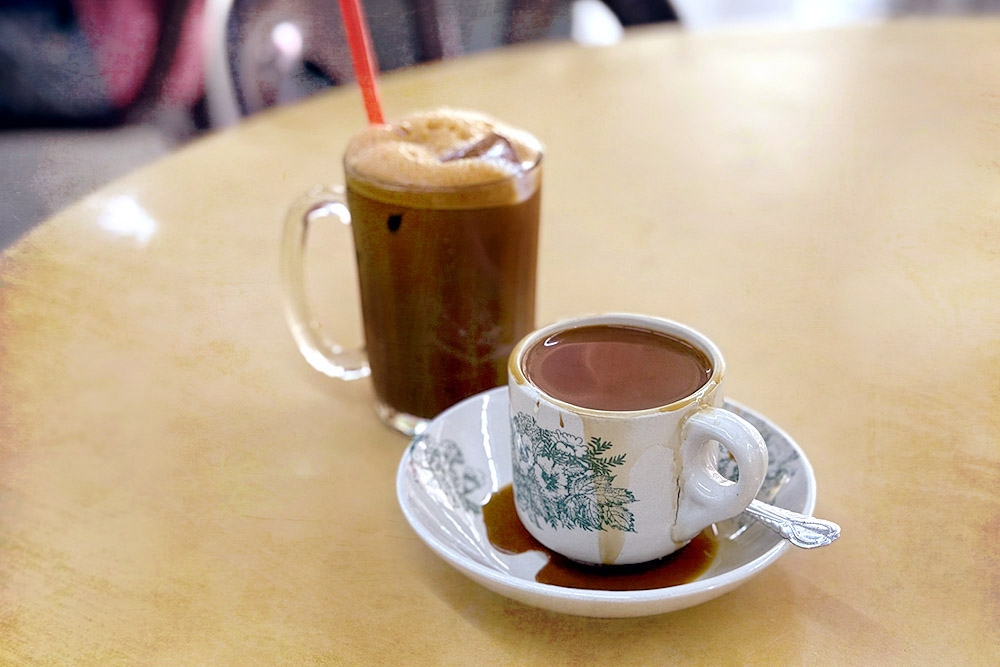
The owner, dressed casually in his singlet and shorts, moves easily between tables, greeting many of the regulars by name and remembering exactly how they take their kopi.
“Mr Lim, your kopi-O kurang manis.”
“Morning, Maniam. The usual?”
These exchanges are brief and almost routine, yet they reflect something that has been built quietly over time, shaped not by intention but by repetition and familiarity.
Around me, conversations begin without ceremony. At one table, politics is discussed with conviction, each point delivered with increasing emphasis.
At another, football results are dissected with a seriousness that feels entirely appropriate to those involved. Local gossip moves quickly, travelling from one table to the next with surprising ease.
An elderly gentleman, seated nearby, shakes his head as he speaks. “Last time, one stick was only RM1.50. Now it is RM2.” There is laughter, a few knowing nods, and the conversation shifts, as it always does, to something else.
These exchanges are ordinary and even predictable, yet there is something within them that has become less common.
People speak to one another with an ease that does not require introduction, where a question can be asked, a comment offered, and a conversation allowed to begin without needing a reason.
Whenever I travel to smaller towns, I often look for a local kopitiam. It does not take long before someone notices that I am unfamiliar.
“Are you new here? How long are you staying?” And then, almost inevitably: “Have you tried the mee rebus here? I know the best stall in town.”
The conversations are brief, sometimes lasting only a few minutes, yet they linger in a way that is difficult to explain, perhaps because they happen without expectation and end without obligation.
They are reminders that, in certain places, it is still possible to speak to someone we do not know, and to be spoken to in return.
Even within these familiar spaces, however, something is beginning to shift.
One morning, a young couple sat at the next table with their little boy. While the parents ate quietly, the child remained absorbed in a game on his tablet, his attention fixed on a world contained entirely within the screen.
At another table, a group of young professionals sat together, each focused on a device, their coffees gradually cooling as emails were answered, messages replied to and meetings attended.
They occupied the same table, yet the space between them felt different, as though each had retreated, in some small way, into a separate world.
This is not so much a criticism as it is an observation. Technology has undoubtedly enriched our lives, allowing us to work, communicate and access information with remarkable ease.
At the same time, it has begun to change how we inhabit shared spaces. The kopitiam remains, the tables are still filled, but the nature of what unfolds at those tables is no longer quite the same.
What seems to be shifting is not the place itself, but the habit that once defined it. The habit of noticing someone beside us, of beginning a conversation without purpose, or of remaining present in a shared space without feeling the need to withdraw into our own.
In its own quiet way, the kopitiam still holds on to this possibility. It is one of the few places where a table is not entirely private, where a stranger may become, however briefly, a companion in conversation, and where the day’s concerns are shared, debated and sometimes exaggerated over cups of kopi.
Every time I leave, I find that I carry with me more than the lingering taste of kopi. There are fragments of conversation, passing remarks and small exchanges that remain, not because they are important in themselves, but because they are part of a way of being that is becoming less familiar.
Perhaps the question is not whether kopitiams will continue to exist, because they will, in one form or another. What feels less certain is whether we will still recognise what they quietly offer, or whether we will continue to sit at the same tables without quite meeting one another in the way we once did.
And it may be that, in learning to notice again, we rediscover that what sustains these places has never been the kopi alone, but the simple act of sharing a space, a moment, and, every so often, a conversation.
* Ng Kwan Hoong is an Emeritus Professor of Biomedical Imaging at the Faculty of Medicine, Universiti Malaya. A 2020 Merdeka Award recipient, he is a medical physicist by training but also enjoys writing, drawing, listening to classical music, and bridging the gap between older and younger generations. He may be reached at [email protected]
** This is the personal opinion of the writer or publication and does not necessarily represent the views of Malay Mail.


