


MAY 12 —The world that Asean once mastered through balance, ambiguity and consensus is beginning to fracture under the combined weight of geopolitical rivalry and artificial intelligence-enabled warfare.
What Professor Vali Nasr recently outlined at the International Institute of Islamic Thought and Civilisation was not merely a lecture about the Middle East. It was a warning about the future of global conflict itself.
The war involving the United States, Israel and Iran is no longer a conventional confrontation confined to West Asia. It is increasingly becoming the world’s first large-scale AI-assisted geopolitical war.
Artificial intelligence now shapes battlefield intelligence, drone coordination, cyber disruption, missile interception, propaganda dissemination, satellite surveillance and predictive targeting.
The distinction between civilian infrastructure and military infrastructure is becoming dangerously blurred.
Financial systems, telecommunications grids, energy facilities and maritime logistics are all vulnerable to algorithmic disruption.
What happens in West Asia today therefore portend what Asean may eventually face tomorrow.
The Gulf is no longer geographically distant from South-east Asia.
Every missile launched near the Strait of Hormuz reverberates economically through the Strait of Malacca.
Every cyber disruption affecting energy infrastructure influences Asean’s inflation, shipping costs and supply chains.
Every escalation involving AI-guided military systems accelerates the global arms race towards autonomous warfare.
Professor Nasr’s central argument remains deeply significant: the world is moving away from rules-based governance towards what he called “raw politics.”
Yet in the age of AI-enabled conflict, raw politics is becoming even more dangerous because technological superiority increasingly amplifies geopolitical coercion.
Power is no longer measured solely through military hardware or economic size.
It is increasingly determined by algorithmic dominance, data control, semiconductor access, quantum computing potential and AI-driven military integration.
For Asean, this creates an uncomfortable strategic dilemma.
For decades, Asean survived because it mastered the need not to side with any great powers too overtly as a collective polity.
The region welcomed American security guarantees while simultaneously embracing China’s economic rise.
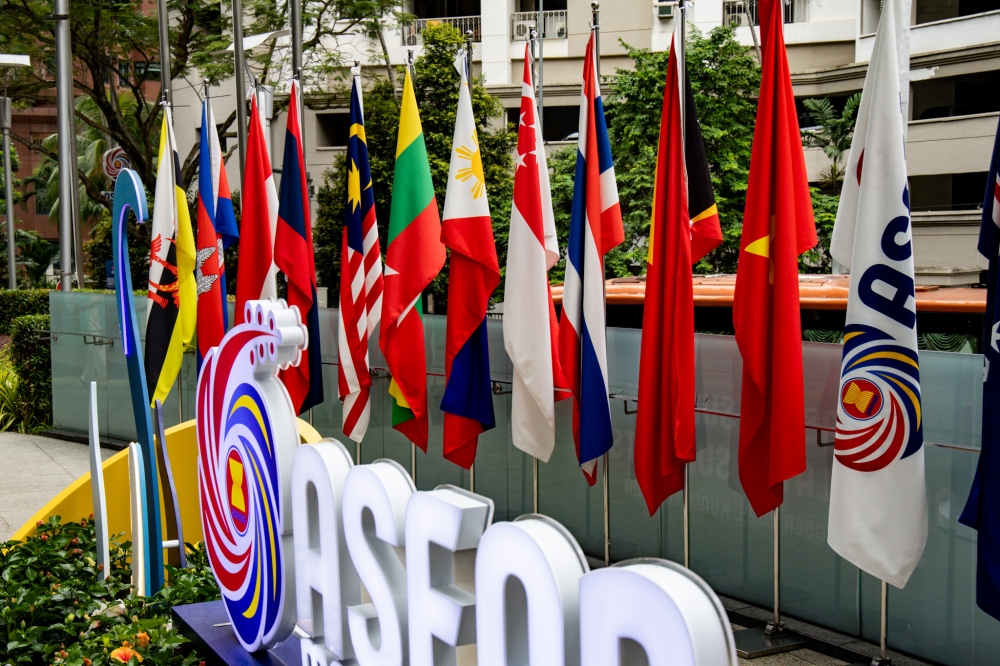
It institutionalised neutrality not as passivity, but as a sophisticated survival mechanism.
The so-called Asean Way was frequently criticised for being slow, consensus-driven and indecisive.
Yet ironically, this flexibility allowed South-east Asia to avoid the catastrophic strategic polarisation experienced in other parts of the world.
Today, however, ambiguity is becoming harder to sustain.
The conflict in West Asia demonstrates that great powers are no longer merely competing through trade or diplomacy.
They are contesting strategic endurance across multiple domains simultaneously: artificial intelligence, supply chains, maritime choke points, semiconductors, cyber systems, rare earth minerals and ideological narratives.
AI has now become inseparable from warfare itself.
Autonomous drones can overwhelm traditional air defence systems.
Predictive algorithms can identify strategic vulnerabilities faster than human planners.
Deepfake technology can manipulate public opinion during wartime.
Cyber-attacks enhanced by machine learning can disable ports, airports and financial systems without a single soldier crossing borders.
The battlefield is no longer linear. This lesson will not be lost on China.
Beijing is observing carefully whether prolonged conflict weakens American credibility globally, particularly regarding Taiwan and the South China Sea.
If Washington struggles to impose decisive outcomes in the Gulf despite overwhelming military superiority, questions naturally emerge regarding the sustainability of American primacy elsewhere.
Professor Nasr rightly observed that America’s standing has suffered not necessarily because it lost militarily, but because the aura of uncontested dominance has diminished.
AI-assisted warfare may accelerate this perception further.
Military superiority alone no longer guarantees political victory.
Smaller actors equipped with drones, cyber tools and AI-assisted targeting systems can impose disproportionate strategic costs on much larger powers.
The diffusion of advanced technologies is flattening traditional hierarchies of power.
For Asean, this matters enormously.
The region’s post-Cold War prosperity depended heavily on predictable sea lanes, open trade, restrained great-power competition and functioning international institutions. Yet all four assumptions are becoming increasingly uncertain.
The weaponisation of maritime choke points, from Hormuz to the Red Sea, now intersects with the weaponisation of digital infrastructure. Shipping systems, port logistics and energy networks are increasingly vulnerable to AI-enabled sabotage.
The South China Sea therefore cannot be viewed merely as a territorial dispute anymore.
It forms part of a much larger contest over maritime leverage, technological supremacy and strategic connectivity across the Indo-Pacific and Eurasian supercontinent.
Equally worrying is the gradual erosion of international norms.
Professor Nasr observed that even Europe is retreating from consistently defending the liberal international order.
This is historically significant. Europe once served as the principal normative backbone of the post-war system.
If international law becomes selectively applied according to geopolitical convenience, smaller states may gradually lose confidence in multilateral protections altogether.
Asean therefore faces a defining question: can it remain merely an economic platform, or must it evolve into a genuine strategic actor capable of surviving an AI-driven geopolitical age?
The answer cannot simply be military balancing.
Asean is not the North Atlantic Treaty Organisation, nor should it aspire to become one.
South-east Asia’s strength lies precisely in avoiding rigid bloc politics. Yet neutrality without technological resilience is no longer sufficient.
A stronger Asean will inevitably invite external pressure. But weakness invites manipulation too.
Thus, Asean’s future relevance depends not on choosing between Washington and Beijing, but on deepening its own collective resilience.
This means accelerating regional digital integration, strengthening cyber defence coordination, protecting semiconductor supply chains, investing in indigenous AI capabilities and safeguarding maritime infrastructure against both physical and digital disruption.
More importantly, Asean must cultivate strategic patience. Without which it can lapse into using AI embedded with quick decisions on who or what belongs in its “kill chain”.
Unlike some major powers driven by electoral cycles, ideological maximalism or military urgency, South-east Asia’s civilisational strength has historically rested upon equilibrium, gradualism and adaptive coexistence.
The region must resist becoming emotionally absorbed into external conflicts while remaining intellectually alert to their consequences.
There is also a deeper lesson embedded in the conflict Professor Nasr described.
Societies under prolonged pressure increasingly rally around nationalism, sovereignty and resistance narratives.
The assumption that economic pain automatically produces political submission is proving dangerously simplistic.
This has implications far beyond Iran.
It suggests the emerging international order will be more fragmented, more technologically volatile and considerably less compliant than the one Asean became accustomed to after the Cold War.
AI-enabled warfare will only intensify this instability.
Once autonomous systems, predictive military algorithms and cyber offensives become normalised, escalation risks multiply exponentially.
Machines may eventually accelerate conflict faster than diplomacy can contain it.
Asean must therefore prepare for a world where uncertainty becomes permanent. Yet this is not entirely pessimistic.
Periods of geopolitical transition also create opportunities for middle powers and regional organisations to exercise greater diplomatic agency.
If the international system is indeed fragmenting, Asean’s long experience in managing diversity, preventing escalation and sustaining dialogue becomes more valuable, not less.
In that sense, Asean should not merely view itself as a buffer between giants.
It must increasingly see itself as a civilisational stabiliser in an unstable technological century.
If anything the likes of Malaysia and Japan have to work together to understand how a rules based order must prevent the permissive proliferation of anything that would render AI Assisted War even more likely than ever.
The era ahead will reward not necessarily the loudest powers, but the most adaptable ones.
South-east Asia has survived colonialism, Cold War confrontation, financial crises and strategic rivalry before.
Its challenge now is to preserve strategic autonomy without drifting into technological dependency or geopolitical irrelevance.
Professor Vali Nasr’s lecture on May 12 2026 ultimately was not only about West Asia or what to him in John’s Hopkins University can be known as the Middle East.
It was about the arrival of a harsher international age shaped increasingly by artificial intelligence, fragmented power and raw geopolitics.
Asean’s task is not to fear that future, but to navigate it with prudence, resilience and strategic maturity worthy of its rising global importance.
* Phar Kim Beng, PhD is the Professor of Asean Studies at International Islamic University of Malaysia and Director of Institute of International and Asean Studies (IINTAS). Luthfy Hamzah is a Research Fellow at IINTAS.
** This is the personal opinion of the writer or publication and does not necessarily represent the views of Malay Mail.


