


MAY 10 — There is something deeply comical about watching politicians in tropical countries lecture the public about “saving the planet” while sitting in traffic jams powered by coal-fired electricity plants.
Malaysia has entered the electric vehicle era the way a middle-aged banker suddenly discovers CrossFit: loudly, expensively, and without fully understanding what’s actually happening.
The EV conversation in this country has become almost religious. Question it and you’re treated like a climate-denying caveman wearing diesel-soaked batik. But engineering does not care about fashion. Physics does not care about hashtags. Thermodynamics certainly does not care about press conferences with green backdrops and smiling ministers standing beside shiny Chinese EVs.
And this is where the entire Malaysian EV narrative starts to wobble like a badly balanced tyre.
Because nobody seems willing to ask the most uncomfortable question of all:
What exactly are we saving here?
Malaysia’s electricity grid is still dominated by fossil fuels. Roughly 80 per cent of the country’s electricity generation still comes from coal and natural gas combined. Coal alone has historically contributed around one-third to 40 per cent of the national energy mix. We are not Norway humming quietly on hydropower. We are not Iceland sitting on volcanoes. Much of the electricity charging these “zero-emission” cars begins life in giant furnaces burning imported coal somewhere in Manjung or Tanjung Bin.
Then the losses begin.
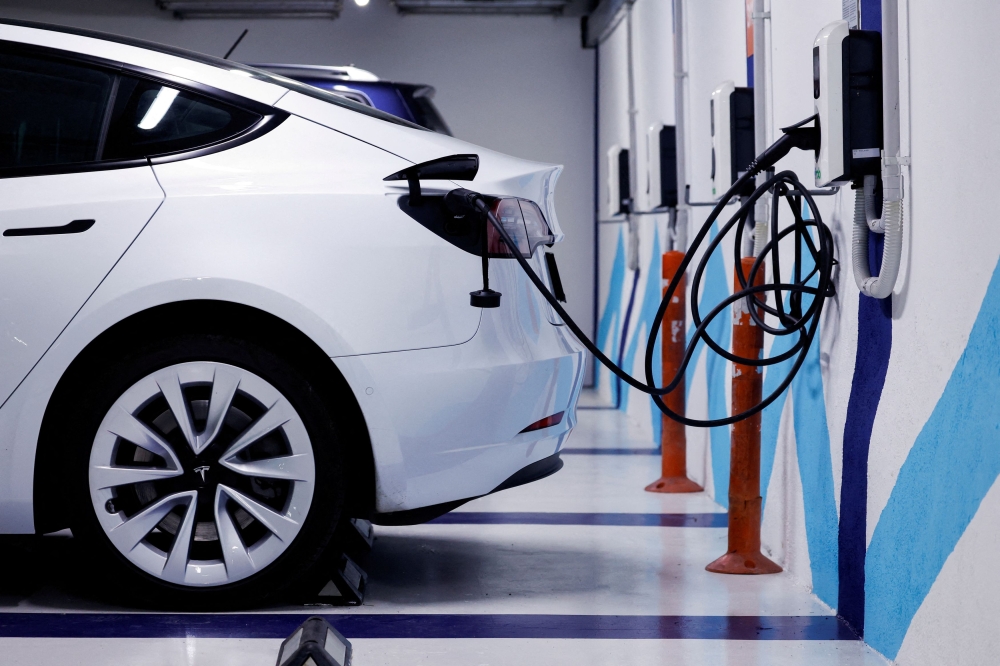
Electricity travels hundreds of kilometres through transmission infrastructure. Energy is lost as heat through cables and transformers. Grid losses alone can approach 6 per cent to 10 per cent. Then the power enters charging systems where AC electricity is converted into DC. More losses. Then into lithium batteries, which themselves suffer charging inefficiencies and thermal losses. Then back again through inverters and electric motors into mechanical movement.
This is not magic. It is an engineering chain.
And every single step leaks efficiency.
The public is sold the fantasy that EVs are somehow “clean.” They are not. The emissions have merely been outsourced to somewhere less visible.
A Tesla plugged into a coal-heavy grid is essentially a very sophisticated electric kettle on wheels.
The irony is that modern internal combustion engines are no longer the dinosaurs environmental activists pretend they are. Today’s small turbocharged gasoline engines can exceed thermal efficiencies of 35 per cent to 40 per cent. Modern diesel engines can push beyond 45 per cent efficiency in ideal conditions. Toyota’s latest combustion engines are engineering masterpieces compared to the smoky carburetted disasters of the 1980s.
Yet governments behave as though replacing petrol stations with charging bays will somehow teleport Malaysia into Scandinavian environmental enlightenment.
It won’t.
Because the economics themselves are beginning to look increasingly absurd.
Take EV batteries. A typical EV battery pack can weigh between 400kg and 700kg. That is effectively the weight of an entire Perodua Kancil being dragged around permanently underneath your vehicle. Batteries degrade over time. Replacement costs can easily run into tens of thousands of ringgit outside warranty periods. In some cases globally, older EVs have been written off after relatively minor accidents because battery replacement costs exceeded the value of the car itself.
And nobody wants to talk about disposal.
Lithium extraction is environmentally brutal. Rare earth mining is dirty. Battery production itself generates enormous carbon emissions before the car even leaves the factory floor. Studies from European lifecycle analyses have shown that EV manufacturing can initially produce significantly higher carbon emissions than equivalent internal combustion cars due to battery production alone. An EV often requires years of driving before it merely “breaks even” environmentally compared to a modern petrol vehicle.
But nuance has disappeared from the conversation.
What Malaysia has instead is policy driven by optics.
Government incentives. Tax exemptions. Green slogans. Net-zero speeches.
And hybrids?
Ah yes. The great South-east Asian automotive loophole.
Malaysia got flooded with so-called hybrid vehicles that delivered marginal environmental benefits while conveniently qualifying for massive tax incentives. It was one of the finest examples of industrial lobbying disguised as environmentalism.
Manufacturers played governments like veteran poker sharks.
The public got sold “green technology.” Car companies got lower duties and premium margins.
Malaysia got what exactly?
Heavy vehicles.
Complicated drivetrains.
Expensive battery replacement nightmares.
Reduced long-term reliability.
Cars that were neither properly electric nor particularly efficient.
Many hybrids were not revolutionary engineering achievements. They were accounting exercises.
Tax optimisation devices masquerading as climate policy.
And now we are doubling down.
The funniest part is that Malaysia is a tropical country with brutal heat, heavy rain, flash floods, and long balik kampung journeys that already punish battery systems and infrastructure. EV range drops in extreme heat. Flooding risks create additional complications. Fast charging infrastructure remains patchy outside urban corridors. Apartment residents still face practical charging headaches.
Yet the national conversation behaves as though every Malaysian lives in a landed house in Bangsar with solar panels and a Wallbox charger.
Real life does not work like LinkedIn sustainability conferences.
And this is where modern society becomes dangerous. We reward performative environmentalism instead of measurable engineering outcomes.
People feel virtuous charging a car while the electricity may have originated from burning coal three states away.
Nobody wants lifecycle calculations. Nobody wants to discuss energy density, mining emissions, transmission losses, battery degradation curves, disposal costs, or infrastructure redundancy requirements.
Because those conversations require actual engineers.
Not social media strategists.
Electrical engineering is not something you bluff your way through after attending a carbon-neutrality summit in Singapore and reading two McKinsey slides about sustainability. Entire generations of engineering students suffered through electromagnetic theory, power systems analysis, and imaginary-number mathematics just to understand how electricity truly behaves.
Physics is merciless.
It does not care about hashtags.
The current EV wave in Malaysia feels less like a carefully thought-out national engineering strategy and more like a giant regional panic attack driven by fear of appearing “left behind.”
Everybody wants to look modern.
Nobody wants to ask whether the emperor’s electric car has any clothes on.
Perhaps one day EVs will genuinely become the superior solution for Malaysia. Cleaner grids may emerge. Nuclear power may enter the conversation. Battery chemistry may radically improve. Solid-state technologies may change the economics entirely.
But today?
Right now?
Malaysia risks building policy based more on fashionable signalling than engineering reality.
And that is how countries end up spending billions subsidising inefficiencies while pretending it is progress.
Anthony Bourdain once said people confuse sophistication with knowing how to pronounce French food correctly.
The same thing is happening with EVs.
People think saying “net zero” loudly enough makes them intelligent.
Real engineering is uglier than that.
Real engineering asks difficult questions.
And Malaysia desperately needs to start asking them.
* This is the personal opinion of the writer or publication and does not necessarily represent the views of Malay Mail.


