


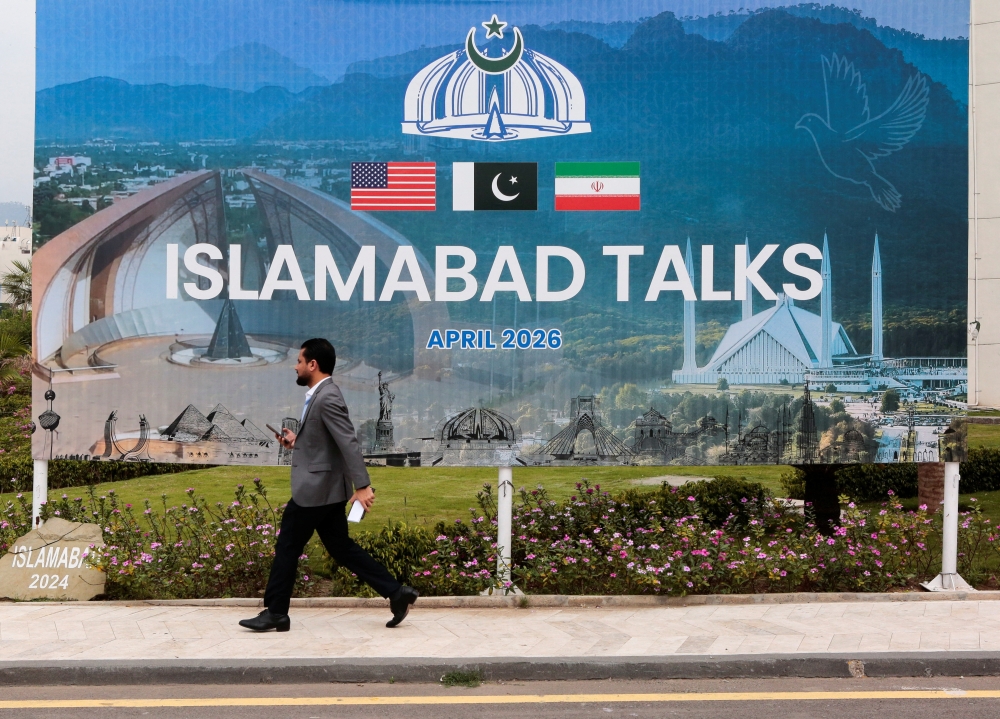
APRIL 11 — Washington's ongoing negotiations between the United States and Iran, now convened in Pakistan, were never meant to be easy.
Yet what is increasingly evident is that the April 20 deadline is not just ambitious — it is almost certain to be overshot.
The reason is simple but profound: war may destroy in weeks, but peace must reconstruct what has been broken across multiple domains simultaneously.
At stake is not merely a ceasefire between two adversaries. The negotiations must grapple with a dense web of interlocking issues — sanctions, military de-escalation, regional proxy conflicts, and above all the security of the Strait of Hormuz, the world’s most vital energy chokepoint.
When such a wide spectrum of concerns is placed on the negotiating table, any rigid deadline becomes politically symbolic rather than diplomatically feasible.
From geopolitics to engineering: The Strait of Hormuz problem
The most underappreciated challenge facing negotiators is that the Strait of Hormuz is no longer just a geopolitical flashpoint. It has become a technical and engineering dilemma.
Reports that parts of traditional shipping lanes have been mined or rendered unsafe fundamentally change the nature of diplomacy. The question is no longer simply who controls the strait, but how it can be safely navigated at all.
Negotiators must determine where new maritime corridors should be established to ensure both safety and efficiency. They must also agree on who will verify that these lanes are free of naval mines.
This is not merely a political question — it is a technical one that requires expertise, coordination and trust.
The issue is further complicated by the question of which countries or coalitions will guarantee safe passage. Whether Iran and Oman will jointly administer the strait, or whether an international mechanism will be introduced, remains deeply contested.
None of these decisions can be resolved through rhetoric alone. They require hydrographic mapping, coordinated mine-clearing operations and enforceable naval protocols.
In effect, negotiators are not just agreeing on peace — they are redesigning the physical and operational structure of one of the world’s most critical maritime corridors.
A trust deficit that slows everything
Even if technical solutions are identified, the negotiations remain burdened by a profound lack of trust.
The United States will insist on robust verification mechanisms and firm assurances that Iran will not reintroduce threats to maritime traffic. Iran, however, is likely to resist arrangements that compromise its sovereignty.
There are also proposals that maritime corridors could be moved closer to the Iranian coastline, potentially giving Tehran greater leverage while limiting foreign naval presence in its waters.
At the same time, Gulf states will demand binding and enforceable guarantees that go beyond diplomatic assurances.
Under such conditions, every clause becomes contested and every concession is scrutinised. Diplomacy does not move forward in leaps — it inches forward cautiously.
War damage and the reality of negotiation lag
The war itself has created conditions that make swift diplomacy extremely difficult.
Infrastructure across key maritime and energy nodes has been damaged. Shipping routes have been disrupted and insurance markets supporting global trade have been thrown into uncertainty. Command-and-control systems have also become fragmented.
This creates what can be described as “negotiation lag” — a gap between the end of fighting and the restoration of stability.
Diplomacy must now catch up with the destruction caused by war. Agreements on paper alone are insufficient; the operational environment must also be rebuilt.
Without this, any agreement risks becoming ineffective.
The illusion of deadlines in high-stakes diplomacy
Deadlines such as April 20 serve an important political purpose. They project urgency, reassure markets and create the impression of momentum.
In reality, such deadlines are often flexible.
The most likely outcome is neither breakthrough nor collapse, but a managed extension. Negotiators will acknowledge progress, continue discussions and quietly revise timelines under a new framework.
This is not unusual. It reflects the realities of diplomacy when global stakes are involved.
When the global economy is the silent stakeholder
These negotiations are not confined to the United States and Iran. The global economy is an unspoken stakeholder.
Any disruption in the Strait of Hormuz affects energy markets, fertiliser supply chains, semiconductor production and food systems.
Countries such as Malaysia and across ASEAN are particularly vulnerable. Higher fuel prices translate into rising costs for transport, food and industry, creating immediate economic pressure.
Even if a ceasefire is achieved, the economic shock will persist and its effects will unfold over time.
Conclusion: The inevitability of delay
The April 20 deadline will almost certainly be missed — not because diplomacy has failed, but because the task is too large for the time given.
Negotiators must rebuild trust, redesign maritime routes essential to global trade, balance sovereignty with international oversight and stabilise a fragile global economy.
These are not tasks that can be completed in a matter of weeks.
The central truth is unavoidable: war was easy, peace is hard. War simplifies problems into force; peace must confront complexity in full.
Delay, therefore, is not weakness — it is reality.
For the world watching, and for economies already under strain, the lesson is clear: peace will take longer than expected, and its costs will be felt long after the war has ended.
* Phar Kim Beng is a professor of Asean Studies and director at the Institute of International and Asean Studies, International Islamic University of Malaysia.
** This is the personal opinion of the writer or publication and does not necessarily represent the views of Malay Mail.


