


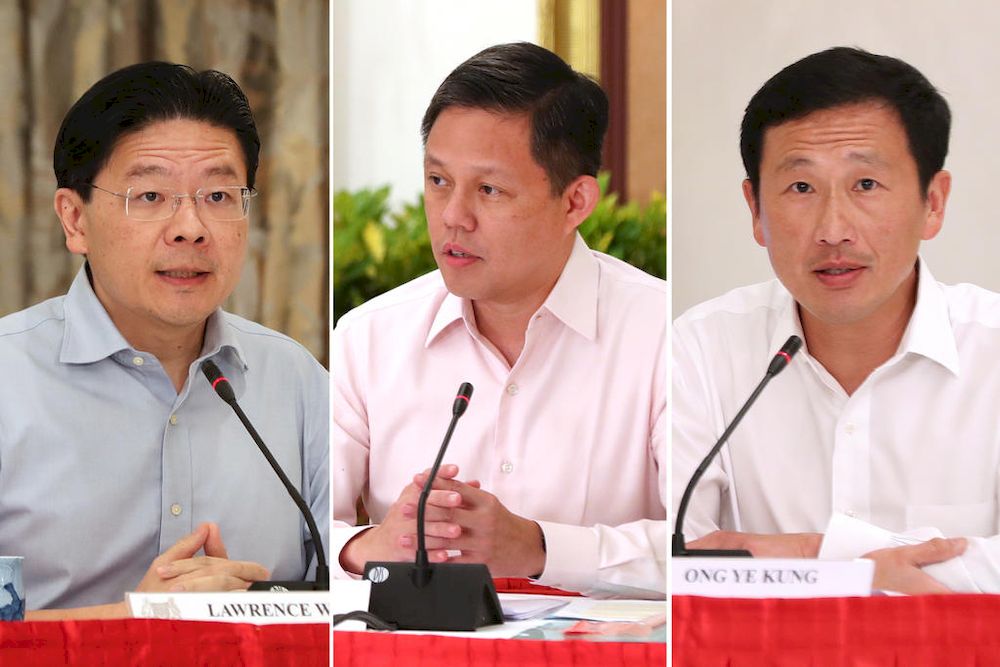


SINGAPORE, March 31 — Having been placed on the back burner as the nation grapples with Covid-19, the issue of political succession is back on the agenda and analysts said that Finance Minister Lawrence Wong has the slight edge given his public exposure and profile, since he fronted several major national issues and is co-chair of the multi-ministry Covid-19 task force.
Some analysts noted, though, that outside of government, the successor to Prime Minister Lee Hsien Loong will also need to have the backing of members of the ruling People's Action Party (PAP).
Apart from Wong, Health Minister Ong Ye Kung, who is also a co-chair of the Covid-19 task force, is seen as the other frontrunner — in a field that has narrowed.
Felix Tan, a political analyst from Nanyang Technological University (NTU), said that the tussle still looks to be between Wong and Ong, but Wong seems to be leading because of the exposure that he has received in the public domain, both as finance minister and from his role within the Covid-19 task force.
Tan noted as well that Wong has publicly taken on social issues such as race and religion. The public seemed to take well to and gravitate towards Wong views on Singapore’s changing socio-political landscape, he said.
This was especially after he delivered a speech at a forum on race and racism organised by the Institute of Policy Studies (IPS) and the S Rajaratnam School of International Studies last June and penned an opinion piece on the topic in The Straits Times last April.
Associate Professor Eugene Tan from Singapore Management University (SMU), a political commentator and law professor, also said that Wong “checks off the appropriate boxes” in his public profile.
On Ong as a contender, Nydia Ngiow, managing director of strategic advisory group BowerGroupAsia Singapore, noted how he has played “a leading role” in the recent lifting of certain infection controls in Singapore as health minister, and his engagement with the public on transiting to a phase where everyone will have to live with Covid-19.
While the analysts did not write off Education Minister Chan Chun Sing, one observed that he seemed to have taken “a backseat” since the Cabinet reshuffle last April.
He has become “quieter”, Tan of NTU said, since he moved from heading the Ministry of Trade and Industry to the Ministry of Education.
However, Chan’s name may resurface as a potential successor and Tan added that he is not dismissing PAP’s second assistant secretary-general as a candidate entirely.
Ngiow expects that there may be clarity on Lee’s successor a month before PAP holds its internal elections for its central executive committee (CEC) this November.
This will give the ruling party enough time to coalesce around the new successor. The outcome of the CEC elections will also affirm the appointment of a successor, she added.
Speaking to TODAY, former PAP Member of Parliament (MP) Charles Chong said he would not say “with complete certainty” that Wong is the frontrunner, but Wong has emerged as a “new” contender for the post.
The search for Lee's successor was brought up again last month by Christopher de Souza, MP for Holland-Bukit Timah Group Representation Constituency (GRC), who said during the Budget debate that PAP must “swiftly choose“ the next prime minister and deputy prime ministers to give the contenders as long a runway as possible before taking over leadership of the country.
More recently on March 19, former prime minister Goh Chok Tong said in a Facebook post that the question of leadership succession should be known “hopefully, in a few months’ time”.
Lee wanted at first to retire as prime minister before he turned 70 in February this year, but two years ago during the General Election (GE) campaign, he said that he would delay his handover to see the country through the Covid-19 crisis.
The search for a successor also hit a roadblock after Deputy Prime Minister Heng Swee Keat took himself out of the running in an unexpected turn of events last April.
Following that, political watchers told TODAY last July that Wong, Ong and Chan were the three frontrunners, and even though Chan may not be in the public eye as much, it may not be a key factor since it is up to the fourth-generation (4G) ministers and political office-holders to choose a leader among them.
4G team may have different take
Assoc Prof Tan of SMU felt that Wong’s public profile and portfolio are “not determinative” of his future appointment.
“A holistic assessment will be made and the criteria the 4G leaders use may well be very different from what the public considers important,” he said.
Among the criteria that the 4G leaders may use are “who is best placed to be the 4G team builder to provide the much-needed cohesion” and “who is a visionary and has the heart in the right place”, he added.
Internal support within PAP for the emerging leader will certainly be a factor in the final decision, the political observers said.
That was the case when Heng, who is PAP’s first assistant secretary-general, was still in the running, with Foreign Affairs Minister Vivian Balakrishnan coming out to say then that they were “in absolute unity under his lead”.
Has the 4G team found someone to support in complete unity yet?
Gillian Koh, deputy director of research at the Institute of Policy Studies (IPS), said that a successor could be clearer as well after the next Cabinet reshuffle, which may take place next April.
Assoc Prof Tan of SMU estimated that a likely successor would need to be announced between 12 and 18 months before the next GE is called.
This will give the successor time to work the ground and be better known as the leader of the 4G team.
Timing of next GE
On two occasions in the past, a GE was called within two years after a new prime minister was sworn into government.
Goh, who was Singapore’s second prime minister, was sworn in as prime minister on Nov 28 in 1990. He then led PAP in the GE held about 10 months later, on Aug 31 in 1991.
His successor, Lee, led PAP in the 2006 GE held on May 6 that year — about 21 months after taking over from Goh on Aug 12, 2004.
When asked, political analysts all but ruled out the possibility of a GE next year. The last GE was on July 10, 2020 while the next is due by 2025.
One reason they gave was the Presidential Election, which is due by September next year. The analysts said that having two elections in the same year could lead to issues in one election affecting another if held too close to each other.
The Government would also want the economy to pick up before going into polls and this will likely happen beyond 2023, they added.
Koh of IPS said that the PAP Government would want “something to show” for its term in office before calling for elections.
She noted that the Government recently introduced policy reforms in this year’s Budget and needed to operationalise these reforms before calling time on the present parliamentary term.
It was also announced during the Budget that the Goods and Services Tax will be raised from 7 per cent to 9 per cent in two phases, in 2023 and then in 2024.
When asked if the announcement of new faces in PAP’s Sengkang GRC branch last weekend was an indicator of an upcoming election, the political observers said that it was not, because the new branch chairmen would need time to build rapport with residents after losing the GRC to the opposition Workers' Party (WP) in 2020.
Koh noted that in 2013 previously, the ruling party appointed new PAP branch chairmen after losing Aljunied GRC to WP in 2011. On that occasion, the new PAP branch chairmen had about two years to work the ground before a GE was held in 2015.
Tan of NTU reckoned that there may be a GE next year if any or some of the following happened: Further easing of the Covid-19 pandemic, a major Cabinet reshuffle that puts younger leaders in important portfolios such as finance or defence, or if the Opposition does not seem prepared for an election.
A snap poll may also occur if Lee steps down and his successor wants to get enough support for his leadership and his team, Tan added.
Chong, the former PAP MP who served seven terms before retiring in 2020, said that the prospect of a GE next year will depend on the prevailing circumstances at the time.
“Better to get the existing team to finish handling the existing crisis and to get the new team in position as soon as possible to start handling the next (potential crisis),” he said. — TODAY


