











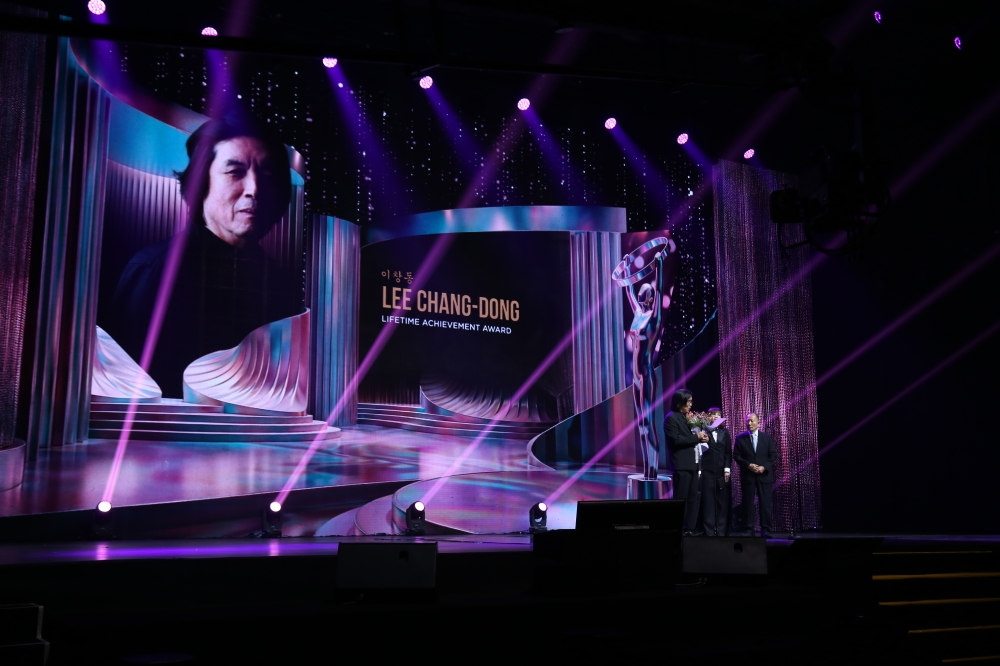
KUALA LUMPUR, July 26 — South Korean filmmaker Lee Chang-dong was honoured with the Lifetime Achievement Award at yesterday’s Malaysia Golden Global Awards (MGGA), receiving one of the festival’s highest accolades for his enduring contributions to world cinema.
The honour, presented to legendary filmmakers and actors for their long careers, artistic achievements and lasting impact on global cinema, marks a milestone for the director behind the acclaimed films Peppermint Candy (1999) and Burning (2018).
Lee received the award at Megastar Arena from MIFFest founder Joanne Goh and former Busan International Film Festival chairman Kim Dong Ho, expressing his gratitude for the recognition.
Speaking to Malay Mail, Lee said he viewed the honor as encouragement rather than recognition of past achievements.
“I haven’t made many films for my age, nor do I feel like I have achieved anything significant, so I think receiving an award like this is probably an encouragement for me to work harder,” he said.
He added that every film he makes reminds him of how much more there is to learn about cinema.
Lee said he hopes to continue studying film, thinking more deeply about the medium and expanding his understanding of the art form.
The enduring need for human stories
The recognition comes after decades of filmmaking exploring trauma, memory, morality, social inequality and the struggles of ordinary people.
Lee revealed there was a period when he stepped away from filmmaking while searching for a project he felt complete confidence and conviction in pursuing.
“Even if I am not making a movie, I am not resting,” he said.
“Writers and directors alike often fall into the misconception that they are working even when they are not.
“Just like that, I have been constantly preparing for movies.
“I pondered over filmmaking, figured out what I should do, and even wrote screenplays.”
He said he ultimately moved forward with projects when the right opportunities and circumstances aligned.
Asked whether his intimate, character-driven storytelling could still resonate with modern audiences, given today’s stronger appetite for horror and action films, Lee said stories centred on the human experience remain essential despite changing viewing habits.
“While audience tastes and habits regarding movies are changing significantly, I think audiences still want a space where films can meet them most closely,” he said.
“I intend to make such movies with the mindset that I can, or must, make them more than anyone else.”
Will cinemas still matter?
As streaming platforms continue to grow, Lee believes the cinema-going experience remains vital, particularly for films built around spectacle and immersion.
“I suspect that cinemas and cinematic films will become increasingly polarised in the future,” he said.
“Movies with massive spectacles that you can enjoy on a huge screen — those are best watched in a cinema to truly feel the value of the ticket.”
However, he noted that some plot-driven films may not necessarily lose their impact when viewed on smaller screens.
Lee added that watching certain films at home could encourage audiences to skip scenes they find predictable, especially as the gap between cinema screens and increasingly larger televisions continues to narrow.
Even so, he believes some films can only be fully appreciated in theaters, where audiences can focus on subtle expressions, visual details and emotions that are difficult to convey through words.
The next chapter
Following the recognition at the ninth Malaysia International Film Festival (MIFFest), Lee said he intends to keep making films and already has many stories in mind.
“I have always been preparing to see which of them I can actually do.
“I cannot guarantee whether I can truly make a movie — how should I put it — and maintain the energy within me to make it all the way to the end,” he concluded.


