


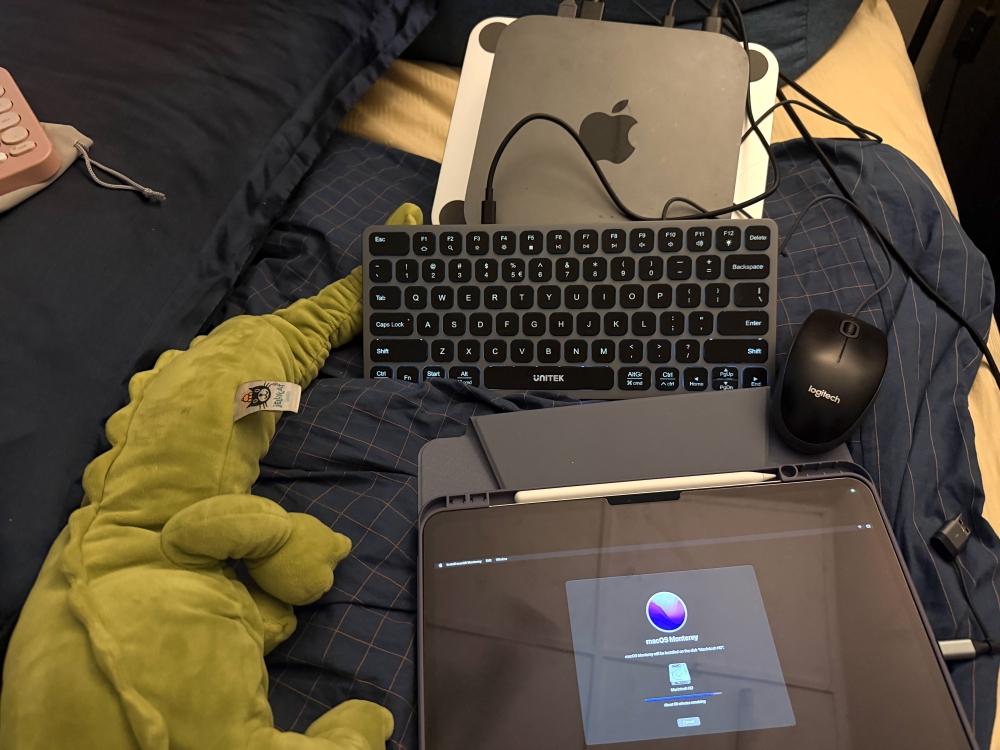
JULY 8 — Right now I am sitting on my bed, with an old 2018 Mac mini desktop connected to a much newer iPad Pro also in my bed.
Rather unsexy but the frustration of trying to figure out tech has far better dividends than trying to figure out, for instance, how not to murder your significant other.
I have become addicted to trading in my old gaming tools at secondhand dealer CeX.
My latest acquisition (after trading in an unused controller and Pokémon Pokopia, finished and unlikely to be replayed) is a curious device called the Jumpgate by a company named Savage Raven.
It seemed like the solution to my newest quandary — how to connect my Nintendo Switch 2 to an iPad.
On paper, it seemed I had all the tools. The right cables, the right power supply and yet nothing was working as it should.
A couple of buttons were too tight; that was remedied with a screwdriver.
Then I realised that the problem was not the hardware but probably the software; my fancy new but used device needed a firmware update.
But reader, the update program runs only on Windows and not Mac OS.
I had a brief moment of insanity where I contemplated getting an old Windows machine but my bank account talked me out of it.
Ah! In a corner was my unused Mac Mini, the only one of my Intel Macs left (that have not gone to the tech graveyard in the sky).
I tried installing VMWare Fusion to run a virtual Windows machine but while I did get it running, it refused to acknowledge that my Jumpgate existed.
The innate perversity of inanimate objects is truly vexing.
So the Mac Mini was booted up, connected to an iPad (my cat peed on my one remaining desktop monitor) and two hours later I am reinstalling Mac Monterey because I seem to have an addiction to suffering.
Yet I am still grateful that I know how all this works.
Figuring out why a computer wasn’t turning on, putting one together with my own hands, those are now skills that are dying out.
PC parts have become increasingly expensive, with RAM and hard disk prices now soaring.
Two thousand ringgit would have gotten me a halfway decent midrange desktop if I got the parts myself, 10 years ago (as Facebook reminded me, showing me a picture of my last PC).
Now that same amount wouldn’t even cover the motherboard, processor, RAM and storage.
I don’t want to see a future where no one can afford to buy or maintain their own computers.
Even this old Mac mini is still expensive in the secondhand market, as having an Intel chip means it can dualboot Windows.
It’s also a machine with replaceable RAM but secondhand RAM is ludicriously expensive now so I doubt I’ll ever add more to my Mac mini’s paltry 8GB.
There’s now a movement in the Klang Valley to learn DIY, fixing or repurposing old items and interestingly, Facebook groups for barter.
I think the youngsters see what we call progress as stifling and truly, who can blame them?
Wireless headphones are overrated.
An old dress at the bundle store is probably made of better cloth and handiwork than the average Zara but costs less.
Have you seen the prices at Zara these days? Hundreds of ringgit for glued on hems, the audacity.
Modern tech and innovation sells us the notion that a friction-less, seamless life is the ideal.
In reality life is so much more interesting when it is well-lived, well-explored, well-savoured.
Kids of my generation understood that if a video game was hard, then you just needed to get better in the best way possible — play more.
One of my friends loves playing at the extreme difficulty level for the rush of euphoria.
It’s so much more satisfying to have conqured something that is an actual challenge.
Yet I see people my age and older choosing to ask a robot what kind of chicken cut to eat or how to word their emails.
Instead of talking to their friends, they ask ChatGPT for dating advice, about their health scares, confiding in it their fears for the future.
I don’t want to talk to a computer; I’d rather take it apart, see what makes it work, find out just why it’s not doing what I want it to do.
A computer should help me make my life better and yet instead we are destroying our forests and seas to keep making them.
We’ll see what happens in the next five years. Maybe RAM will be cheaper. Maybe it’ll be a new War of the Worlds.
Whatever happens, at least I know I won’t have to rely on a machine that has no eyes or soul to tell me how to fix it.
* This is the personal opinion of the columnist.


