













JULY 31 — I am writing these lines from a grand and ancient museum, surrounded by several historic and significant works of art.
It must be one of the biggest museums in the world, spanning several square kilometres to cover the full expanse of a reasonable-sized city. In fact, most people would say that it really is a city, and not a museum at all. It is called Florence.
Florence, capital city of the beautiful region of Tuscany in northern Italy, is spectacular and unique. For a while, many centuries ago, it was the most important and influential place in the world — the New York City of its time.
Thanks to its focal point in international trade and a blossoming art scene, in the fourteenth century Florence was the birthplace of the Renaissance — the cultural awakening which allowed Europe to decisively leave behind the dark days of the Middle Ages, ushering in modernity.
The rulers of Florence were the De Medici family, who started out as successful traders and quickly rose in prominence to lord over the city and much of the civilised world, with members of the dynasty ultimately rising to become popes and royalty.
But the De Medicis weren’t just politicians and businessmen. They also glorified their regime by supporting the arts, with their finances giving a guiding hand to arguably the greatest painter in history, Leonardo De Vinci, and the greatest sculptor in history, Michelangelo, who were both native to Tuscany and employed by the De Medicis.
It didn’t last, of course. In 1492 Christopher Columbus discovered the Americas and Florence soon lost its position at the epicentre of civilisation, with the riches of the New World taking over as the focal point of global affairs while the house of the De Medicis collapsed under the weight of its own corruption.
Now, however, hundreds of years later strong traces of the great Florentine past still remain, with history lurking at every street corner.
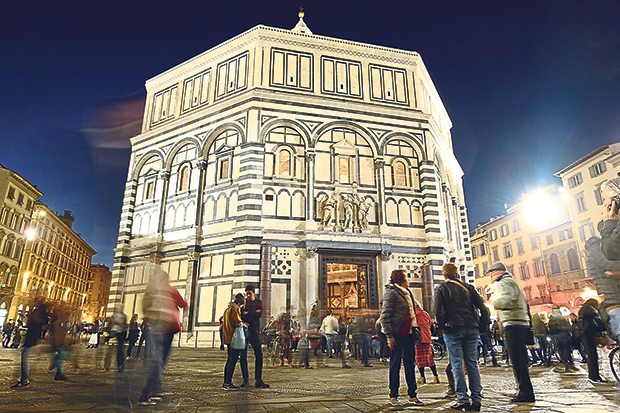
Like every visitor to Florence, I wandered around the iconic red-domed cathedral, crossing the Ponte Vecchio (literally “old bridge”) over the River Arno, contemplating the Santa Croce Basilica and admiring the Piazza della Signoria, the main city square which saw dozens of internal coup attempts, wars and public executions during the city’s violent peak.
And they are impressive sights indeed, evoking a strong sense of what Florence must have been like when it ruled the world all those years ago. Despite its torrid history, the city has been well preserved and when necessary rebuilt, keeping history alive more than any other fallen power I have ever visited.
But Florence also feels like a dead city. It has history, history and history, and nothing else appears to matter. This is a ghost town, a place where the spirits of world-famous artists and scheming political leaders roam free to enchant and beguile an endless stream of tens of thousands of visitors, whose every tourist need is catered for by a steady supply of tour guides and multi-lingual restaurant menus.
Hence my feeling that Florence is little more than a gigantic museum. A spectacular sight, no doubt, but a place where, inescapably and irrevocably, the present is subservient to the past.
The idea of Florence as a museum is literally true in certain locations, especially the always-crowded (with tourists, not locals) Piazza della Signoria, which has been decorated with dozens of sculptures to ensure visitors cannot forget the city’s historic essence.
Usually, priceless treasures such as Michelangelo’s David are kept safely under lock and key, only viewable with the payment of a hefty admission fee at the entrance door of an expensively maintained gallery.
In Florence, however, this world-famous sculpture (even though it is a replica) is right there in the centre of the city: outside in the open air and free for all to view whenever they choose. It is a symbol of the city and it is to be displayed, not hidden.
But like everything else in Florence, the works of art scattered around the Piazza, many of which are originals rather than copies, are many hundred years old and they add to the overall impression that this city is a relic. It does not only showcase the past; it is the past.
On closer thought, however, Florence can’t really be like that. There must be more to the place.
It is a city of nearly 400,000 inhabitants who actually live real lives in the modern world. They have wifi and digital TV and ready meals, and there must be significant areas of the city where they work, study, eat, live and play — but you won’t find them in the historic old centre, which has become the exclusive preserve of free-spending visitors.
This is the problem of being a tourist. You see the sights, but you don’t see the city. Londoners do not live in Trafalgar Square; Parisians do not pass their Sundays queuing to ascend the Eiffel Tower; Florentines don’t spend their leisure time gawping at statues.
There is a huge disconnect between what holidaymakers experience and how locals actually live. Some places manage to hide this disparity better than others, but it nonetheless exists everywhere. And in Florence, it is more evident than ever.
Florence is a real city. People live and work here. But when all you do, like me, is visit for a few days, you will only see the past, revel in the history. You will only chase the ghosts.
* This is the personal opinion of the columnist.