


MAY 25 — I am writing this week having just returned from a work trip to Milan, which was my first visit to Italy’s second biggest city.
Like many other countries, the current definition of Italy is a relatively recent construct, and that is very much reflected in Milan’s history. At various times, the city has come under the control of France, Austria-Hungary and Spain, only eventually becoming a part of Italy in its present guise in 1859.
Milan’s geographical position lends itself to such historic cultural and political diversity. It is located on the edge of a large and easily accessible plain, the Po Valley, near the southern tip of the majestic Alpine mountain range which also cuts across France, Germany, Austria, Switzerland and Slovenia.
As such, Milan marks the gateway into mainland Europe from the Italian peninsula, and vice versa, and has therefore always been an important trading post and financial centre.
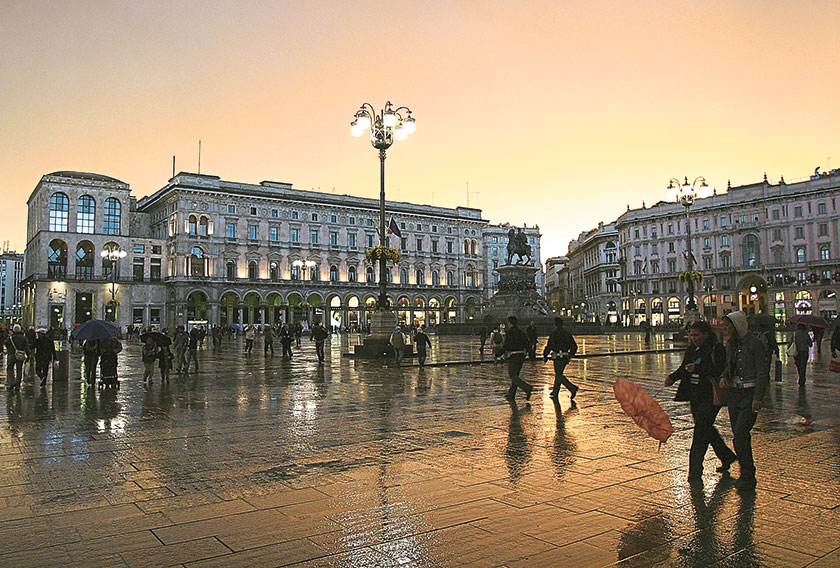
These days, there are two main attractions for visitors. Firstly, the world’s fifth biggest cathedral, the “Duomo” which dominates the centre of the city along with its spacious accompanying square.
And nearby is the famous “Golden Rectangle” of shopping streets, containing the best known examples of Milan’s other main claim to fame — exclusive fashion designers.
The small city centre is atmospheric and small, easy to traverse by foot. Away from the Duomo and its immediate environs, though, Milan is a sprawling, industrial and not particularly attractive city.
Once you leave the slightly shambolic grandeur of the compact old town, an unseemly jumble of cheaply constructed apartment blocks and factories seems to roll on forever, with little to separate the city of Milan itself from the wider metropolitan area which encompasses satellite cities such as Bergamo and Novara and a total population of more than 10 million people.
I wasn’t in Milan for the fashion, but I took advantage of some spare time to wander around the Golden Rectangle, purely out of interest and with no intention of buying — even if I’d had the budget to do so.
Along the particularly chic Via Montenapoleone, the storefronts became especially glitzy and somewhat forbidding for novice shoppers like me, featuring famous brand names such as Armani, Gucci and Versace.
The shop assistants, I was reliably informed, are largely recruited these days for their ability to speak Mandarin or Russian, because that is the mother tongue of an increasing number of their customers.
So when I entered for my no-buying browse, it was no surprise that they didn’t show much interest — I assume a badly dressed 41-year-old Englishman is not exactly their target market.
I’m sure they are kept busy though, because there was a notably large number of Russians in the city – and not just because their basketball team was competing in the Euroleague basketball finals over the weekend (the reason for my visit).
Indeed, the migration of wealthy Russians is a growing phenomenon across many cities across Europe, including my hometown of Barcelona.
In the last few years, it appears, a significant number of young Russians who have the resources to do so (earned by what means, it is not always clear) are leaving their country to escape the bribery and corruption that has become inherent within the Muscovite business environment — not to mention the awful traffic and the blisteringly cold winters.
Blessed with money to burn, those wealthy Russian families can take the pick of Europe, and Barcelona, London, Paris and Milan are becoming their favourite destinations.
With that in mind, whilst walking the streets of Milan over the last few days, the thing that struck me the most was the temporal nature of the city, with centuries-old buildings serving new purposes as they welcome different business priorities and an ever-changing demographic.
I suppose this is something major urban areas all over the world have in common. However fixed we may sometimes believe it to be, our societies are constantly changing.
The Duomo, for example, was once the epicentre of Milanese life for people who were born in the city and lived there throughout their lives. But now it’s chiefly
a tourist attraction, constantly sporting long queues of visitors (free entry but 2 Euros for the pleasure of taking photographs) who are eager to tick one of the world’s biggest places of worship off their to-do list.
Perhaps Milan’s history has been more changeable than most, as a result of its proximity to a number of major European countries which have experienced fluctuating fortunes over the passage of time.
And who knows what will become of the city in the future, but my overriding impression from this part of Italy which used to be in Spain, France and Austria is that everything is transient, nothing lasts forever.
*This is the personal opinion of the columnist.


