


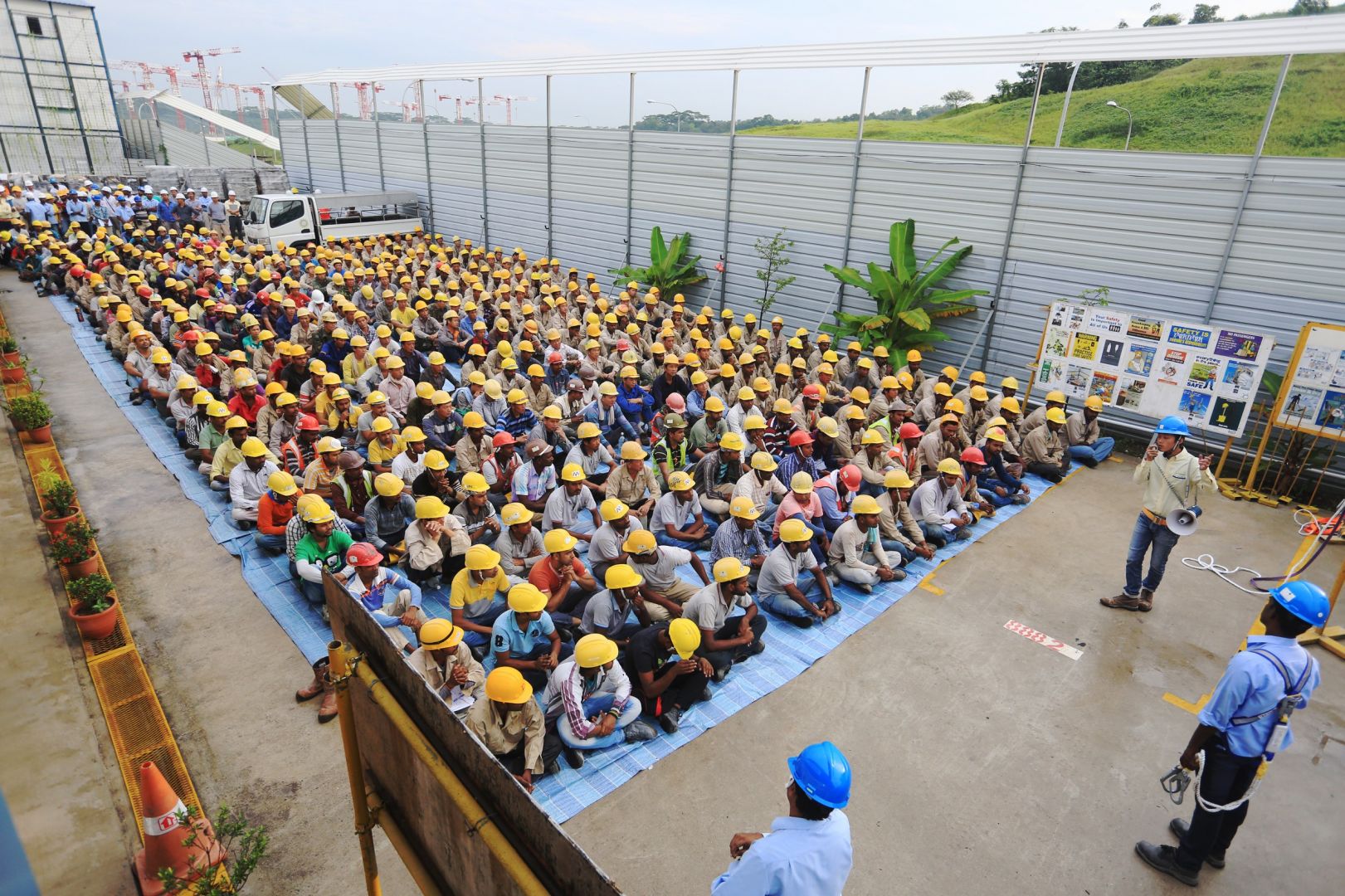


SINGAPORE, Sept 4 — Even as Singapore is on track to reaching its target of 1.8 workplace deaths per 100,000 workers by next year, it has set a new target to cut its workplace fatality rate further by about half to under 1.0 before 2028.
Announcing the move at the opening of the World Congress on Safety & Health at Work at the Sands Expo and Convention Centre yesterday, Prime Minister Lee Hsien Loong said other countries have made the same journey and succeeded.
“We’ll have to work hard, but I’m confident that we can achieve the new target,” he said, noting that Finland had halved its rate from 1.8 to 0.9 in 11 years, between 2002 and 2013.
Last year, Singapore’s workplace fatality rate was 1.9 per 100,000 workers, and though it is on track to meeting its previous target set in 2008, PM Lee acknowledged this was “still not the best that can be achieved”.
In recent months, several high-profile workplace mishaps have occurred. In July, the partial collapse of an uncompleted viaduct at Upper Changi Road East left one worker dead and 10 hurt.
While fewer people died in the workplace in the first half of this year, the number of occupational diseases rose 37 per cent from the second half of last year. There were 19 workplace deaths from January to June, down from 24 in the second half and 42 in the first half of last year.
Noting that Organisation for Economic Cooperation and Development countries like the United Kingdom (0.8), Sweden (0.7) and the Netherlands (0.5) have rates below 1.0, PM Lee added that Singapore can achieve its new target by having employers, workers and the government keeping at its work.
For firms, ensuring a safe and healthy workplace is “sound business policy”.
“If you take good care of your employees, make sure that they’re well-rested and train them well in safety procedures, they’ll be more productive,” PM Lee said, adding that good companies will set issues right quickly and ensure they do not recur.
Workers, too, can chip in by raising the alarm when they spot potential work hazards or by attending courses on workplace safety and health.
While the government will take the lead by putting in place rules and incentives to urge firms to emphasise a safe and healthy workplace, PM Lee said imposing more regulations alone will not solve the problem.
In 2004, Singapore’s workplace fatality rate was 5 per 100,000 workers. To enhance workplace safety and health comprehensively, the government took steps including rolling out a new Workplace Safety and Health Act in 2006.
Acknowledging it would be “impractical” to introduce new regulations after every workplace accident and that “more rules will result in heavier burdens but not greater safety” beyond a point, PM Lee said a balanced approach is needed to support firms without unduly bogging them down with high compliance costs and impractical requirements.
The government will work with sectors with higher accident rates like construction, marine and logistics, and continue pushing efforts in other industries to build an “economy-wide” safety and health culture.
To encourage smaller firms to take a holistic approach towards workplace safety and health, he said the Manpower Ministry (MOM) is setting up a Total Workplace Safety and Health Services Centre in Woodlands to support about 300 companies which together employ 3,000 workers.
Opening by the end of this month, it will run for two years and help the firms, which are mainly in metalworking, food manufacturing and construction, incorporate workplace safety and health into their business and human-resource-management practices, among other things.
More such centres will be set up in other industrial areas if the approach works well, PM Lee added.
Technology is also pivotal in reducing human error which causes workplace accidents, so the government wants to encourage firms to use technology more pervasively, he said.
To that end, the MOM is setting aside a S$2 million (RM6.29 million) kitty to fund companies and research institutes to devise new technological solutions, under a Workplace Safety and Health Technology Challenge, which will focus on vehicular safety – the leading cause of workplace deaths – for a start.
It will also support piloting “ready-to-go” off-the-shelf solutions.
With human capital being Singapore’s only resource, PM Lee said workplace safety and health is taken very seriously as “every life counts, every worker matters”. — TODAY


