


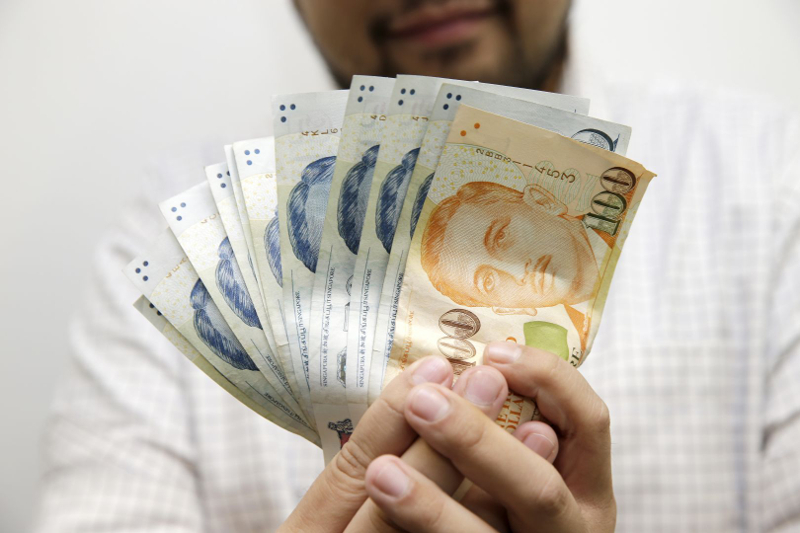


SINGAPORE, Oct 28 ― Singapore’s dollar will weaken about 2 per cent versus the greenback by the end of the year after the city-state’s central bank “slightly” reduced the pace of the currency’s gains versus those of its trading partners this month, according to a survey of analysts by Bloomberg News.
The currency will slide to S$1.42 (RM4.34) by the end of December after the Monetary Authority of Singapore probably lowered the slope of its appreciation against a basket of currencies to 0.5 per cent this month, from 1 per cent, according to the median estimate of 19 analysts. The projected level would still be stronger than the six-year low of S$1.4366 reached on October 2.
The local dollar slipped 0.1 per cent to S$1.3980 at 8.39am in Singapore. Oversea-Chinese Banking Corp forecast it will tumble to S$1.4570, the most bearish projection, while Mizuho Bank Ltd saw it stronger at S$1.39.
The central bank, which uses the currency rather than interest rates to guide the economy, eased monetary policy on October 14 for the second time in 2015. The nation avoided a technical recession in the third quarter, expanding 0.1 per cent from the previous three months, when it shrank a revised 2.5 per cent.
Guiding currency
The MAS guides the local currency against an undisclosed basket and adjusts the pace of appreciation or depreciation by changing the slope, width and centre of a band. It refrains from disclosing details of the basket, the band, and the pace of appreciation or depreciation.
“An even stronger policy easing in the most recent October review, including flattening the slope of the S$NEER policy band, was clearly unwarranted, as the Singapore economy was neither experiencing an outright retraction in economic activity nor widespread price declines,” the monetary authority said in its semi-annual Macroeconomic Review released yesterday.
The US dollar probably accounts for 22 per cent of the basket, while the ringgit and yuan about 15 per cent, according to the median estimate of eight of the analysts who provided the numbers. ― Bloomberg


