


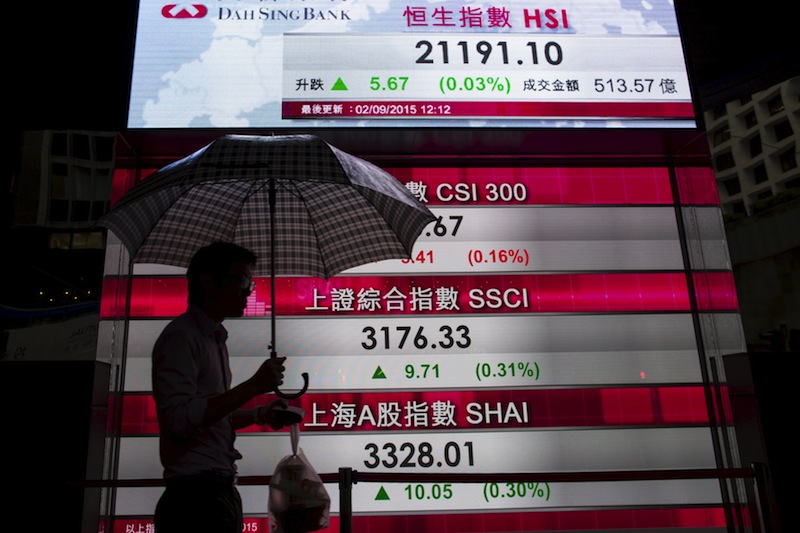


HONG KONG, Sept 14 — Asian stocks advanced, led by gains in Hong Kong, after China published plans to reform its state-run companies as it battles to meet economic-growth targets.
The dollar was weaker against most peers before this week’s Federal Reserve meeting.
The Hang Seng China Enterprises Index extended gains after capping its biggest weekly advance in six months.
Australia’s dollar led commodity-producers’ currencies higher after weak Chinese industrial-production and fixed-asset investment reports raised prospects for increased stimulus.
US stock-index futures signaled gains, while Treasuries were little changed, with traders and economists split on whether the Fed will boost borrowing costs on Thursday for the first time since 2006. Corn gained.
“Trading will remain volatile ahead of the FOMC meeting,” Bernard Aw, a strategist at IG Asia Pte in Singapore, said by phone, referring to the Fed Open Market Committee gathering.
“Sunday’s data reinforced concerns about China’s economy slowing down. Investors may expect more stimulus in the pipeline, which could provide some support to Chinese equities.”
Traders are holding odds at 28 per cent that the Fed will raise interest rates at its Sept. 16-17 meeting. China plans to list more of its state-owned firms and improve their management of capital in its biggest overhaul of the sector since the 1990s.
Australia’s dollar climbed 0.4 per cent to 71.19 US cents by 10:51 a.m. in Tokyo. Equity gains in Hong Kong and Australia helped the MSCI Asia Pacific Index up 0.3 per cent. The Shanghai Composite Index swung between gains and losses.
Japan’s Topix index dropped 0.2 per cent as NTT DoCoMo Inc., the country’s biggest mobile carrier, slid 9.1 per cent.
Prime Minister Shinzo Abe said easing the burden imposed by mobile fees on Japanese households was an important issue. Communications Minister Sanae Takaichi agreed to look into it, according to minutes of the country’s Council on Economic and Fiscal Policy. DoCoMo was the biggest decliner on the Nikkei 225 Stock Average, which fell 0.3 per cent.
Standard & Poor’s 500 Index futures climbed 0.5 per cent, signaling a third day of advance for the US equity benchmark.
India reports on trade and wholesale prices, an inflation indicator, on Monday, while Australia will update on credit card purchases. Japan issues data on industrial production and Hong Kong reports on producer prices.
Japan also reviews monetary policy this week. With the country’s economy struggling to gather momentum, 11 of 35 economists surveyed by Bloomberg see the central bank stepping up easing measures in October, while two are forecasting a move as soon as tomorrow.
Currencies
The Aussie — regarded as a bellwether for Chinese sentiment given the two countries’ close trading links — rose for a sixth straight day. The New Zealand dollar added 0.2 per cent, to 63.28 US cents.
A better-than-expected reading on Chinese retail sales helped mute the impact of the disappointing industrial output and fixed assets data, said Raiko Shareef, a markets strategist in Wellington at Bank of New Zealand Ltd.. Sales climbed 10.8 per cent in August from a year earlier, exceeding the 10.6 per cent increase predicted by economists in a Bloomberg survey.
The Korean won led emerging-market currencies higher, gaining 0.3 per cent to 1,180.69 per dollar. The Norwegian krone and Canadian dollar also gained.
The yuan was little changed at 6.4036 per dollar in Hong Kong trading, after jumping 0.9 per cent last week amid speculation China intervened in the market to prop up the offshore rate and align it more with the onshore one. The spread between the Hong Kong rate and the official one is now the smallest in nine months.
Commodities
West Texas Intermediate crude rose 0.6 per cent to US$44.89 (RM192.969) a barrel.
WTI sank 2.8 per cent on Friday, capping a weekly loss of 3.1 per cent amid ongoing concern over a glut in the commodity. Goldman Sachs Group Inc. helped stoke declines last session, with its analysts saying in a report that prices could slide to as low as US$20 a barrel as the global surplus is even bigger than they first estimated. Brent was little changed Monday at US$48.20, after sinking 3 per cent last week.
Futures on wheat advanced 0.9 per cent while those on corn added 1.1 per cent. Contracts on soybeans due in November gained 0.5 per cent. — Bloomberg


