


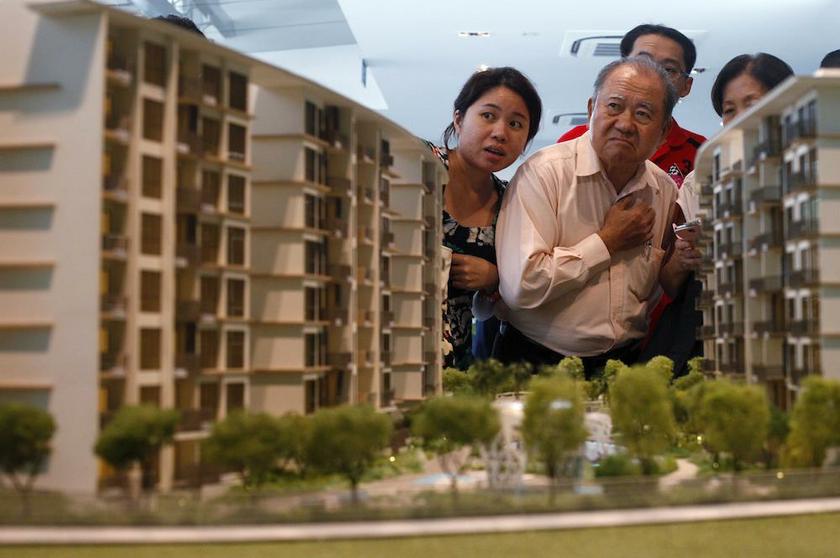


SINGAPORE, Feb 16 ― When it comes to the best and worst property markets in Asia, Singapore has it covered.
Office rents in the city’s central business district jumped 14 per cent last year, the biggest increase in the region, while luxury home prices slumped 6 per cent, the most in Asia, according to Jones Lang LaSalle Inc, a property brokerage and consulting company.
The gap is about to widen. Prime office rents in the city, Asia’s most expensive after Hong Kong and Beijing, are projected to extend the gain by a further 5 per cent this year with a limited supply, said Chua Yang Liang, Jones Lang LaSalle’s head of research for Singapore and Southeast Asia. High-end homes may post a decline similar to the drop in 2014 on the government’s housing curbs, he said.
“Singapore has seen quite a polarity in its property market compared to the rest of Asia,” Chua said in an interview. “As long as the government curbs on housing are in place, we will continue to see this diverging trend.”
The city’s prime office rents are set to extend gains this year with a limited number of new commercial properties in 2015, Lynette Leong, chief executive officer of CapitaCommercial Trust, said in an interview last month.
The property trust is building the 40-story CapitaGreen office tower in the city’s financial district, and has leased more than two-thirds of the building, she said.
About 1.15 million square feet of new office space will come on stream in 2015, rising to 1.6 million square feet in 2016 and 4.7 million in 2017, according to real estate broker Knight Frank LLP.
Office rents
So-called grade A office rents may climb 11 per cent this year as a dearth of supply until mid-2016 helps boost rents, said Alan Cheong, a Singapore-based director at broker Savills Plc.
“The coast is clear for a rise in office rents,” he said, at the same time predicting a drop of as much as 10 per cent for residential values this year.
Singapore’s overall home prices fell 4 per cent in 2014, the first year-on-year decline since the 2008 global financial crisis, according to government data. The slump came as Singapore added more measures to its five-year campaign to rein in property values with some of the strictest measures, including capping total debt repayments at 60 per cent of a borrower’s income.
In November, City Developments Ltd, Singapore’s second-biggest developer, said the high-end residential segment may face “fire sales” with mortgage defaults as the housing curbs hurt home sales and prices.
Challenging market
The developer, controlled by billionaire Kwek Leng Beng, added that property companies are holding back the sale of new projects as rents are on the decline with the measures weighing on the market. City Developments is scheduled to report its full-year earnings today.
Keppel Land Ltd, Singapore’s third-biggest publicly traded residential developer, said last month the city’s housing market remains “challenging” after new home sales halved in 2014 with falling prices. The company said it has started seeking out investments in developed countries such as the US.
Home sales may stall in 2015 as growth slows. Singapore’s economy expanded less than estimated in the fourth quarter after its manufacturing industry weakened with slowing growth in China and an uneven global recovery.
Gross domestic product rose an annualised 1.6 per cent in the three months to December 31 from the previous quarter, when it expanded 3.1 per cent, the trade ministry said in a preliminary report last month. The final data will be released tomorrow.
Trailing Asia
“Singapore would be among the few countries where prices are contracting compared to the rest of Asia where economies are expanding,” said Nicholas Mak, executive director at SLP International Property Consultants. “Had it not been for the government curbs, Singapore may have outperformed the rest of Asia in terms of pricing.”
Singapore remains a high-end housing market in Asia. The city was ranked the most expensive city to buy a luxury home after Hong Kong in the region, according to a 2014 Knight Frank wealth report.
Foreigners, who have previously made up a third of all purchases in Singapore’s prime residential areas, will shy away from the city-state with the additional taxes on home purchases, said Cheong at Savills, adding that the levy on overseas buyers have added as much as 18 per cent to their costs.
“Luxury homes will face challenges to lure the overseas buyer back as they are loathe to pay the additional taxes,” he said. ― Bloomberg


