


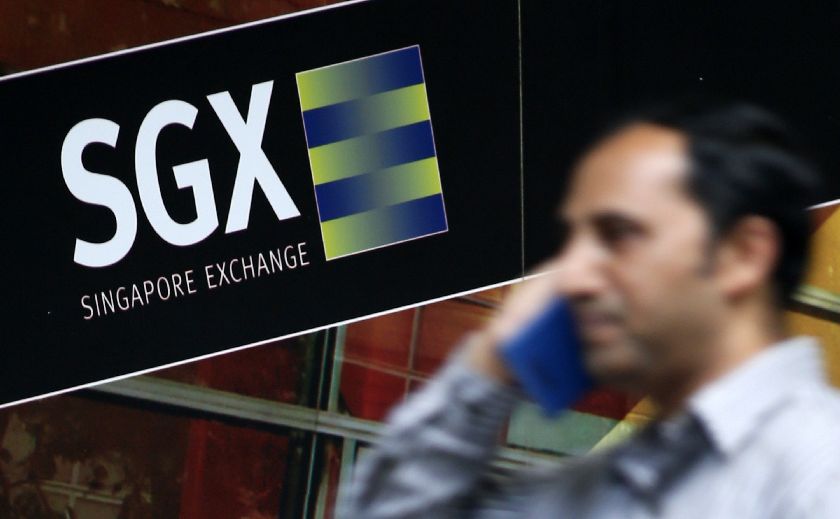


SINGAPORE, Dec 3 — Singapore Exchange Ltd suffered its second trading disruption in less than a month, prompting Chief Executive Officer Magnus Bocker to apologize to investors and brokers amid criticism from the financial regulator.
Southeast Asia’s biggest stock market opened 3 ½ hours late today because of a software error, less than a month after the bourse operator halted trading for more than two hours on November 5 due to a power-supply failure. The delay was “unacceptable,” the Monetary Authority of Singapore said in an e-mailed statement, with the regulator pledging to take supervisory action against SGX if needed.
“This should not have happened and we take full responsibility,” Bocker, 53, said in a statement. “We are reviewing our processes to prevent any recurrence.”
The head of Singapore’s bourse operator is already grappling with a slump in stock trading volume that spurred a 16 per cent decline in profit last quarter. SGX shares eked out a 0.1 per cent advance this year through yesterday, trailing the Bloomberg World Exchanges Index’s 3.5 per cent gain, and have dropped 7.5 per cent since Bocker took on the top job in 2009.
Today’s disruption was announced in a stock exchange statement shortly after 4 am local time. The market will remain open until 5 pm, with SGX holding a media briefing after the close. Trading volume was 55 per cent below the 30-day intraday average at 2:12 pm, data compiled by Bloomberg show.
“Brokers have lost confidence in the system, clients are upset,” said Manoj Kumar, a broker at CIMB Group Holdings Bhd. in Singapore. “The mood hasn’t been good the whole year, and this has just ruined things again. It’s one screw-up after another.”
Power probe
MAS said November 6 that it would take action against the exchange operator if lapses were found to be behind last month’s power outage. SGX has started a probe into the breakdown. In April 2013, the opening of derivatives trading was delayed for three hours because of a computer breakdown, forcing investors to use a rival exchange operator in Osaka to buy and sell Japanese index contracts.
SGX’s own shares climbed 0.3 per cent to S$7.29 (RM19.13), pacing a 0.3 per cent gain for the Straits Times Index.
Programming changes over the weekend created the software error that caused today’s disruption, SGX said. The delayed open was to give brokers time to reconcile client positions and fix any mistakes in the end-of-day processing for December 1 on a client-accounting system hosted by SGX, it said.
“It’s quite annoying,” said Steven Leung, Hong Kong-based director of institutional sales at UOB-Kay Hian Holdings Ltd “There will certainly be complaints.”
Global faults
Faults happen periodically in some of the world’s biggest stock markets. The CAC 40 Index of France’s largest companies failed to calculate for more than three hours on November 27 after Euronext NV suffered a technical incident. This also stopped the national benchmark indexes for the Netherlands, Belgium and Portugal—and their respective derivatives gauges—from opening at the normal time.
On October 31, a computer malfunction forced Deutsche Boerse AG to suspend trading on its Xetra equities platform for 72 minutes. A day before that, the New York Stock Exchange had to switch to a backup system after a network hardware failure caused its price feed to malfunction.
Companies worth a combined US$572 billion are listed in Singapore, data compiled by Bloomberg show. The benchmark Straits Times Index rose 4.9 per cent this year through yesterday, compared with the MSCI World Index’s 4.5 per cent advance.
Trading value
The daily value of stocks traded in Singapore averaged S$1 billion this year, a 25 per cent slump from 2013, data compiled by Bloomberg show. The city-state is strengthening securities rules to help restore investor confidence after a penny-stock slump wiped US$6.9 billion off the market value of three commodity companies over three days in October 2013.
Analysts expect SGX shares to rise to S$7.49 over the next 12 months, a 3 per cent advance from yesterday’s close, according to target-price estimates compiled by Bloomberg.
“As long as no one has lost money due to the error, and there is no legal action, this shouldn’t really impact the stock price,” said Andrew Clarke, director of trading at Mirabaud Securities Asia Ltd in Hong Kong. “As always with these types of incident, the relevant exchange always hopes no one notices or just forgets.” — Bloomberg


