




KUALA LUMPUR, Aug 20 — Malaysia's plan to run two cost-benefit analyses (CBA) is likely to delay the Washington-led Trans-Pacific Partnership Agreement (TPPA), the Wall Street Journal (WSJ) reported today.
In its Southeast Asia Real Time section online, the international business daily claimed that the global free trade arrangement was originally slated to be concluded by October this year, when US president Barack Obama plans to visit the region.
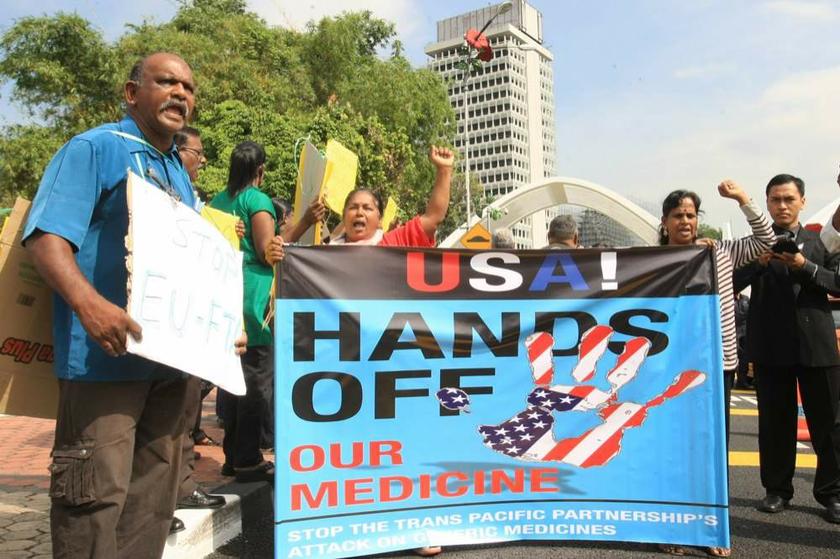
But the timeline may be pushed back due to Putrajaya's capitulation to public pressure from opposition lawmakers and lobby groups such as Bantah TPPA, a coalition of NGOs, to carry out the studies to safeguard Malaysian economic interests.
"The only way to convince the stakeholders is to do a cost-benefit analysis and send a message that, even though there are some short term losses, in the long run the country is going to benefit,” Sanchita Basu Das, a lead researcher in economic affairs at the ASEAN Studies Center, told WSJ.
Last week, the Cabinet held a three-hour special meeting where two additional studies were mooted, as it sought to allay fears of a neo-colonisation agenda through the 12-nation agreement.
One of the CBA will study TPPA's effect on national interests, while the other focuses on small and medium-scale enterprises and the bumiputra business community.
High on the priority is the concern that Malaysia will have to sacrifice its affordable, government-regulated healthcare and medicine.
“The Cabinet is firm in ensuring access to affordable medicine remains its utmost priority which will not be compromised in the ongoing TPPA negotiations,” the Ministry of International Trade and Industry (MITI) said in a statement last week.
“Though a lot of progress has been made in the past rounds of TPP talks, some crucial areas including healthcare need more attention and the process could take longer than expected,” AmBank Group chief economist Anthony Dass told WSJ.
However, Dass stressed that the agreement will broaden Malaysia's opportunity for exports, which is essential for a country where government-driven domestic demand has come up as the primary growth driver.
Earlier this month, the Department of Statistics (DOSM) released Malaysia’s external trade statistics for June, highlighting a 6.9 per cent decline in exports year-on-year to RM56.7 billion.
This slated delay comes as the US Trade Representative Michael Froman urged a rapid conclusion to the agreement on Monday, after rounds of talks started more than three years ago.
Meanwhile, Putrajaya was adamant that Malaysia will not be bound by any fixed timeline to sign the agreement.
Consisting of Malaysia, the US, Australia, Brunei, Canada, Chile, Japan, Mexico, New Zealand, Peru, Singapore and Vietnam, the TPPA aims to boost trade in the region by removing present barriers.
The 19th round of negotiations is currently ongoing in Brunei.


