












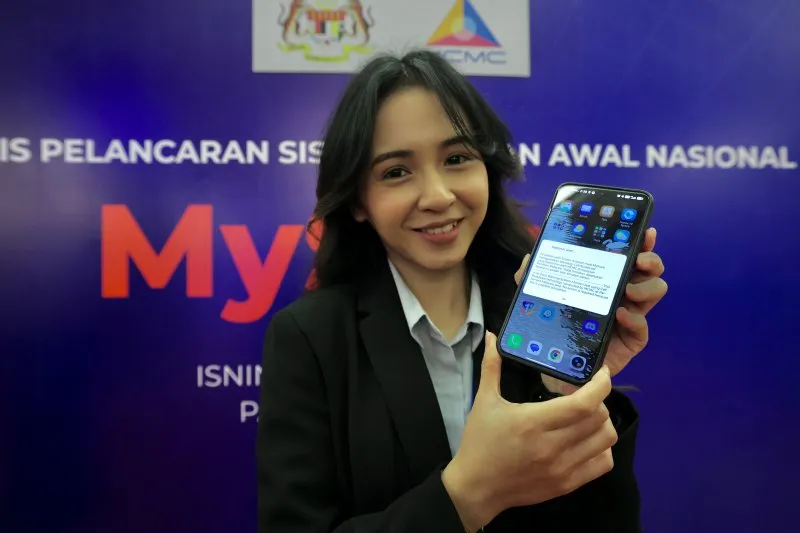


KUALA LUMPUR, Nov 24 — Members of the public will be able to receive emergency alerts directly on their mobile phones without downloading an application or subscribing to any service once the National Early Warning System (MySiren) is fully operational.
According to a frequently asked questions (FAQ) document issued by the Malaysian Communications and Multimedia Commission (MCMC) yesterday, MySiren was developed to alert the public during emergencies, enabling them to take immediate action to protect lives and property
The system uses Cell Broadcast System (CBS) technology to rapidly transmit security alerts simultaneously to compatible mobile devices in affected areas through 4G and 5G networks.
“Unlike SMS-based systems, which send messages to specific phone numbers and rely on a queue for delivery, CBS alerts do not use mobile data.
“This means alerts can still be received even when networks are heavily congested or users have exhausted their data quota,” the FAQ stated.
MCMC said alerts could be issued in the event of serious and imminent threats to life, health, safety or property arising from incidents such as severe weather, floods, tsunamis, major fires, hazardous material incidents, public security threats and other major emergencies.
The FAQ stated that authorised disaster management agencies could issue six categories of alerts, depending on the type and severity of an emergency: National Alert, Extreme Alert, Severe Alert, Missing Person Alert, Test Alert and Exercise Alert.
It also clarified that genuine MySiren alerts would appear through the emergency alert function built into mobile phones, rather than as ordinary SMS messages or notifications from third-party applications.
However, disaster management agencies may continue to issue official SMS notifications separately through existing alert channels.
MCMC also advised the public to be alert to scam messages impersonating MySiren alerts.
“MySiren alerts will never ask users to provide passwords, banking details, one-time passwords (OTPs) or make any payments.
“If you receive a suspicious SMS claiming to be a MySiren alert, do not click on any links or share personal information. Report suspected fraudulent messages to your mobile network operator and verify the information through official government or disaster management agency channels,” the FAQ stated.
In response to whether scammers could send alerts through MySiren, the FAQ clarified that only authorised agencies could issue alerts through the official CBS platform.
MySiren is expected to be ready for operational use by the end of this year, subject to the completion of the required tests and readiness assessments.
A nationwide public alert test is scheduled for November 29 to assess the system’s performance, identify technical issues and evaluate how alerts are transmitted and received.
“The test is part of operational preparations and does not, in itself, mean that the system is fully operational. Alert tests may also be conducted periodically to ensure the system remains effective and reliable,” the FAQ stated.
On alert settings, MCMC said the National Alert and Extreme Alert categories could not be disabled through device settings, although users could opt out of other alert categories depending on their device model and operating system.
“As MySiren alerts provide important information that can help protect lives during emergencies, users are strongly encouraged to keep all emergency alert settings enabled, except for Test Alerts, for their own safety,” the FAQ stated.
For official information and the latest updates on MySiren, visit www.mcmc.gov.my/mysiren or refer to the official communication channels of MCMC, the National Disaster Management Agency (Nadma) and other relevant authorities. — Bernama