


GEORGE TOWN, Aug 16 — Before commercial talcum powders and skincare products became commonplace, bedak sejuk was a familiar household staple, used to cool the skin in Malaysia’s hot and humid weather and to soothe the itchiness associated with conditions such as chicken pox.
Made simply from rice and water, the traditional cooling powder was once prepared at home for personal use.
Children and adults alike would often be seen with the white streaks it left on their faces and bodies after being mixed with water and applied to the skin.
Over the years, however, bedak sejuk gradually fell out of favour, often regarded as an old-fashioned product used mainly by older generations.
But in recent years, traditional bedak sejuk has begun to regain popularity, helped by greater public interest in heritage products, according to maker Yeoh Siong Huat.
The 49-year-old took over Bedak Sejuk Lean Seng from his father in 2016 and now supplies retailers and shops across Penang.
“The method of making bedak sejuk has been handed down for generations, but it used to be made at home for personal use until my parents began selling it about 50 years ago,” he said.
Yeoh said his parents had previously operated a small-scale business rearing pigs while also producing belacan and bedak sejuk for sale.
“When they first started selling bedak sejuk, many families were still making their own at home because it was easy to prepare using only rice and water,” he said.
Business gradually improved over the years, and Yeoh stepped in to take over the operation about a decade ago as his parents grew older.
His father died just a year later, leaving Yeoh to continue the craft largely on his own, with occasional help from his brothers on weekends.
Although rice is the only ingredient, making bedak sejuk is a slow and labour-intensive process involving several stages.
“The first step is to wash the rice and soak it for a month. Every week, I have to change the water or it will spoil,” he said.
After a month, the rice is washed and rinsed again before being blended into a paste.
The paste is then strained and left to drip dry for between eight and nine hours.
“Once it has dried, I can form the granules. Each batch contains more than 900 granules,” he said.
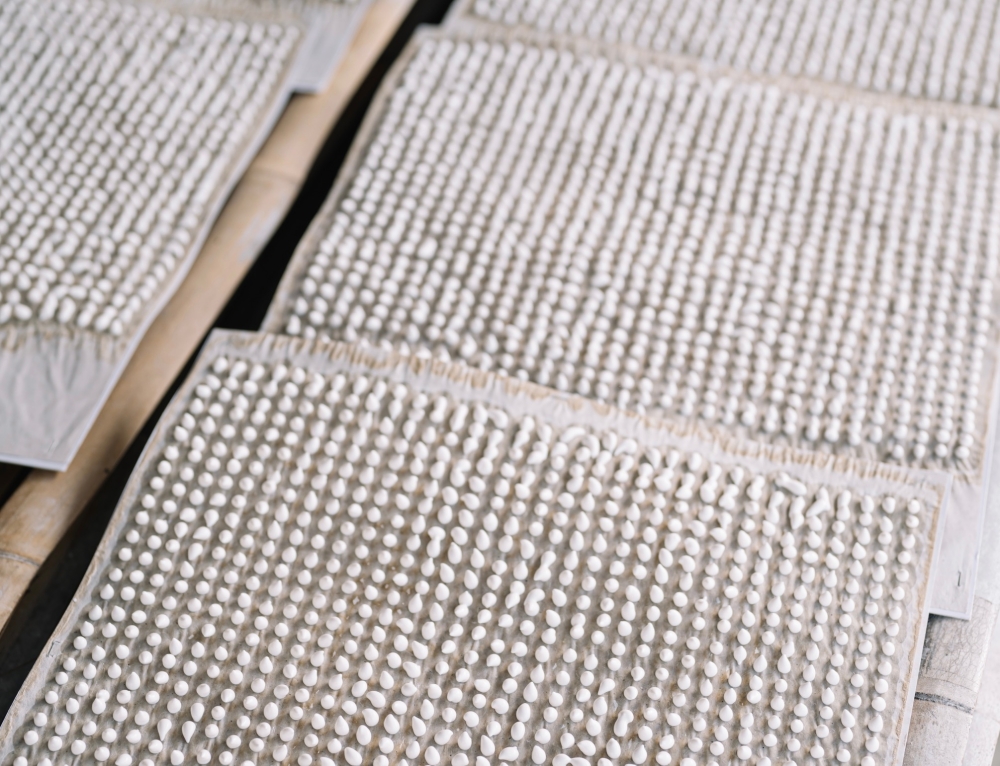
The granules are arranged in rows on trays and dried under direct sunlight for three days, with at least three hours of sunshine needed each day.
The process is highly dependent on the weather.
“If it is the rainy season, I have to wait for sunny days to dry the granules. If it rains for too many days, the batch may grow mould and I would have to discard it and start all over again,” he said.
Once fully dried, Yeoh uses a fan to remove dust before sieving the granules again to separate out crushed pieces and powder.
The finished granules are then bottled and sent to retailers.
“I have sent my products for laboratory testing to ensure the quality remains good and that they are safe for use on the skin,” he said.
Yeoh packs about 100 bottles a day, but completing a single batch can take at least 40 days, sometimes longer, depending on the weather.
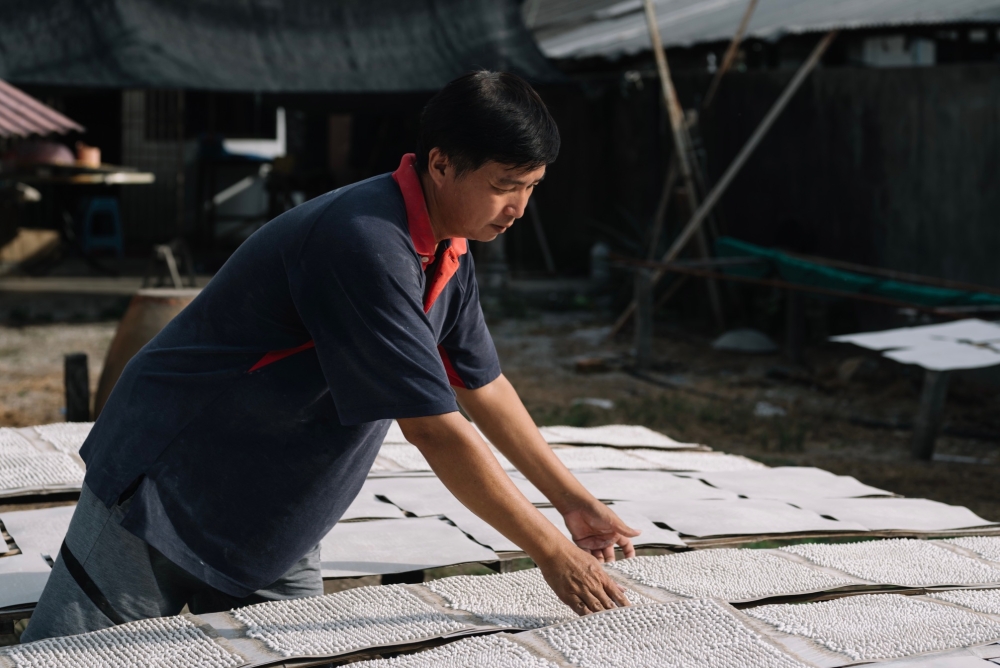
Traditionally used as part of a skincare routine, bedak sejuk continues to be used in much the same way today.
Each bottle retails for RM8, which Yeoh said brings in only enough revenue to cover costs and provide him with a modest living.
“I continue doing this because it is a traditional craft passed down by our ancestors that should be preserved,” he said.
“It is a lot of work and hard labour, and I am definitely not becoming rich from it,” he added.
Yeoh is single so he hoped that his nephews or nieces may one day be interested in taking over the business in future.


