


PUTRAJAYA, Aug 16 — Incidents of fallen trees in Malaysia can no longer be considered isolated incidents that only occur during the rainy season; instead, they require a preventive approach that is more systematic through regular safety audits, inter-agency data sharing and consistent maintenance.
Malaysian Fire and Rescue Department (JBPM) statistics show that 26,001 cases of fallen trees were recorded nationwide from 2021 to June, last year, resulting in 50 fatalities and 243 injuries.
Its director-general, Datuk Seri Nor Hisham Mohammad said that emergency calls related to fallen trees remain consistently high, ranging between 4,400 and 5,200 cases per year, while for the first half of 2026 alone, 1,912 cases were recorded.
“During that period, the incident of fallen trees resulted in 50 deaths and 243 injuries, while 360 victims were successfully rescued without injuries.
“This data shows that although the number of cases has not consistently increased, the occurrence of fallen trees still poses a serious risk to public safety,” he told Bernama.
The media had reported that the Maran Umno Youth chief was among the four who perished in a fallen tree incident on Jalan Lama Bentong heading towards the Janda Baik entrance, Bentong, on Aug 3. On July 19, a 43-year-old man died after the car he was driving was crushed by a fallen tree near the Singapore Embassy on Jalan Tun Razak, Kuala Lumpur.
Nor Hisham said that among the main factors identified as causing tree falls are thunderstorms accompanied by strong winds and heavy rain, especially during the monsoon transition phase.
Continuous rain can cause the soil to become saturated and reduce the stability of the tree’s root system, thereby increasing the risk of the tree falling.
“In addition to weather factors, the physical condition of the trees such as old, diseased, decayed trees or those with weak root and branch structures also contribute to the occurrence,” he said.
A recent investigation by the Penang City Council found that the cause of the 90-year-old angsana tree that fell on Jalan Macalister, Penang, on Aug 3 was due to rotting roots, cavities at the base of the trunk, chronic soil compaction and limited root space.
“JBPM views that tree falls are usually not caused by a single factor, but rather involve a combination of various factors including weather, the physical condition of the tree, and the level of maintenance,” he said,
He said that JBPM supports the implementation of regular tree safety audits and assessments, especially in high-risk areas such as main roads, schools, hospitals, public parks, residential areas, and locations with high foot traffic.
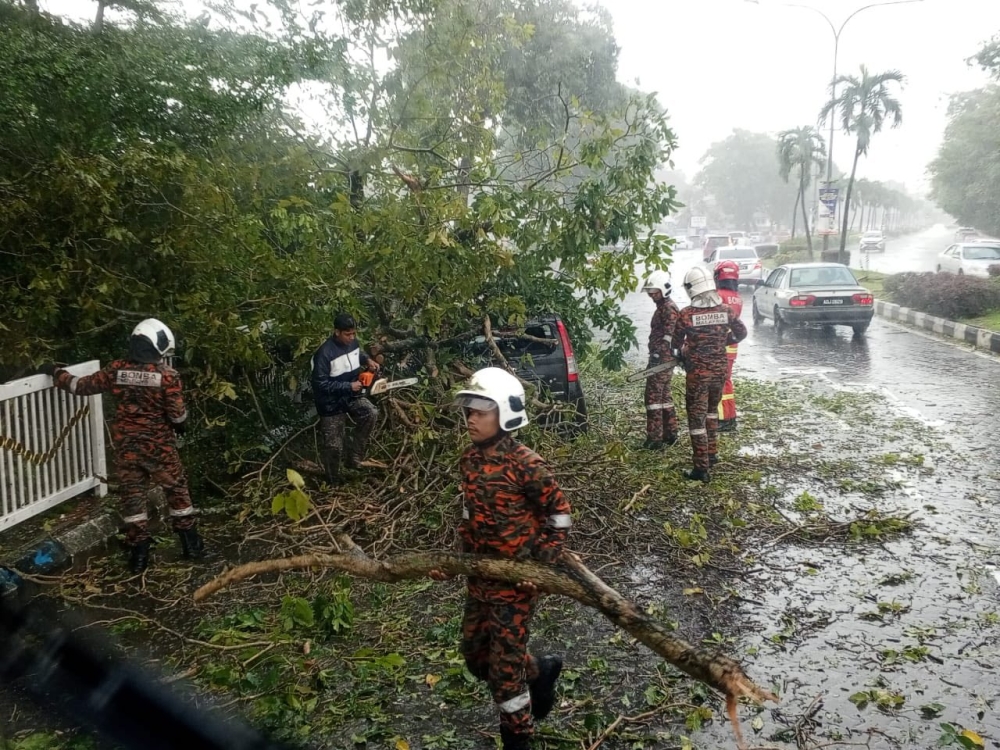
“The audit needs to be conducted by the local authorities (PBTs), the premises owner, or the responsible agency, involving qualified officers or experts. The inspection should include the condition of the trunk, branches, canopy, root system, tilt level, signs of decay, diseases, and the impact of development work around the tree,” he said.
“Trees that have been identified as high-risk need to be acted upon immediately, such as pruning, treatment, support installation, or controlled felling if they pose a threat to public safety.
“JBPM believes that regular audits allow early signs of tree structure failure to be identified before incidents occur, thereby reducing the risk of injury, loss of life, property damage, and disruption to public pathways,” he said.
He said that although the management and maintenance of trees fall under the jurisdiction of the relevant parties, the JBPM is ready to cooperate in terms of sharing incident information, identifying locations where incidents frequently occur, and coordinating preparedness for adverse weather conditions.
In an effort to strengthen prevention, Nor Hisham suggested that the sharing of data on fallen tree incident locations recorded by JBPM be fully utilised by local authorities to identify areas where incidents frequently recur.
“Other collaborations that can be strengthened include mapping high-risk areas, joint inspections, coordinating actions before the monsoon season or periods of bad weather, and faster reporting channels,” he said.
Commenting on operational readiness, Nor Hisham said that JBPM has sufficient personnel, machinery, and equipment to handle fallen tree incidents on a normal and localised scale.
“JBPM also collaborates with local authorities, the Royal Malaysia Police (PDRM), the Malaysian Civil Defence Force (APM), utility companies, the Public Works Department (JKR), and related agencies to expedite tree removal, traffic control, and ensure the safety of the incident area,” he also said.
He also advised the public to always be alert to weather forecasts and warnings issued by METMalaysia through the official website, the myCuaca app and official social media channels. — Bernama


