


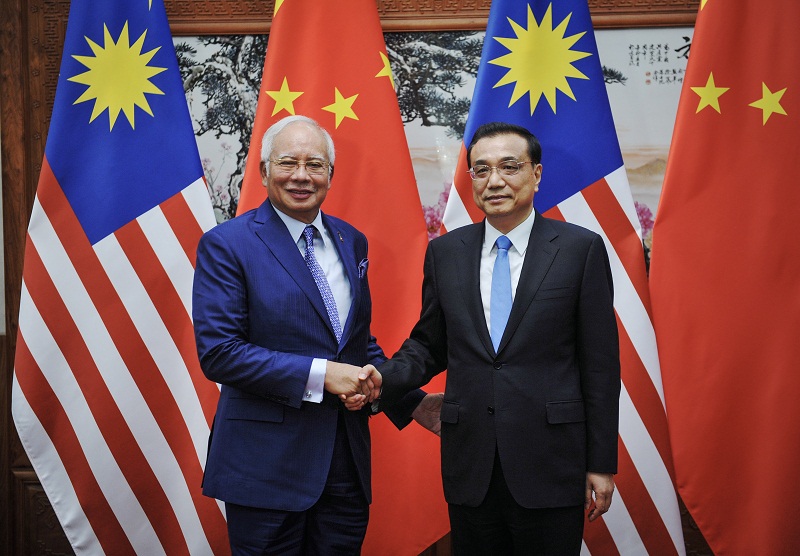
PETALING JAYA, Jan 8 — Leaders from communist China had offered the former Barisan Nasional (BN) government under Datuk Seri Najib Razak a deal to bail out 1Malaysia Development Berhad (1MDB) in return for contracts here that would further its ambitious “One Belt, One Road” agenda, according to the Wall Street Journal (WSJ).
In a report today, the US-based news outlet cited previously undisclosed minutes from meetings between Malaysian and Chinese officials as well as sources from the new Pakatan Harapan (PH) administration for China to use its power and influence to gain more information on 1MDB investigations as well as get them called off.
“Notes from that meeting said Malaysia was working to enhance bilateral ties, citing support Mr Najib voiced for China’s position in the South China Sea during a regional summit in Laos.
“Two months later Najib went to Beijing and signed the deals. Together with other projects, they made Malaysia the second-biggest recipient of One Belt, One Road funding after Pakistan,” the daily wrote.
The WSJ article by Tom Wright and Bradley Hope — the authors of Billion Dollar Whale — also reported clandestine talks between then prime minister Najib and Chinese officials to allow naval ships from China to dock at Malaysian ports.
It also reported that within months of China’s offer, Najib signed US$34 billion worth of rail, pipeline and other deals with Chinese state firms that were to be funded by Chinese banks and built by Chinese workers.
Two people familiar with the discussion told the WSJ that Najib allegedly held secret talks with China to let its naval vessels dock at two Malaysian ports, which would have been pivotal for the superpower’s ambitions in the region.
However, this arrangement did not ultimately materialise.
The WSJ also reported US officials as asserting that China was using the Belt-Road initiative to hold sway over developing nations and trap them in debt while advancing its geopolitical aims.
Several countries, including Pakistan and the Maldives, have been reviewing One Belt, One Road projects amid allegations that some deals unfairly advanced Beijing’s interests.
Minutes purportedly of Chinese-Malaysian meetings further showed that although the projects’ purposes were “political in nature” — to settle 1MDB’s debt — it was imperative the public viewed them as commercial pursuits.
“Documents reviewed by the Journal show Malaysian officials suggested that some of the infrastructure projects be financed at above-market values, generating excess cash for other needs.
“Investigators from the current Malaysian government, which replaced Mr Najib’s last year, believe some of the money helped Mr Najib finance his political activities and cover maturing debts of 1MDB, a fund he set up in 2009 to finance local development,” the WSJ reported.
Najib has insisted that the deals were above board and beneficial to Malaysia by way of job creation and economic stimulus.
After Pakatan Harapan formed the federal government, Prime Minister Tun Dr Mahathir Mohamad swiftly put the Chinese projects on hold.
The Mahathir administration has also cancelled at least two such projects and is still trying to terminate the East Coast Rail Link that is seen as the flagship project of the Belt-Road initiative here.
Najib is currently on trial for corruption, money laundering, and criminal breach of trust offences related to 1MDB, as are several members of his administration.
China announced its ambitious multi-trillion One Belt One Road initiative in 2013, ostensibly to recreate a modern-day Silk Road, but the programme remains hobbled by suspicions that it is a vehicle for Chinese neo-colonialism.


