


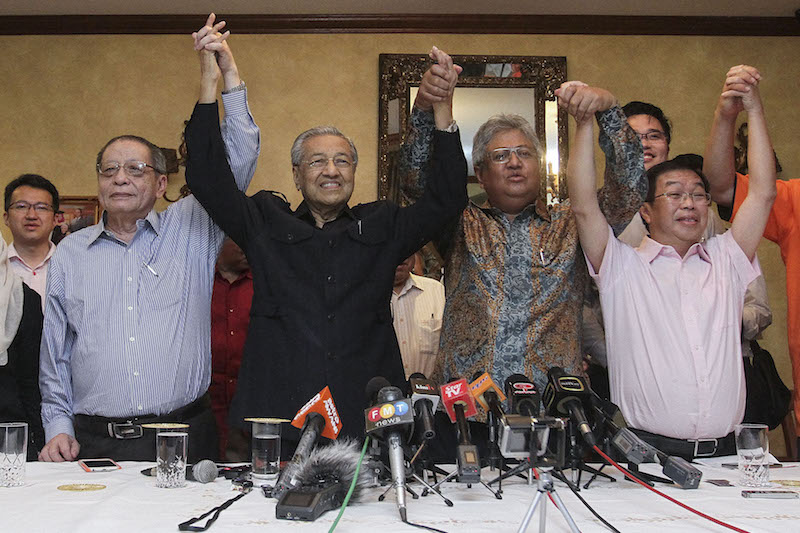
KUALA LUMPUR, Feb 9 — Datuk Zaid Ibrahim’s entry into DAP is unlikely to help the party tap into the rural Malay electorate despite being a former minister from the community, according to political analysts .
They explained that Zaid — formerly of Umno, PKR and Kita — was viewed as a “liberal” Malay politician, whose appeal would likely cover the type of voters who were typically sympathetic to DAP’s cause.
“DAP already has progressive Malays. So I do not think it (Zaid's entry) will have any significance in terms of changing the perception of rural Malays towards DAP,” Faisal Hazis, associate professor at Universiti Kebangsaan Malaysia’s Institute of Malaysian and International Studies, told Malay Mail Online when contacted.
Although DAP should be applauded for trying to present a more multi-ethnic membership, its appeal to the urban, progressive crowd remains unchanged, he said.
Faizal added that what the predominantly Chinese party required was Malay leaders who resonated more strongly with the rural voters.
PKR’s Rafizi Ramli had, on the day Zaid announced his entry into DAP, raised concerns that the Malay community distrusted the opposition due to its leaders who talked down to them.
“Instead of echoing the concerns of rural Malays, the Malay leader who joins DAP sounds like the rest of the other leaders who cater to an urban narrative.
“You need a Malay leader who can easily relate to the rural Malay crowd, not talk to them by looking down at them, someone who doesn't criticise Malays and their love for hudud in a certain way,” Faisal added.
Like his new party, Zaid has caustically spoken out against hudud and PAS's plan to enhance the powers of the Shariah courts in Malaysia.
He has likened the Islamist party to the Taliban, regularly excoriates their effort to further Islamic rule via his blog, and is unlikely to be the source of any rapprochement between DAP and PAS.
The academic said that, ultimately, DAP still needed a Malay-based party like PAS or Parti Pribumi Bersatu Malaysia (PPBM) to partner with heading into the next general election.
“Based on political reality for DAP, for them to have any significant impact on rural Malays, (they) need to join forces with PAS, [PPBM]. These are the agents of change you want to use heading into the next GE,” he explained.
Zaid's history of party-hopping should also be a concern for DAP, according to Faisal who said it would invite doubts over the former’s commitment to his latest party.
PPBM chairman and former minister Tun Dr Mahathir Mohamad voiced similar sentiments on the day Zaid signed on with DAP, saying in jest that he hoped the latter would “stay a little longer” in DAP tha his previous parties.
“I am not surprised if he (Zaid) joined and left, someone with his character.... I am not not looking down on him, but a person with this kind of character, you expect him to connect to rural Malays? That itself is a big challenge.
“If you have certain principles, you need to have certain amount of loyalty to the party,” he said.
Oh Ei Sun, adjunct senior Fellow at the S. Rajaratnam School of International Studies in Singapore, also noted Zaid’s lack of appeal within the rural community, and said this predates his switch to the opposition.
“Despite being from Kelantan, Zaid was never strong [or] popular among the rural Malays at all. So I wonder what DAP got out of this,” he told Malay Mail Online when contacted.
Like Faisal, Oh also predicted that Zaid’s foray into DAP would end in much the same was as his stints with Umno, Parti Kesejahteraan Insan Tanah Air (Kita) and PKR.
“His personal ego must be quite expansive,” Oh added.
But other analysts cautioned against writing Zaid off, saying his entry into DAP could still help shape the perception that the party is a Malaysian party instead of a Chinese-centric one.
Ooi Kee Beng, deputy director of Singapore's ISEAS-Yusof Ishak Institute, added that Zaid’s actions during the Abdullah administration had earned him an image of integrity, which could be used to cement existing support for the Opposition.
“Zaid Ibrahim’s history of leaving parties and positions for moral reasons provides him with a reputation of being straightforward and honest.
“His joining the DAP says that he is giving the party a chance and that he sees membership in the party as his best bet in trying to change Malaysian politics,” Ooi told Malay Mail Online.
He added that party loyalty in Malaysian politics was not an accurate measure of character but more of a result of communal politics.
“The gang mentality involved in such loyalty is not something that should be exalted blindly,” Ooi said, commenting on Zaid's history of switching political parties.
Centre for Policy Initiatives director Lim Teck Ghee said Zaid will appeal to the younger generation of Malaysians and be seen as a “moderating influence.”
“I see his political impact as potentially significant. This assumes that he stays the course and works with the party's different interest groups.”
Under Umno, Zaid had been law minister during the administration of Tun Abdullah Ahmad Badawi in 2008, but resigned from the post the same year to protest a spate of arrests under the Internal Security Act 1960, resulting in suspension from the ruling party and his eventual exit.
The next year, Zaid joined PKR, and went on to contest the Hulu Selangor by-election in 2010. He lost to Barisan Nasional’s Datuk P. Kamalanathan, who is now deputy education minister.
He quit PKR later that year after pulling out of a race for the party’s deputy president post and formed Kita, but later stepped down as its president in 2012.


