


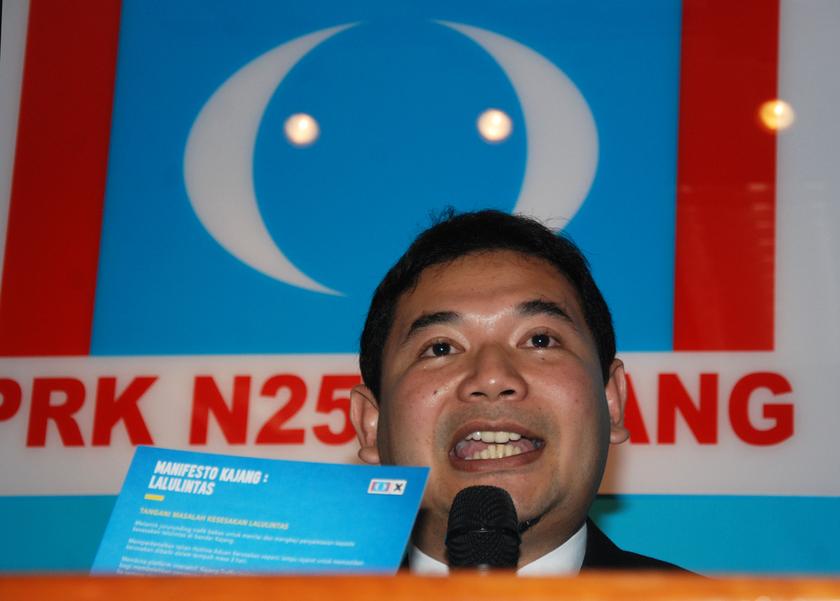


KUALA LUMPUR, Nov 24 — The federal government’s move to roll back on fuel subsidy and to revert to a managed float system to determine the price of RON95 and diesel does not alleviate the burden of people, said an opposition lawmaker today.
Instead, PKR’s Rafizi Ramli claimed the managed float system adopted by Putrajaya still guarantees the profits of oil companies and petrol dealers of up to 30 sen per litre.
“Therefore, in an open market, oil companies use MOPS only, so it is up to them to deal with their competition and sell cheaper,” said Rafizi, at a press conference at the Parliament lobby.
The Pandan MP was responding to Youth and Sport Minister Khairy Jamaluddin’s defence of the floated pricing mechanism.
“Khairy tweeted that the price of petrol and diesel will be determined by the managed float system, as if that is the answer to all the angst and criticism,” Rafizi said.
He insisted that the float price system does not justify the removal of the fuel subsidy, adding that the minister’s statement showed the Barisan Nasional government was lopsided in favour of large corporations.
“If the federal government is going to allow fluctuation and remove the subsidy, it should also then do away with the protection given to the oil firms.
“Not only do we have to pay the fluctuations in petrol and diesel prices but we have to guarantee the profits of oil companies as well,” he said.
Guaranteed profits was introduced in the 1980s under automatic pricing mechanism (APM) to protect both, oil giants and Malaysians, against the fluctuation in the global crude oil market, among other reasons.
The Pandan MP explained that the countries that practised the open market system based their pricing through the Means of Platts Singapore (MOPS).
MOPS is a mechanism devised by commodity information company, Platts, based on the daily average price of petroleum product transactions that go through Singapore and is preferred to the NYMEX crude oil prices as it reflects the bids, offers and trades determined by buyers and sellers in the open market.
* NOTE: An earlier version of this story had inaccurately described MOPS as a measure where the fuel price is determined by the oil traded through Singapore and in which the oil companies’ profits are taken into account, with the balance left to the market to determine. The error has since been corrected.


