




KUALA LUMPUR, Dec 26 — With Thailand again in upheaval and Singapore stunned by rare riots, Malaysia’s place among the Economist Intelligence Unit’s (EIU) list of countries with the lowest danger of social unrest next year may not guarantee a trouble-free 2014.
In an entry under its Cassandra global forecast series this week, The Economist noted that strife arising from economic uncertainty was now increasingly regular and beginning to creep into countries once thought beyond political turmoil.
“Even places traditionally more muted, such as Japan and Singapore, have seen demonstrators in the streets. Social inequalities and political discontent have spurred citizens to gather. Resistance can be co-ordinated with greater ease than ever in the age of the smartphone,” it said in an entry titled “Protesting Predictions”.
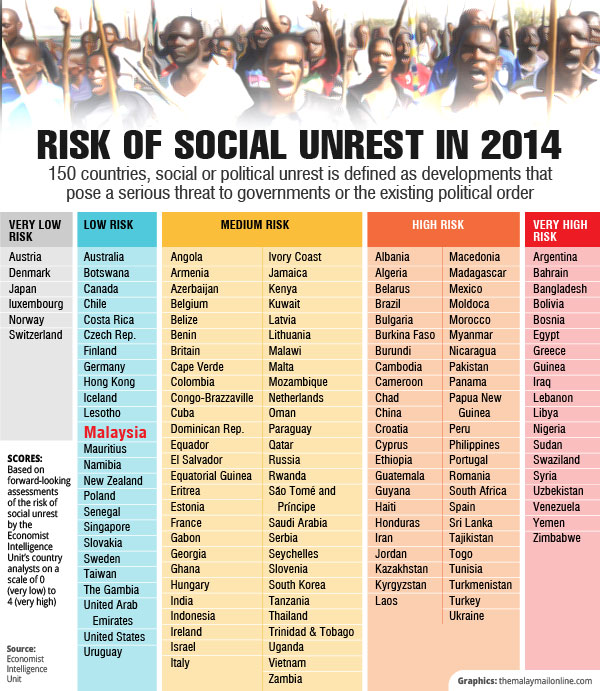
Citing a previous report by its EIU independent research arm that predicted the likelihood of rebellion in over 150 countries worldwide, the London-based business weekly reiterated that declining wages and unemployment combined with factors such as wide income-inequality, poor government, low levels of social provision, ethnic tensions and a history of unrest made for a recipe for rebellion.
In the original report, Malaysia was among 22 countries such as Australia, Canada, Singapore and the United States that faced little risk of unrest in 2014.
But the examples of Japan and Singapore above, and the growing protests sweeping through Thailand now has moved The Economist to call into question the reliability of forecasts such as that made by the EIU.
“Thailand was identified as only being at ‘medium risk’ but in recent days protesters have surrounded the house of the beleaguered prime minister Yingluck Shinawatra. Demonstrations started in November, after a controversial amnesty bill passed Thailand’s lower house,” it noted.
Yingluck was forced to concede to a general election to try and soothe the protesters, but a boycott by the Thai opposition has raised the question of whether this will put an end to the conflict.
Earlier this month, straight-laced Singapore was also rocked by the first case of violent civil unrest in the republic for more than four decades, when over 400 foreign workers rioted in the Little India district after a Bangladeshi national was killed in a bus accident.
Although protests in Malaysia were plentiful in the days following Election 2013, these have since faded as Malaysians returned to their daily lives after the closest and most divisive general election in the country’s history.
But a recent series of subsidy cuts, tariff hikes and accompanying price increases appear to have again stoked the embers of discontent among Malaysians already straining under the burden of rising costs and stagnant wages.
On the opposite side is an administration that put in place a Peaceful Assembly Act ostensibly to allow Malaysians greater liberty to gather, but has shown a marked sensitivity to any protests that are considered anti-establishment in nature.
 On Tuesday, police arrested the leader of a group planning to rally in protest of the recent price increases and are investigating him over the event supposedly planned for New Year’s Eve and an alleged plot to overthrow the government.
But the authorities’ concern may not be entirely unfounded, if the EIU’s readings are to be believed.
“The recession is now over or has eased in much of the world. Yet political reactions to economic distress have historically come with a lag. Austerity is still on the agenda in 2014 in many countries and this will fuel social unrest.”
Since September, Putrajaya has embarked on aggressive cost-cutting measures after pressure grew for it to rein in a chronic budget deficit that traces back to the Asian Financial Crisis of 1997 and which has left Malaysia’s national debt at just below a critical legal ceiling.
It has pledged to bring its overspending down from around 5 per cent of gross domestic product now to 3 per cent by 2015.
Among others, it has reduced fuel subsidies, removed price control for sugar, allowed an increase in electricity tariffs and confirmed the introduction of a new goods and services tax all within the space of four months.
Kuala Lumpur residents are also in line for an assessment increase after valuations of their properties were doubled or tripled in some cases, while public transport charges in the Klang Valley are also set to go up next year.


