


KOTA KINABALU, Sept 14 — For North Borneo stamp collector William Wang, 67, the hobby known as the “King of Hobbies” is more than collecting pieces of paper, offering a way to explore history, knowledge and the evolution of society.
His passion began at the age of 10, encouraged by his father, a school principal, as well as through exchanging stamps with school friends.
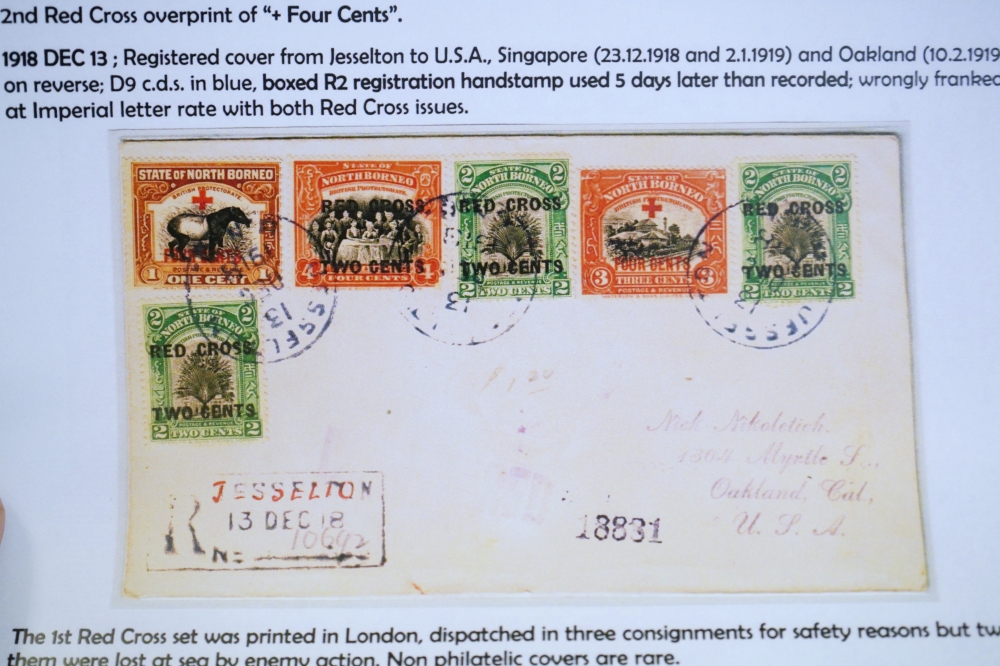
His main collection comprises North Borneo stamps issued from 1883 to 1963, alongside old envelopes, postcards, postmarks and a pre-stamp entire issued in 1845, before North Borneo produced its first stamps.
“There is something very therapeutic about this hobby in the 21st century because philately offers physical relief from constant digital fatigue.
“Sitting at a table with a stamp tweezer, a magnifying glass and a collection of historical envelopes requires focus, patience and curiosity, allowing us to study and delve into history without the distraction of digital screens,” he told Bernama.
William, who is also a member of the Malaysian Philatelic Society (PSM), said two-cent North Borneo stamps were used for sending letters throughout Sabah, including to Singapore, Malacca, Penang and Hong Kong, from 1883 to 1891.
For letters sent to the United Kingdom (UK), senders had to use Straits Settlements stamps, which could be purchased at post offices in Elopura, Kudat and Gaya.
“A stamp is not merely a receipt for postage; rather, it is a small window into the past, capturing art, history, geography and human stories on a small piece of paper,” he said.
His passion for philately has also taken him to exhibitions in countries including Indonesia, New Zealand, Uruguay, China, Brazil and Thailand, with him funding the trips himself.
In August last year, William received a Large Gold Medal for his exhibit, The Postal History of Labuan & North Borneo Before and Under Chartered Company Rule, at an exhibition in Bangkok, Thailand.
In February that same year, he also received a Large Gold and Special Award in Uruguay, making him the first Malaysian to receive the recognition under the Fédération Internationale de Philatélie (FIP).
The achievement drew the attention of Communications Minister Datuk Seri Fahmi Fadzil, who conveyed his appreciation and congratulations in a 45-second video message.
William, who is a member of the Malaysian Philatelic Society (PSM), began exhibiting his stamps in 2013 and won a Large Gold and Special Prize at the Tri-Nation Stamp Exhibition Malaysia before becoming active on the international circuit.
After retiring from the private sector, he now focuses on writing, organising, studying and preserving his collection, while sharing information through the North Borneo Philately Facebook page, which has about 34,000 followers.
He said one of the basic ways to determine a stamp’s authenticity is by examining its colour and perforations, or “stamp teeth”, which are the protruding edges left after a stamp is separated from a sheet.
William said his North Borneo stamp collection had also been authenticated by The Royal Philatelic Society London, confirming its historical and philatelic provenance.
He obtains items for his collection not only while in the UK but also through auctions, where each piece must be carefully assessed for its condition, history and authenticity.
To preserve the collection and prevent its colours from being affected by weather conditions, he replaces the stamp hinges every 10 years.
William said fewer than 10 Malaysian collectors usually participate in international philatelic exhibitions, and expressed hope that more young people would discover philately as a hobby with historical value.
“This hobby adapts to whatever interests and arouses a person’s curiosity,” he said, expressing hope that more stamp exhibitions would be held in Sabah to revive the world of philately. — Bernama


