


KUALA LUMPUR, Aug 12 — Seeing grown adults, especially teachers, cheering loudly at public gatherings that have to do with education was not on my expected agenda.
The teachers I grew up with maintained decorum for the most part but the excitement at the Apple Education event at the Hyatt Regency Kuala Lumpur at KL Midtown was palpable.
What is often ascribed as the “halo effect” surrounding Apple’s brand is strong even among educators but how much of it is warranted?
Studying teacher satisfaction
A study that came out this year surveyed teachers in eight countries in the Asia-Pacific (APAC) region, namely: Australia, Indonesia, Japan, Malaysia, Singapore, South Korea, Taiwan, and Thailand.
The study involved 10,995 teachers and was conducted online by a third-party research panel from August 25 and October 1.
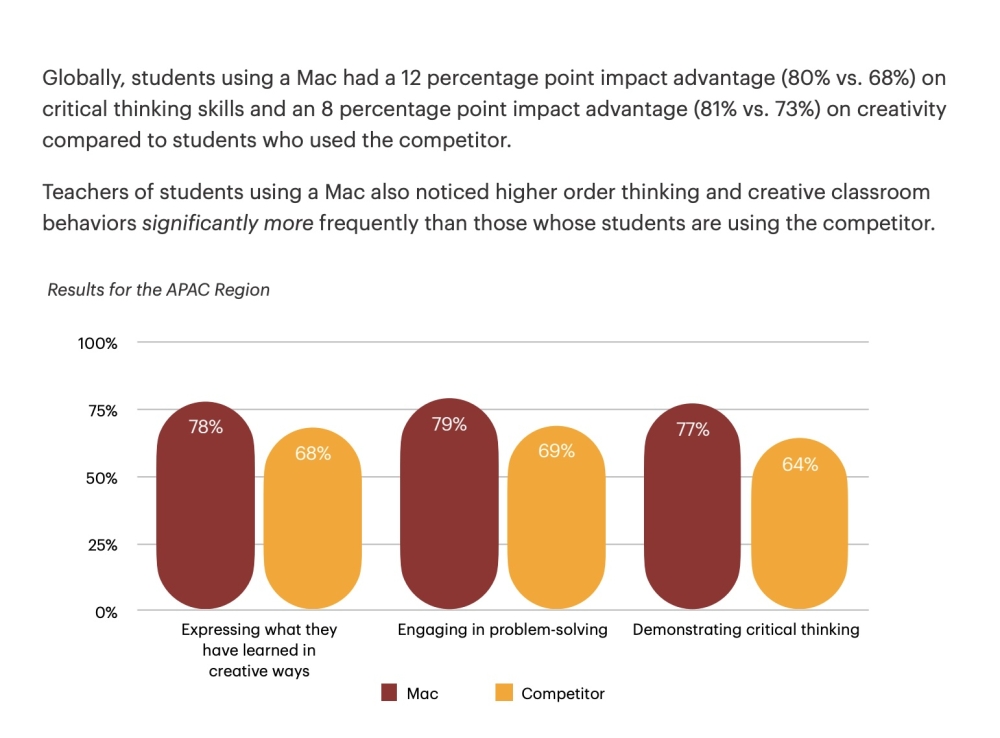
A large majority of the APAC teachers surveyed, 90 per cent, said of the Mac that it had a “positive impact” on their students with the Mac having a 5-point advantage in overall positive impact versus the competition.
This advantage held in both private and public schools.
Another interesting takeaway from the study is over 80 per cent of the teachers surveyed saying that the Mac contributed positively to creativity as well as higher-order thinking.
“In particular, the perceived impact on students using critical thinking skills and developing creative skills was significantly more positive for Mac than it was for the competitor,” the study noted.
A tool to encourage and not inhibit learning
In an age where generative AI, in particular large language models (LLMs), has become a hot button topic in general and not just in the education sphere, I was very keen to know where Apple stood.
I had a chat with Apple’s worldwide product marketing senior director for education Dominic Liechti and he was quick to disabuse any notion of Apple’s tech replacing, instead of encouraging, thinking.
Liechti said,”We definitely believe that students still need to write their first draft. And maybe then using AI to challenge the assumption or the thesis as a thought partner.”
He said that it was not about replacing basic skills such as reading, writing or math, which are still critically fundamental to learning.
Instead, he said Apple creates a framework where both teachers and students can more thoughtfully apply AI.
“What we’re creating in our new programmes is like a framework, where like, hey, think about this when you’re planning AI lessons, how you prompt for example.
“Students, they don’t know what they don’t know, right? They may be typing in something but they don’t know if this is right or wrong,” he said.
Instead, he says AI could be a launching pad where they could start off their research with AI but still seek out books, go to the library to verify what they got from prompts.
“And that,” he said, “That could be a good critical thinking exercise.”
Liechti went on to elaborate on Apple’s loftier views on technology.
“We deeply believe when technology is infused with humanity, it can change people’s lives.”
A gift horse must still be examined
The high level of engagement and enthusiasm in relation to Apple technology in the classroom (according to the study as well as my own observations of classrooms and teachers using Apple tech) is notable.
Yet I must concur with researcher Steven Lewis’ own thoughts in his paper An Apple for teacher (education)? Reconstituting teacher professional learning and expertise via the Apple Teacher digital platform.
He rightly notes that the free services offered by Apple in its education offerings “should not be seen simply as a neutral means for facilitating and curating teacher professional collaboration and dialogue."
“Within the diverse marketplace of teacher education, Apple is instead increasingly becoming just another ‘accredited’ service provider, but with the unique distinction of being able to leverage its global brand recognition to compellingly promote its own vision of teacher knowledge and expertise.”
It cannot be denied that Apple’s offerings in the technology and software space for education are in an enviable position — with the perception of their tools “just working” and being more reliable as well as more accessible than the competition.
In an ideal world the education space would be technology neutral, especially where tech names are concerned.
There is also the troubling question about whether if there is superior technology available, will the students or teachers who are unable to leverage said technology for whatever reason be unfairly left behind?
In the Malaysian context, however, there is still some wiggle room -- entry level iPad pricing has remained fairly competitive and the relative affordability of the MacBook Neo also makes it less of a financial stretch compared to more expensive Apple devices.
While on paper, a cheap Android tablet can be had for a few hundred ringgit and a Chromebook is also far cheaper but both devices have their own limitations.
Perhaps one of the smarter things Apple has done is to “give away” its operating system and the apps it comes with, making entering the ecosystem a more compelling choice even if there is a higher price of entry.
The best things in life can’t always be free but Apple demonstrates that its platform and hardware have enough of a value proposition in the education space to please even one of the toughest of crowds — teachers and their students.


