


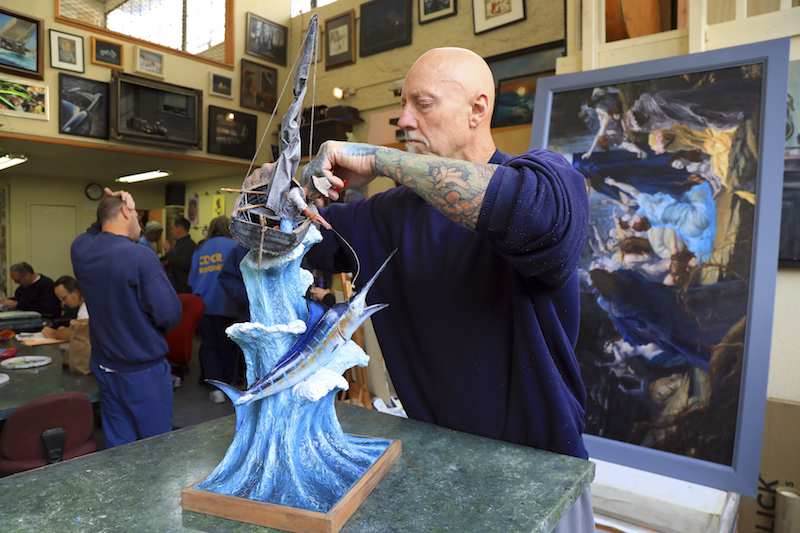
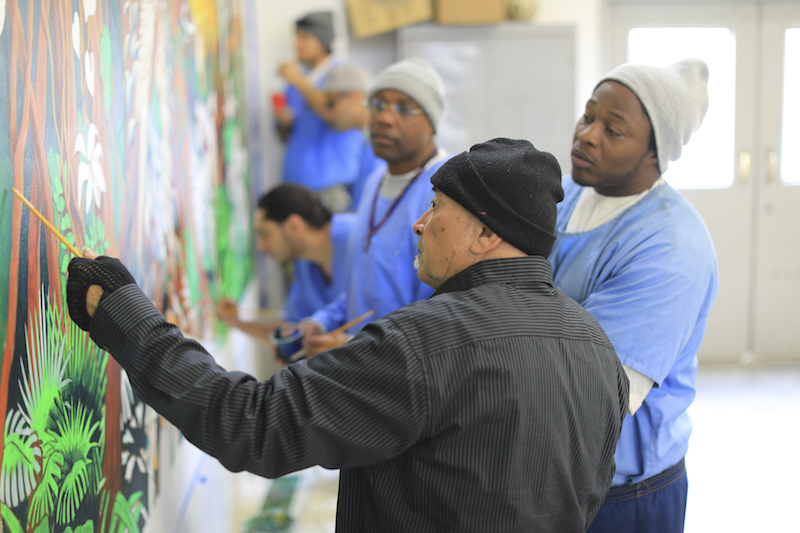
SOLEDAD (California), April 3 — More than most artists, the men who gather twice a week for mural class in the B Facility are accustomed to darkness.
But the scene they are creating — a tropical rainforest — requires colour and light, elements in short supply at Salinas Valley State Prison.
“I don’t have much of a legacy,” Jeffrey Sutton, who is serving 41 years for armed robbery, said of his life. “This is something positive that helps me focus on getting out,” he added, daubing flecks of green onto the leaves of a jungle vine.
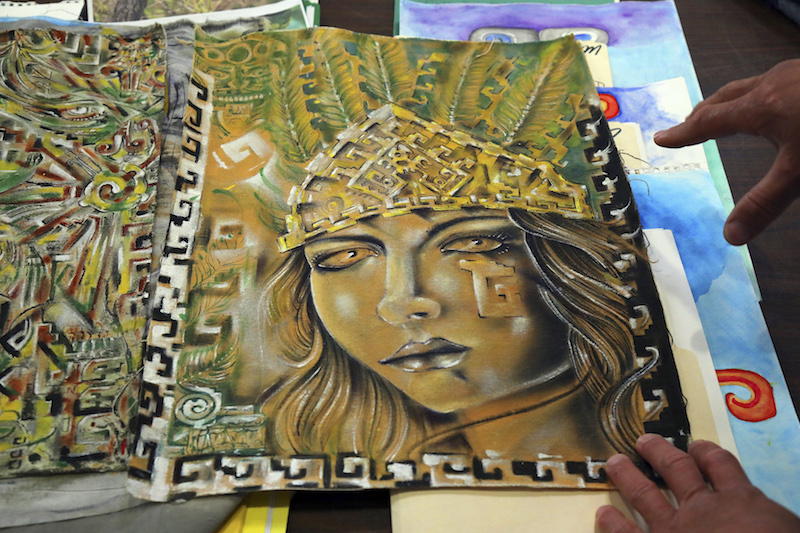
The mural class for high-level offenders is part of a new initiative by the state of California to bring the arts — including Native American beadwork, improvisational theatre, graphic novels and songwriting — to all 35 of its adult prisons, from the Richard J. Donovan Correctional Facility near the Mexican border to Pelican Bay, the infamous supermax just shy of the Oregon line.
In a political climate in which federal arts agencies are under siege, the state has allocated US$6 million (RM26.6 million) annually for the Arts in Corrections programme, a figure set to rise to US$8 million next year.
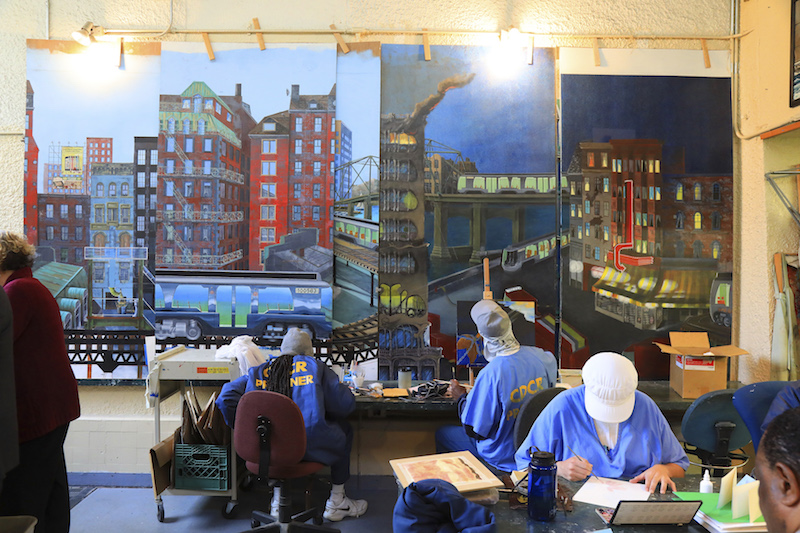
Scott McKinstry, 47, convicted of second-degree murder and firearm possession, has spent seven of his 51-years-to-life sentence designing a 16-panel homage to urban life. His fanciful mural, intended to brighten the walls of the chow hall, teems with mansard roofs, neon signs, Victorian houses and other details inspired by the Japanese-born painter he admires, Hiro Yamagata. His project, along with anger management classes, has helped McKinstry understand “why things bug me and why I ended up here,” he said.
“A lot of guys in prison don’t have a sense of self-worth,” he continued. “It helps you grow as a human being to say ‘Hey, I can do something.'”
Survivors of crime have their own distinct view of the justice of such programmes. “These classes shouldn’t be solely for enjoyment purposes,” said Dionne Wilson, the widow of Nels Daniel Niemi, a police officer who was fatally shot 12 years ago in San Leandro, east of San Francisco. “I’d like to see them coupled with a deeper discussion about acknowledging the harm they caused,” said Wilson, a survivor advocate for the Alliance for Safety and Justice, a national organisation dedicated to public safety and criminal justice reform.
Art’s presence in prisons is ages old: Visiting Philadelphia in 1842, Charles Dickens admired a Dutch wall clock with a vinegar-bottle pendulum made by a prisoner.
The California initiative coincides with a series of reforms that began in 2011, when the US Supreme Court ordered the state to reduce prison overcrowding.
“When inmates are triple-bunked in a gym, the last thing you’re thinking about is a Shakespeare programme or a mural class,” said Kristina Khokhobashvili, a corrections spokeswoman. The majority of the state’s roughly 117,500 inmates will eventually be released or have the possibility of parole. California voters have supported bolstering rehabilitation programming, which now comprises roughly US$396 million of the state’s US$11.3 billion corrections budget. As with climate change policies and other issues, California appears to be forging its own trail.
Arts classes alone do not change criminal thinking or behaviour but they can change behaviour within a prison, Mary Butler, president of the Chief Probation Officers of California, said. The Arts in Corrections project also has support from Governor Jerry Brown.
“The arts, through creative expression and discipline, help prepare inmates for their eventual return to society,” he said. “It’s a real opportunity for them to gain greater insight into their lives and their relationships.”
There is little scientific data to support arts programming in reducing recidivism, but Susan Turner, a professor of criminology, law and society at the University of California, Irvine, is evaluating the state’s new initiative for the William James Association, a non-profit specialising in arts programmes in non-traditional settings, to assess whether it positively affects resilience and self-awareness and if so, why. “Art resonates,” she said. “People want to believe that the arts make a difference.”
Tom Lackey, a Republican state assemblyman who is a retired California Highway Patrol officer, has a prison in his district and visited a theatre programme there. “Six million is no joke,” he said of the state-wide funding. “It was, ‘OK, I’m going to watch this incredible waste of money,'” he said. Lackey said that he wasn’t prepared for the impact. “I could tell it was building morale and self-respect among inmates, which is hard to do. How do you measure the value of a person in dollars? This in an investment that yields a return.” — The New York Times


