


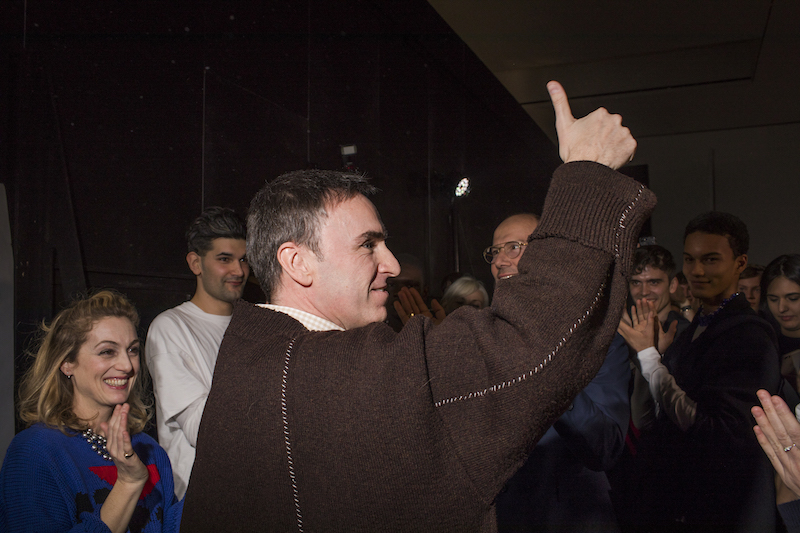


NEW YORK, Feb 9 — In a nondescript office building on West 39th Street, behind key-card-locked doors and a stack of nondisclosure agreements, Raf Simons is at work, rebuilding the house of Calvin Klein.
Calvin Klein’s is a name so famous as to have earned pride of place on underwear bands the world over. Maybe yours. Klein was, in the words of The New York Times, a “pop star” and “the first American designer to become household-name famous.” That name is synonymous with American fashion design in the 20th century, part of a small, one-name pantheon that includes Ralph (Lauren), Donna (Karan) and Oscar (de la Renta).
His forte was sportswear: easy, effortless clothes, later expanded to include blockbuster underwear and jeans. But you knew that. It was more than 30 years ago when a young Brooke Shields cooed that nothing comes between her and her Calvins. She did not need to specify which Calvin.
Simons, although by no means unknown, is not Calvin. His name, Raf (rhymes with “laugh,” with a rolled Flemish R), is invoked with adoration in high-fashion circles. But even after a successful stint as the artistic director of Christian Dior, he has arrived in New York with less name recognition among the public. His task is to bring energy and excitement back to Calvin Klein — and back, by extension, to New York fashion.
“I think it’s very exciting for New York to have someone of his calibre come here,” said Grace Coddington, the creative director at large of Vogue, who first came to the United States as a design director for Calvin Klein in the 1980s.
In recent years, New York fashion and especially New York Fashion Week have been dogged by a reputation for spotlighting both too much and not enough. The city’s relatively democratic show schedule packed a couple of hundred runway shows and presentations into a “week” stretching to eight days or more, but much of it has not been considered on par with what is shown in Milan or Paris.
“The New York shows have often felt slightly odd to the Europeans, I think,” said Gert Jonkers, a founder of the magazines Fantastic Man and The Gentlewoman, who has not attended New York shows in several years. “It’s a busy schedule, but with a lot of things that don’t speak to us. I won’t fly trans-Atlantic for one or two seven-minute shows. I know there are other shows in New York, but I just don’t feel the urgency.”
Simons, 49, considered one of the great designers of his generation, is well positioned to ratchet up that urgency.
From the obscure perch of his own Raf Simons menswear label, he won over critics in Paris in the late 1990s and early aughts. Cathy Horyn, then the fashion critic of The Times and one of Simons’ most enduring supporters, wrote in 2004 that in all her years reporting on fashion, she had “stood up from only a handful of shows with a conviction that everything had been transformed.” Simons’ was one. Yet he maintained such a low profile that when he was named the creative director of Jil Sander in 2005, many in the industry hardly knew who he was.
Simons breathed new life into Jil Sander, and after six years there, as Sander returned, he joined Dior, ascending to one of the highest mounts of Parisian ready-to-wear and haute couture. He stabilised Dior, rocked by L’Affaire Galliano — John Galliano, its previous designer, went on a drunken, anti-Semitic public tirade that cost him his job and tarnished Dior’s image — and won the support of consumers (sales rose 60 per cent under his tenure), the press and Hollywood. (It was one of Simons’ Dior gowns that tripped Jennifer Lawrence on her way to accept her Oscar.)
He left Dior in 2015, citing the breakneck pace required to keep up with so many collections and shows each year.
Yet the pace is only likely to quicken for Simons, who has relocated from Antwerp, Belgium, a city small enough that its fledgling designers count seeing him at the supermarket as a celebrity sighting, to Manhattan, with a mandate to revivify Calvin Klein. He has been given complete creative control, of a type not seen since Klein and his partner, Barry Schwartz, sold the company to the Phillips-Van Heusen Corp in 2002; Klein stepped down from design the next year.
Simons has oversight of all of the many categories and varieties of products that bear the brand name, from the high-end Calvin Klein Collection and the lower-priced apparel and accessories carried at malls and Macy’s, to underwear, jeans and fragrances (both for men and women), as well as home goods. As if this were not enough, he has imported his namesake Raf Simons menswear collection and keeps a studio for it in the Calvin Klein headquarters.
“New York definitely needs some excitement,” said Jennifer Sunwoo, the executive vice president and general merchandise manager for womenswear at Barneys New York.
Simons is, in a sense, an unusual person to provide it. He is serious, intense and soft-spoken, more discussed but less known by many in the fashion establishment than his more bombastic peers. He keeps close, nearly cloistered company, an inner circle that he has imported with him to Calvin Klein.
That includes devoted staff, including Pieter Mulier, his longtime No. 2 and now the creative director of Calvin Klein; Mulier’s boyfriend, Matthieu Blazy, the design director of women’s ready-to-wear; and Simons’ boyfriend, Jean-Georges d’Orazio, now a senior director of “brand experience.” He is also continuing to collaborate with artists like Sterling Ruby, who once worked with Simons on a collection and has been spotted at the Calvin Klein studios, and photographer/stylist duo Willy Vanderperre and Olivier Rizzo, friends from their days at the Royal Academy of Fine Arts in Antwerp, Belgium, who have worked with him on Calvin Klein’s new advertising campaigns.
Since Simons’ designs for the new collections are so tightly guarded that even many Calvin Klein staff members have not seen them, these ads are the only glimpse of what Calvin Klein could look like under his watch. (Simons declined to comment for this article.)
Advertising may seem an ephemeral marker of change, but few were as aware of its power and potential as Klein himself. Many of the ads the fashion world considers iconic were manufactured at Klein’s in-house CRK Advertising studio: Kate Moss, nude, at her heroin chicest; Mark Wahlberg, then known as Marky Mark, grabbing his groin through boxer briefs.
The new ad campaign, appearing now, features models in their underpants, just as many of Klein’s most provocative did. But Simons runs cool where Klein ran hot. In one shot, photographed at the Rubell Family Collection in Miami, they gaze, backs to the camera, at a canvas by Ruby. Klein’s models were barely contained by their Calvins, courting scandal and the occasional recall; Simons’ are gawky in the European high-fashion style and barely fill theirs out.
Another campaign, for Calvin Klein By Appointment, offsets dresses made to order — a sort of American sportswear version of couture — with flat shots of a pair of classic white Calvin Klein briefs.
“I thought it was interesting they put the underwear in every other photograph — the iconic thing he’s known for,” said Sam Shahid, the veteran art director who ran CRK Advertising during the ‘80s and early ‘90s. “But I’m not sure it’s Calvin. It doesn’t have the same sensuality or sexuality. It doesn’t have the physicality Calvin always had. It’s more like Raf Simons.”
Of course, more like Raf Simons is, in part, exactly what PVH, Calvin Klein’s parent company, wants. Simons has been handed the keys to the kingdom with the hope that he will reinvigorate a brand that, despite US$8.2 billion (RM36.4 billion) in sales in 2015, was seen by many as coasting and too diffuse.
It is one thing for luxury retailers to believe in Raf; it is another for the general consumer, who may not be aware of him. Calvin Klein Collection has historically received the bulk of press coverage and the spotlight offered by runway shows but accounts for a small percentage of the company’s sales.
“We used to joke that that whole business was smoke and mirrors,” said a former employee, who declined to speak on the record, citing continuing business relationships.
How Simons’ Calvin Klein will play out at retail will have to wait. Tomorrow morning, it makes its runway debut, as one of the most anticipated shows of New York Fashion Week.
“I definitely feel this is one of those moments everyone will look back at, seeing Raf’s first season showing,” said Humberto Leon, a founder of Opening Ceremony, which has teamed with Calvin Klein Jeans and Calvin Klein Underwear on projects in recent years.
Coddington is cautiously optimistic about the pairing. “All those houses that take on new people, it’s always a challenge and a gamble,” she said. “You just pray that it works for everybody.” — The New York Times


