


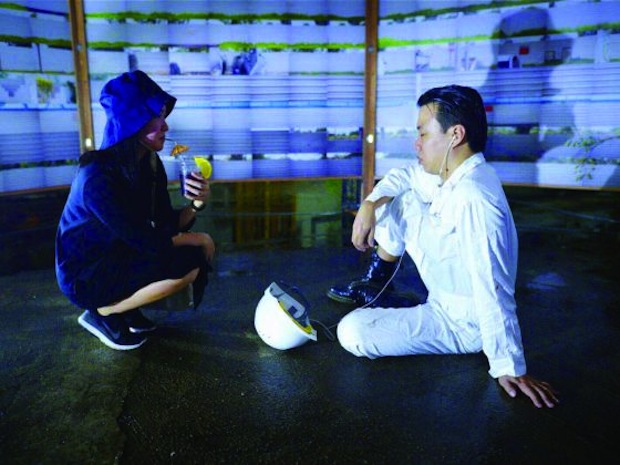


SINGAPORE, Jan 18 — Part of Singapore Art Week, the PPC: A Public Living Room is an exhibition held over three weekends at an unusual space at the open air carpark of People’s Park Complex.
Completed in 1973, People’s Park Complex was then an iconic structure and one of the tallest mix-used buildings in Chinatown that encompassed residential, office, shopping and car parking facilities.
It has been a decade since I last stepped foot here but time seems to have stood still for many of its tenants and shops. After making my way past crowds purveying Chinese horoscope boards and Chinese New Year goods on the ground level, I was greeted by raw, indie vibes on level six.
The exhibition, organised by Hyphen, tackles notions of blurred public and private spaces, while at the same time offers a new interpretation of the architecture and usage of the carpark and complex.
(Jason Lim’s installation, for example, uses kitchen utensils used by residents in the apartment above.)
Showcasing more than 20 visual and performance artists and music acts over three weekends, there are also workshops and tours.
On the breezy open deck the evening I visited, there was a motley group of visitors walking in tow with Professor Widodo (NUS Architecture, ICOMOS) who was leading them on a walk-through tour, expounding on deeper insights into the complex’s architecture. In another corner, a handful of visitors rested nonchalantly against an old railing around performance artist Ezzam Rahman.
Seated on a white sheet on the concrete floor, Ezzam’s fully-masked dark figure solemnly folds and places a white blanket, the slow and repetitive actions creating a silent black and white mise-en-scene of the forlorn, a displaced figure that complements the context and grey backdrop of the taller, surrounding buildings.
Alecia Neo’s Public Conversations was a series of stark portraits that captured the essence of foreign workers in public spaces.
Photo prints of a Chinese foreign worker holding his mobile phone lined the walls at the entrance and evoked a sense of reflection; I pondered the stories behind the subject and their delicate undercurrents and the shared spaces.
Speaking of which, one could also take respite and enjoy some tapas and craft beers at indoor bar Lepark, which has a music stage.
That said, this multi-disciplinary art intervention of sorts does invite one to rethink societal and architectural spaces.
However, it would be even more meaningful if they could reach new audiences such as Chinatown residents and tenants, in addition to niche art-goers, as the venue is essentially home to the former. Perhaps bilingual event signage at the lift lobby could help invite residents to visit.
The journey of getting to the exhibition is part of the experience, so do explore Chinatown and soak in some real life art before catching a 1960’s Tea Dance and other art and music collectives next weekend. — TODAY


