


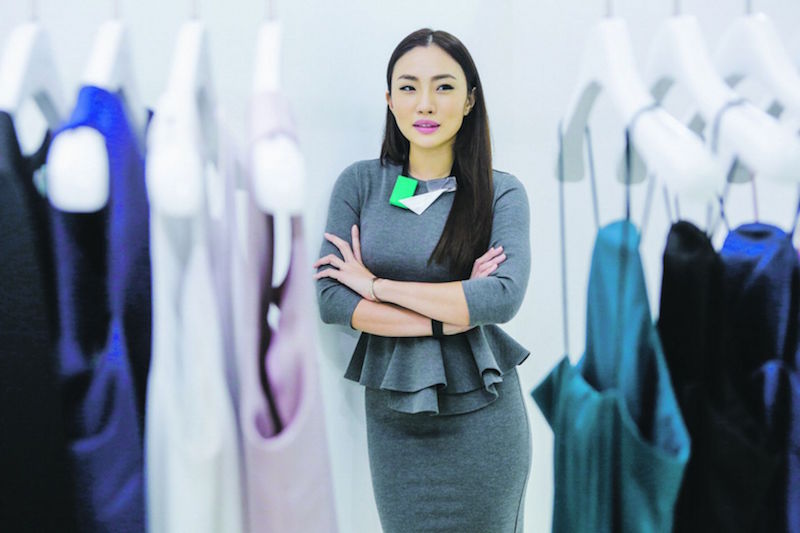


SINGAPORE, Aug 14 — In the heart of an old industrial estate in Toa Payoh North, an immaculately dressed Velda Tan sits in a small office as office workers, aunties wearing tight clothes and construction workers carry on with their lives outside. It’s the home of Tan’s latest fashion venture, Collate The Label, a humble but comfortable space, but with a well-equipped studio for fashion shoots, space for a dozen employees, stacks of sketches, fabric samples and magazines lying on tables and shelves, and even a doggy bowl for furry friends.
Collate The Label is one of many new fashion brands that have popped up in Singapore over the past few years, but it has been exceptional in its success so far. Although it’s only a few months old, the Singaporean mid-market womenswear brand, which launched in May at Singapore Fashion Week, will soon head to New York to participate in Coterie, a three-day fashion trade-show event, with the Textile and Fashion Federation Singapore (TAFF).
“I think, for me, (the aim) is really to build Collate as an independent Singapore label,” said the founder and creative director of the brand. “We want to identify ourselves as a local brand, and one of our goals is to make Singaporeans proud of wearing local labels.”
Facing up to challenges
The local retail scene is certainly more vibrant than a decade ago. Local designers have been given more platforms, such as the annual Singapore Fashion Week and Digital Fashion Week, to showcase their works to an international audience. TAFF also works with government agencies such as SPRING Singapore and International Enterprise (IE) Singapore to organise events such as the Asian Fashion Exchange, a one-stop event for local designers, regional and international buyers and other industry professionals, as well as trips to about a dozen overseas fashion trade shows every year.
“It’s a wonderful time to be a designer in Singapore at the moment,” said Carolyn Kan, founder and designer of jewellery line Carrie K and co-organiser of retail outfit KEEPERS: Singapore Designer Collective, which opened its second pop-up store at Changi Airport Terminal One last month. “There is a lot of support by the Government, there is also a growing design community to tap into, and Singaporeans are slowly starting to seek out local brands.”
Still, the challenges remain. In setting up their labels, designers such as Tan had to learn to overcome numerous obstacles, including the size of Singapore’s market.
“Because Singapore’s market is quite small, we have to think about crossing borders and going overseas,” she said.
However, Priscilla Shunmugam, founder of Singapore-based womenswear label Ong Shunmugam, saw a silver lining. “I would say the only good thing about having a fashion brand in Singapore is you have a significant population of people with high disposable income, and not much else to spend their money on. That really leaves women, in particular, with a high appetite just for consumption,” she said, although she added that there were “plenty of drawbacks”. “Far more drawbacks than benefits! We lack all the requirements for a solid fashion industry. We don’t have production facilities, we don’t have skilled labour and we don’t have natural resources. Most of our manufacturing industries are all sunset industries, so they don’t look very sustainable. We have very high overheads, like high salaries and high rents. That really just makes producing in Singapore a very expensive game.”
The proliferation of fashion brands, while a good thing for consumers, also means it may be a dog-eat-dog situation here. “Singapore is small, but crowded with many brands. It is very hard to stand out and find loyal customers,” said Singapore-based designer Sabrina Goh, adding that the level of competition here is comparable to those in other major cities such as New York.
Fashion capitals
This is perhaps why so many designers here dream of the opportunity to have their work showcased and validated in the fashion capitals of the world — New York, Paris, London and Milan. Odile Benjamin, creative director of homegrown fashion and leather goods brand Raoul, explained that it is partly because local fashion labels often have to succeed abroad before people back home start paying attention.
“It is a fact that only after people in Singapore started seeing us in European stores that they actually started taking Raoul seriously,” Benjamin said in an e-mail interview. “We were present for years before that, but somehow, (as a) ‘local brand’, it did not pique consumers’ interest the way it did after we started selling internationally.”

For Shunmugam, part of the thrill of being in the fashion capitals is also the opportunity to “expose your work to the sharpest eyes and minds possible”, particularly when international media and buyers congregate in these cities during fashion week.
“It’s a meeting point for the brightest and most talented people, and if you really want to get to the heart of it, you want to get your work seen,” said Shunmugam, who recently made a trip to the Big Apple with two other Singapore labels, Elohim by Sabrina Goh and Dzojchen, to meet members of the New York fashion industry under the inaugural Fashion Futures programme, which was conceived and established by Singapore Fashion Week and the Council Of Fashion Designers Of America (CFDA).
“Not everyone wants that, because you can’t always guarantee a positive response. You could show your work to Anna Wintour or Suzy Menkes or Nick Wooster and they might think it’s bulls***. Not everyone is up for that,” Shunmugam opined. “For me, I like to be able to show our aesthetic to as many people who matter. I prefer to show to quality over quantity, instead of hitting as many markets as possible. It’s more important for me to hit a good market where people have matured tastes, and the consumption of fashion is something to be admired.”
Celebrity cameos
Like other brands abroad, local labels can also capitalise on the power of celebrity. Raoul, for instance, boasts of an impressive “Who Wore It” section on its website, with big names such as Jennifer Lawrence, Jessica Alba, Patricia Arquette and Viola Davis donning signature Raoul pieces at various events. The label also caused a frenzy back in 2012, when Catherine Middleton, the Duchess of Cambridge, wore a patterned Raoul blouse and matching skirt during her visit to Singapore. But how important are celebrities in the fashion game?
“Very,” Benjamin acknowledged. “These individuals are very recognised and add, in a way, their stamp of approval. However, the most important thing is that the product has to stand up to the competition and consumer expectations.”
“There are companies in the United States that specialise in seeding products with celebrities, but that is a very costly option,” said Carolyn Kan, whose label Carrie K. has been showing in Paris since 2012. “Carrie K has been very fortunate to have a really supportive circle that has recommended our designs to stylists and stars such as Zhang Ziyi and celebrity blogger Margaret Zhang. Having celebrities embrace a brand is always a great way to fast-track awareness to a wider audience. And it is brilliant if the celebrity chooses to wear the designs because he or she likes it. When someone votes with her wallet, that is the true win.”
Getting in focus
Building a truly successful brand, however, takes more than cash, celebrities and trips to fashion capitals. It takes focus, an eye for detail and, above all, grit and determination.
“I think to build a fashion label today, you need to have passion,” said Goh. “You need to ask yourself how much you can take for the daily stress. Are you willing to tighten your belt just to go through lean periods? Your business has to be sustainable and realistic.”
“You can have a really good idea, but if you don’t execute it well, it just remains a good idea,” said Shunmugam. “The big problem is that a lot of young creative people have brilliant ideas, but are just not able to execute them to a standard that would allow them to play on a par with Japanese, Korean or English designers.
“That will be your ceiling if you don’t realise how important it is to use good-quality fabric, for example; or to ensure that the construction of your bag, shoe or dress is immaculate. If it is not good enough, then it shouldn’t be put on sale. Those standards should never be questioned.”
She continued: “People (have to) realise that you need to have attention to detail — even if it takes you endless tries, you have to do it; otherwise, this is not the industry for you. And there are no two ways about it. If you walk down the floor of any reputable department store or boutique in the world, you will find that it’s not just creativity that hangs on the racks, it is also comfort and quality.”
Collating designs
For now, Tan will work with her team of designers and colleagues to navigate what will likely be a challenging but rewarding journey through the complex world of fashion. And when the going gets tough, she will remind herself why she started Collate The Label in the first place.
“The biggest question I asked myself was what can I provide in this market space? What difference can I make?” said Tan, who was one of the founders of online fashion retailer Love, Bonito. “I think mass-market fashion is just a money-making route. I’d just be taking a slice of the pie, knowing that it would work, from my previous experience. But that is not my motivation. My motivation is to carve out something different. That is why when I travel, I look at Australian labels. In Australia, they really, really love their own designers, and are willing to pay good money for local designers.
“I think that is something we can create for Singapore as well,” she added. “We are known for our food, we are known for our Singlish, but we are not known for our arts and design. We don’t really know how to identify Singaporean fashion. I think this is a space we can work on. This is my motivation — to try to carve an identity for us.” — TODAY


