KUALA LUMPUR, June 1 — Ebelyn lacks even the documentary proof that she exists.
She’s never had any papers, neither do her five children.
She lives in a makeshift shack among other makeshift dwellings in a slum a few kilometres out of Lahad Datu on the eastern coast of Sabah.
Abdul Han and his family live on a tiny boat off the same coast. They too have no official documents.
Both families are stateless.
Di Ambang: Stateless in Sabah, a video documentary expected to be completed late this year, captures the daily lives of the two paperless migrant families over two separate eight-week periods in 2012 and 2013.
Their struggles to live in a land that won’t welcome them but is happy to exploit their energies is commonplace in some parts of Sabah, co-director of the project, Vilashini Somiah, told The Malay Mail Online in a recent interview.
As a child growing up in rural Sabah, Vilashini had encountered people like Ebelyn and Abdul, passing through the town where she lived, working at menial jobs.
“People called them Filipinos. They’re still called Filipinos but they are people with no documents. Labelling them as Filipinos is problematic,” the film student at Ohio University said.
“This documentary is a chance to tell their story.”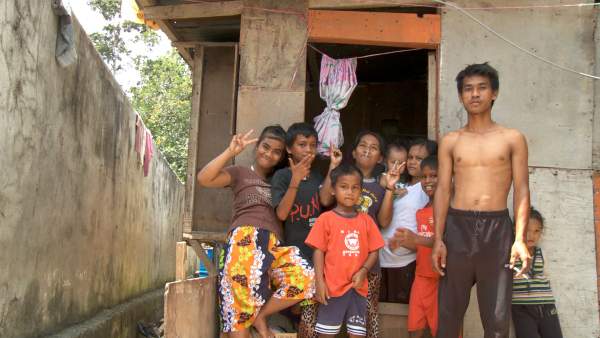
Estimates of Sabah’s paperless migrants vary, but their figures are said to be in the hundreds of thousands, in a state with a total official population is just over three million people.
Most are believed to be from the Philippines and Indonesia.
They make it their business to keep out of the reach of the authorities, taking on jobs no one else will do.
“This is where we hide if they (the authorities) come looking for us,” father of five Abdul Han says in the documentary, pointing to a clearing at the top of a hill.
“If they get us, then it’s fate.”
Historians say that it was common for people to make a living travelling between Sabah and the smaller islands to its east and north-east before Malaysia and the Philippines became nation states and modern sea borders were drawn.
The Philippines hasn’t dropped its claim on Sabah and the sea border between the state and the Philippines remains notoriously porous.
More recently, the restive situation in the southern Philippines has also driven people to seek their fortunes in relatively prosperous Sabah.
“We come from the sea. We go wherever there is peace and we can make a living,” Abdul Han tells the audience in the opening sequence of the trailer for the documentary.
He belongs to a group of people commonly called sea gypsies. They are accomplished divers and swimmers who live off the sea.
But even just making a living is hard.
“If we’re looking for jobs at a restaurant or at a shop we just can’t get them. Those jobs all require papers,” Ebelyn says.
The tough life takes a toll on the families, with no access to basic services including government schools and hospitals.
“It is hard to miss how weather-beaten they look, even the children,” said Azliana Aziz , the producer of the documentary and also a film student at Ohio University.
It was hard to win their confidence, but mostly they were just surprised anyone would be interested in their lives, she said.
During the second part of the filming in 2013, the families were thrust into the national conscience. In April, men claiming Lahad Datu for the Sultan of Sulu, a kingdom based in the Sulu archipelago now part of the Philippines, landed near Lahad Datu.
As the incursion led to bloodshed and a standoff that lasted several weeks, migrants in the area whom locals believed to be compatriots of the intruders, came under scrutiny.
Malaysia’s federal government mobilised the army and navy. Troops poured in, road blocks were set up and house-to-house searches ensued to flush out the intruders.
“We were in the middle of filming at the time. The feeling of danger was palpable,” Matthew Fillmore, the project’s co director said.
It seemed like overnight the people who were mostly ignored came to be viewed as enemies of the state, he added.
“They were already living very uncertain lives. One of them might go out and never come back because they might have been detained by the authorities.”
Fillmore’s role in the documentary came by chance. He met co- director Vilashini and producer Azliana as they were about to start the project and were looking for technical film-making know- how.
The trio, currently based in Athens, Ohio, pooled resources, using small grants and their own savings to pursue the project.
Filming complete, the documentary is now in post-production having obtained funding from the crowdfunding site Kickstarter.
Trailer 1
Trailer 2