


BENGALURU, Oct 1 — Bengaluru, the capital of the southern Indian state of Karnataka and the country’s third-most populous city, is perhaps best known as India’s “Silicon Valley”.
It is home to the headquarters of Infosys and Wipro, two of India’s “Big Six” IT companies, and to multinational giants like Amazon, Microsoft and Google, which unveiled its “Ananta” campus in 2025, a sprawling 12-storey structure of roughly 1.6 million square feet, with seating for more than 5,000 employees.
I visited the city last month. After landing at Kempegowda International Airport, which runs on 100 per cent renewable energy, and clearing security at Terminal 2, through its hanging gardens and indoor waterfalls, I got my first taste of Bengaluru’s infamous — and noisy — traffic.
Lanes appeared to be a mere suggestion; honking is a habit, and our driver did his best to live up to the famous Ayrton Senna quote — “If you no longer go for a gap that exists, you are no longer a racing driver.” — weaving through a never-ending sea of motorcycles and auto-rickshaws.
It gave me plenty of time to look at the buildings in an increasingly dizzy state.
There wasn’t much at first: a few local businesses selling concrete, then a Nike factory outlet, then a succession of car dealerships.
And then, all at once: Amazon, Infosys and Philips, only 20 minutes from the airport.
Traffic slowed to a crawl as we left the outskirts and entered the city centre.
There are no expansive technology campuses here; those are kept to designated districts and special economic zones spread across the city and away from the centre.
The oldest of these, the aptly named Electronic City, was established in 1978 across 800 acres of land and is about 19 kilometres from the city centre.
Instead, the centre is a mix of high-rises and the old city, where colonial architecture stands side by side with modern towers of steel.
But the true heart of Bengaluru predates the British by a few hundred years.
The city was established in 1537 by Kempe Gowda I, a governor under the Vijayanagara Empire who defeated a local ruler and built a fort here.
That fort, built from mud, would become the core of the modern city.
Today, the fort and the walled market area branching from it, known as Bengaluru Pete (“pete” is Kannada for “market centre”), are a tangle of crowded streets and historic landmarks.
It is also home to Krishnarajendra Market, the city’s largest wholesale market, and one of the biggest flower markets in Asia.
We visited Krishnarajendra Market, also known as K. R. Market, the next day, crammed together with what felt like half of Bengaluru’s estimated 12 million residents.
The original building dates to 1928, with a three-storey structure added in the 1990s to expand capacity and improve overall conditions.
Still, traders spill out beyond the open-air section and onto the road, selling fresh vegetables and fruit.
Pomegranates glittered like rubies under the hot Indian sun, while mosambi, limes the size of oranges and a staple ingredient in sweet lime juice, stacked up toward the sky.
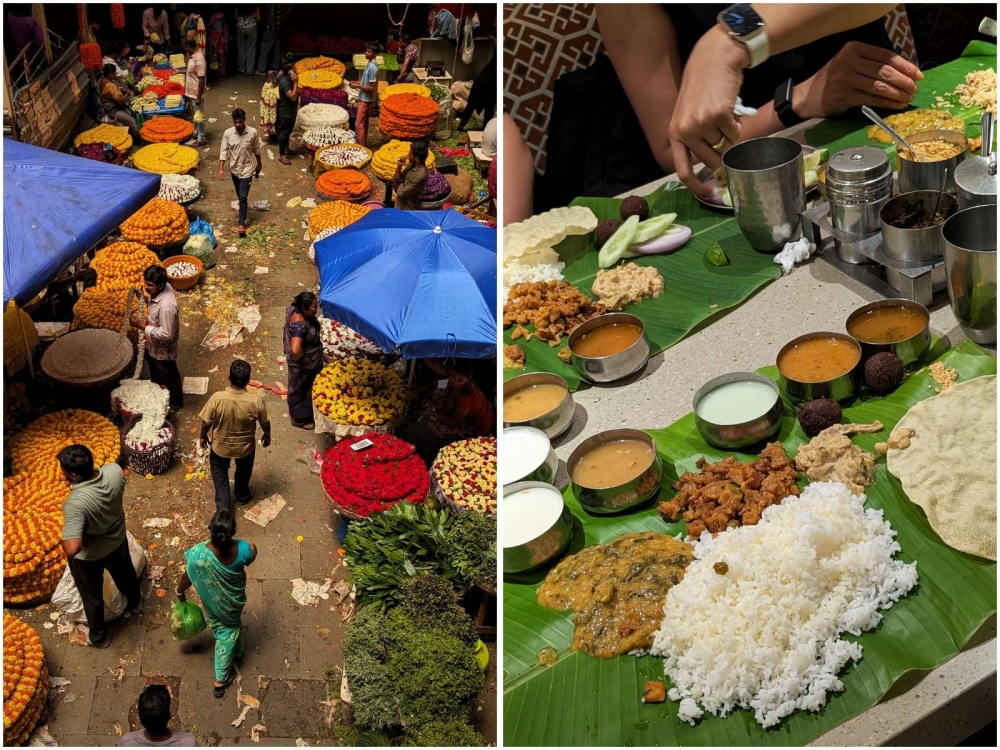
Inside the main building, the basement floor is a kaleidoscope of gold, red, orange and white, as coils of flower garlands dot the scene.
The market was buzzing even when we visited after 1pm, but it is busiest around 6am every morning, with wholesalers and vendors locked in hurried, intense haggling over flowers by the kilo and garlands by the metre.
The sights, smells and constant jostling for space amid throngs of people are enough to work up an appetite in anyone, let alone my hungry self.
I hadn’t eaten all day in preparation for the meals to come.
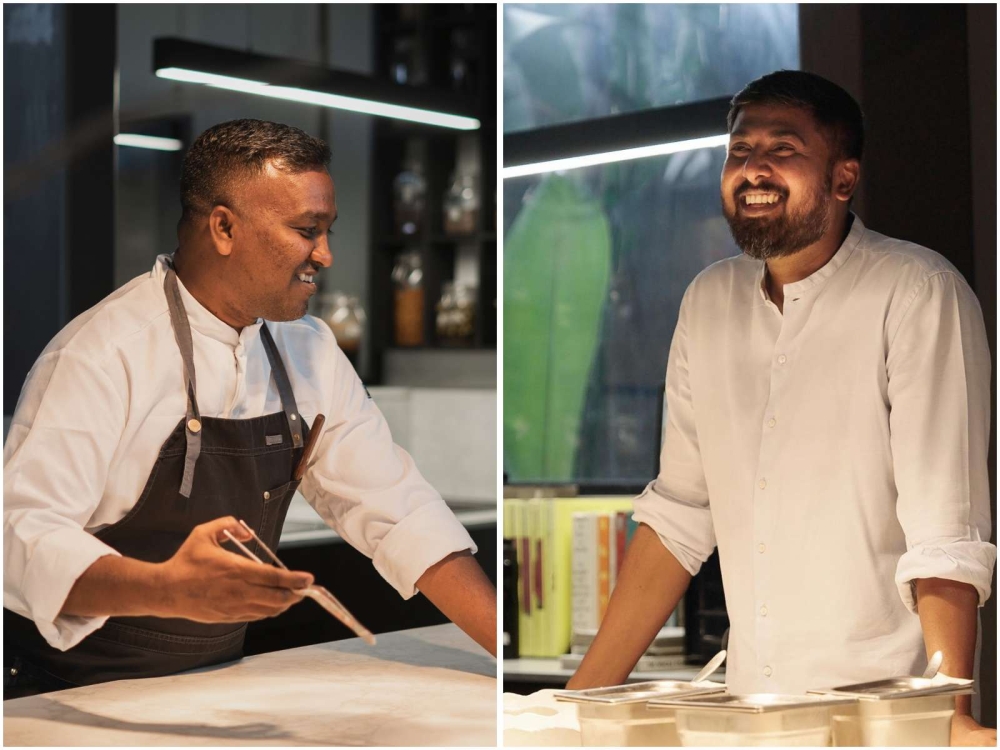
Swati Rao, who runs the restaurant Farmlore with her husband on a farm on the outskirts of Bengaluru, took me and two others for a quintessential Bengaluru meal — one that originates from Andhra Pradesh, the state bordering Karnataka to the east.
“I know, it’s funny, but Andhra restaurants are very popular all over Bangalore for some reason,” she said, laughing.
“This one we’re going to is a big chain, but I’m taking you guys to the original location, which has been here since 1984.”
It was a short drive from the old city to the newer side of Bengaluru’s central business district, where we hopped out of the car and into another crowd: the lunch rush was in full swing at 2pm on both floors of Nagarjuna Restaurant.
Along with everyone else, we were there to sample Andhra bhojanam, a traditional banana leaf meal.
Banana or plantain leaf meals are found throughout southern India, and bhojanam is the Telugu word for “meal”; the Telugu people are native to the state of Andhra Pradesh.
Rice laced with ghee and topped with podi (gunpowder masala) arrived in a flurry on a banana leaf, alongside sambar, a variety of pappu koora (lentil and vegetable stews), perugu (fresh curd) and pachadi (chutney), and bookended by cups of charu (the Telugu version of rasam, a sour and spicy soup) and payasam (a sweet pudding).
It felt both familiar and new to me as a Malaysian: big on lentils and generous with spice, though notably lacking the coconut and seafood that our more Kerala-influenced banana leaf meals include.
The most popular dish to order at Nagarjuna, Rao told us, is the “chilly chicken”, or pacha karam kodi.
Chicken is stir-fried with a spicy paste of fresh green chillies and other aromatic spices.
She did a quick check of our spice tolerance, warning that it wasn’t for the faint of heart.
I cautiously agreed to try, admitting to a “medium level” of spice tolerance, but really, I needn’t have worried. It is fiery and punchy, but anyone who can handle ayam berlado hijau will love this.
The heat is milder, but the rest of the aromatics make for an addictive, savoury sauce, which I smothered over my rice once the chicken was gone, then sucked my fingers clean.
Later that night, we embarked on an hour-long drive out of the city to Farmlore for dinner.
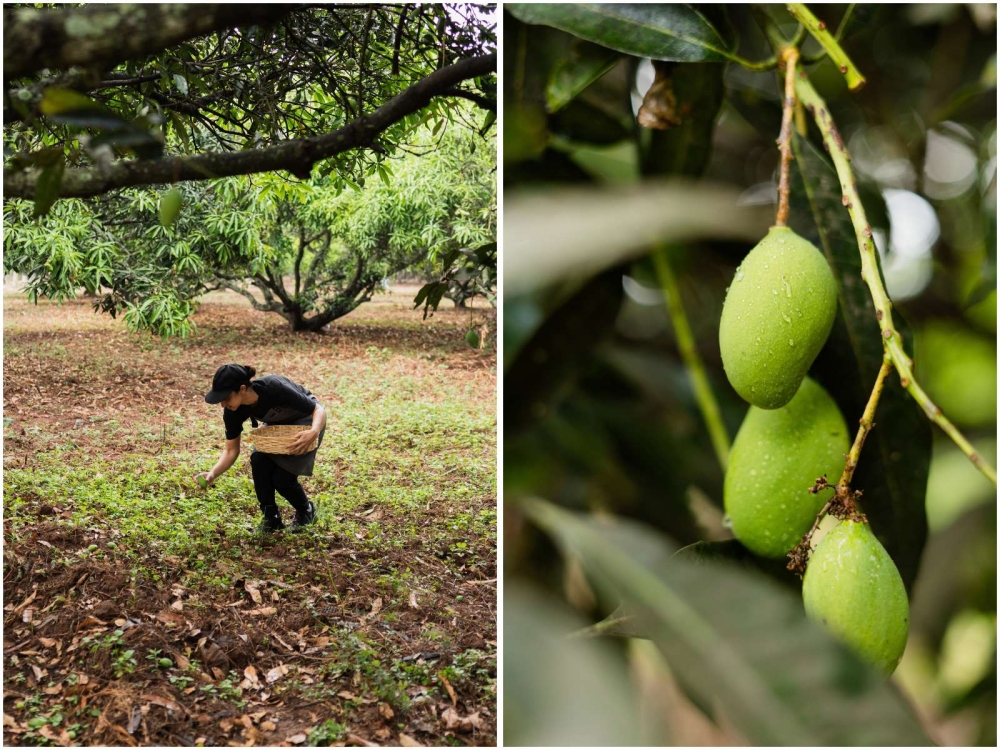
The restaurant is the brainchild of Rao’s husband, Kaushik Raju, and chef-patron Johnson Ebenezer.
Ebenezer’s career includes a two-year stint as opening chef at Nadodi, arguably Kuala Lumpur’s first modern Indian “fine dining” restaurant.
After returning to India, he met Raju and, after a series of pop-ups around Bengaluru, they decided to open Farmlore on Raju’s family farm.
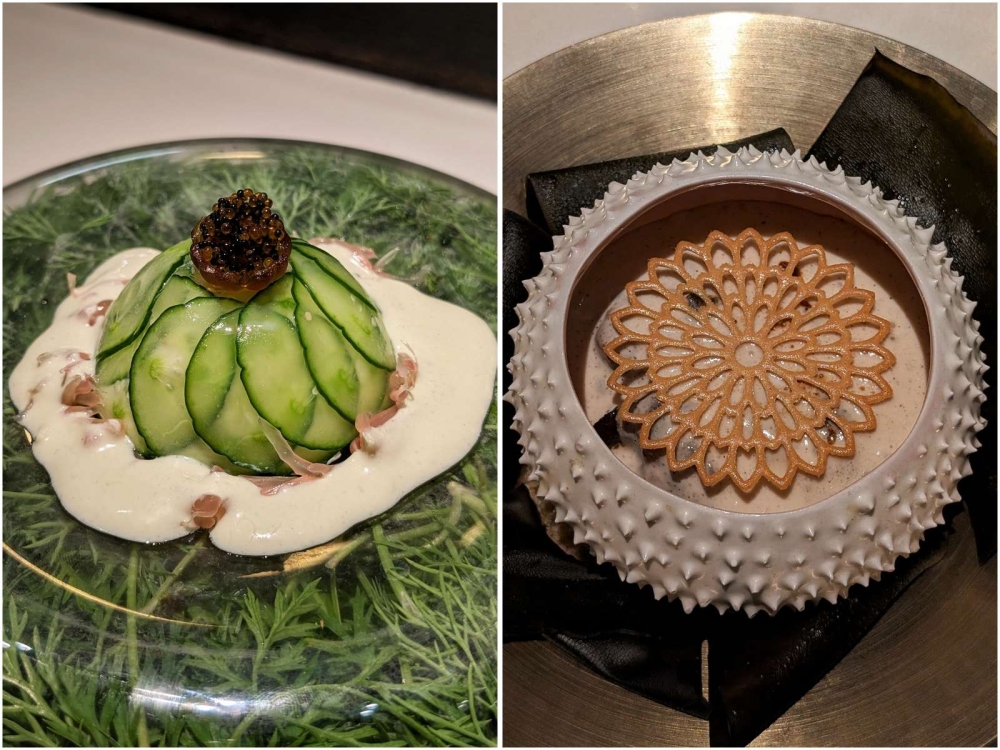
“It was my grandfather’s farm, and we grew mangoes and coconuts mostly,” Raju told us as he took us on a tour.
We visited the hydroponic system he added to ensure the restaurant has fresh produce year-round, tasting chilli flowers, stevia and tomatoes off the vine.
He then took us to see the native Hallikar calves, whose dung, along with pruned mango wood, provides the fuel for the open-flame cooking in the restaurant.
In the centre of the 33-acre property is a sleek, modern 18-seater space powered by solar panels.
The path leading to it is lined with mango trees on one side and coconut trees on the other.
Inside, Ebenezer serves a 10-course tasting menu (6,825 INR, RM290) that changes monthly, and a 5-course lunch menu (4,200 INR, RM180).
When I asked Ebenezer about the decision to offer lunch service so far from the city centre, he said the restaurant gets “pretty busy” on weekdays.
The closest technology park, Manyata Embassy Business Park, is about 12 kilometres away.
“We get a lot of people from the tech companies who will eat here and then take a meeting,” he said. “So many of them ask for the Wi-Fi password!”
The cooking at Farmlore is often described as “cuisine-agnostic”, a label I understand but find ludicrous.
But it does prime the mind to think beyond the constraints of “Indian cuisine”, as wide-ranging and regionally diverse as it is.
I tucked into a cold blue crab salad with pomelo and kingfish roe from the Keralan coast, followed by a salt fish and raw mango custard, like chawanmushi on steroids, filled with plump paddy snails and topped with a curry leaf and coriander foam.
A playful palate cleanser of sorts saw Ebenezer nod to his time in Malaysia. Pandan, which grows in neighbouring states like Kerala and Tamil Nadu, is made into a milk and poured over a sorbet of local pineapple.
A “probiotic” ice is shaved on top. He asked me to guess; I replied that it was unmistakably Yakult, which he confirmed with a toothy grin.
A pork course leaned much deeper into regional cuisine than it appeared to.
Presented as a sando of sorts, with a mustard and purple cabbage dip, the slow-roasted pork was cooked in the style of a pandi curry, a traditional dish of the Coorgs, or Kodava people, native to a mountainous region of Karnataka.
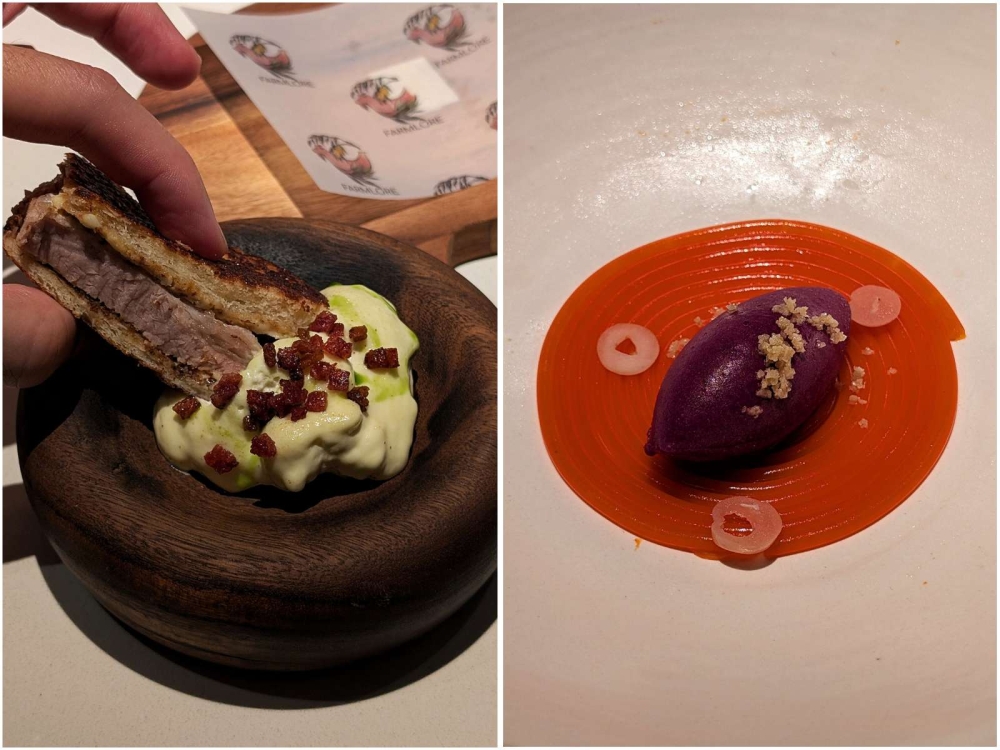
The curry is characterised by its distinctly sour flavour, which Ebenezer sought to incorporate by using a traditional vinegar called kachampuli, made from the Garcinia fruit kodampuli.
It is perhaps the dish that best fits the “cuisine-agnostic” tag, a label neither Ebenezer nor Farmlore has claimed for itself, but one others have seen fit to apply to the cooking.
In some ways, it is a distillation of modern-day Bengaluru: deeply rooted in history, yet eager to adopt a forward and outward-looking approach.
For dessert: seasonal jamun, typically eaten with chilli and salt, is made into a sorbet, placed atop a chilli gel “noodle” and flaked with salt.
On the drive back, I fell asleep in the car. The incessant honking that had jarred me at first had faded into ambient noise, becoming the soundscape of Bengaluru.
Nagarjuna Restaurant — Residency Road
Ashok Nagar, Bengaluru,
Karnataka, India.
Open daily, 12-3.45 pm, 7pm-10.45pm
Tel: +91 80 2555 9848
https://www.nagarjunarestaurants.com/
Farmlore
Survey No. 67, Mohan, Raju Layout,
Open Wednesday to Sunday, 12.30pm--2pm, 6.30pm--10pm
Tel: +91 80502 48469
* Follow us on Instagram @eatdrinkmm for more food gems.
* Follow Ethan Lau on Instagram @eatenlau for more tales of chilly chicken and restaurants around the world.


