


MARCH 20 — In the larger scheme of things, the party called Ikatan matters little.
Fully dubbed Parti Ikatan Bangsa Malaysia — National Alliance Party — it was reportedly founded in 2012, but only finally launched in May last year, ostensibly as the vehicle for veteran politician Abdul Kadir Sheikh Fadzir.
As part of Dr Mahathir Mohamad’s loyalists who followed the statesman to form New Umno in 1988, Kadir has tried to claw himself back to relevance ever since he fell out of Abdullah Ahmad Badawi’s administration’s favour.
Who can forget Kadir joining the short-lived NGO Angkatan Amanah Malaysia formed by another Umno has-been Tengku Razaleigh Hamzah in 2011 (not to be confused with PAS splinter Parti Amanah Negara), only to quit it the following year because the group would not evolve into a political party despite public clamour?
What do the other top leaders of Ikatan — Tunku Muin Putra and Tony Looi — stand for? Come to think of it, what does Ikatan itself stand for?
Little is known apart from Kadir’s proclamation at the party’s launch that its allegiance lies not with the government nor the Opposition, but rather with the “souls” of Malaysia’s founding fathers such as Tunku Abdul Rahman, Tan Cheng Lock, Dr Ismail Abdul Rahman, and V.T. Sambanthan.
Even the party’s flag, red and white stripes with a yellow circle — similar in more ways than one to Umno’s — has a silhouette of Tunku’s “merdeka” pose on it, instead of the keris that symbolises Malay supremacy.
So when Ikatan announced itself as part of PAS’s new opposition pact — despite vehemently denying it just a few days before — it begs the question: does Ikatan know it is being taken for a ride when it hopped onto the PAS train?
Despite the announcement, Kadir himself seemed unsure as to the direction that the pact will take — especially on the thorny issue of hudud, the Islamic penal code that undeniably contributed to the fallout that killed Pakatan Rakyat (PR).
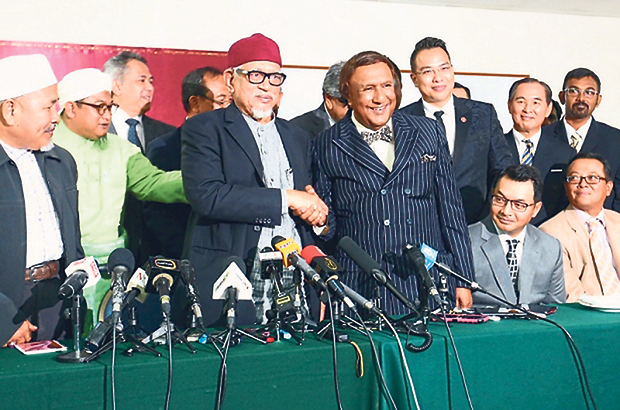
Speaking at the press conference, Kadir did not acknowledge the media’s question about the issue, only claiming that PAS champions a “universal and inclusive brand of Islam”.
Pressed by Malay Mail Online later, Kadir replied that voters will ultimately decide on hudud, but only through Parliament. According to him, hudud implementation may have to be delayed until the conditions are right.
But in another interview with a different news portal — done in anticipation of the pact’s announcement, perhaps — Kadir said both PAS and Ikatan felt the country was not ready for hudud.
Many lashed out at the latter, since it was the same stance taken by PR, especially DAP, and the PAS leaders who would later leave to form Amanah. Some accused PAS of abandoning its principles, if that consensus was ever true.
But of course Kadir’s statement should be viewed with massive caution, considering he can hardly be the most reliable spokesman for the Islamist party.
Indeed, there should be no question as to PAS’s consistency when it comes to hudud.
After the conflicting remarks made by Kadir, PAS information chief Nasruddin Hassan was quick to issue a statement claiming that Ikatan does not reject the party’s Islamic policies, but also respects and agrees with its struggle to implement Islamic code through democracy.
“PAS would like to remind all parties, especially the warlords behind certain media, to not try to split and throw slander at PAS as if it is abandoning the principles of its struggle. PAS’s principles will be hailed and respected by all its allies,” the Temerloh MP said.
Similarly, vice-president Idris Ahmad also asserted that any claims that PAS is dropping hudud “does not make sense”.
“PAS has countless times stressed that to implement hudud we must go through accepted means using the democratic channel. PAS is not Taliban, theocracy, revolution, nor Islamic State,” he said.
So yes, there should be no illusion on the part of Ikatan that PAS will still continue to push its hudud agenda, with or without Ikatan by its side.
Ikatan vice-president Looi has since declared that he will leave the party if PAS is adamant in enforcing hudud through the majority. He might as well quit now. Obviously, he did not make his stand clear enough, before Ikatan joined the pact.
After all, how faithful can Ikatan be to the “souls” of our founding father — who undeniably espoused a liberal, plural, and secular Malaysia — if it decides to get in bed with an unashamedly Islamist party?
If there is ever a silver lining from the pact, it was that PAS had chosen Ikatan to be its partner, of all people.
They could do worse, and pick Berjasa. The PAS splinter party became the umbrella for 11 candidates from hardline Islamist group Ikatan Muslimin Malaysia (Isma) during General Election 2013 — nine in federal seats. Sharing a manifesto, the party was effectively Isma’s proxy.
The fact that they did not win any single seat might have swayed PAS’s decision. (They lost to DAP in all but one seat). But then again, Ikatan did not even field any candidate in the last elections.
PAS could choose to include Perkasa in the pact. After all, PAS president Abdul Hadi Awang had welcomed his Perkasa counterpart Ibrahim Ali with open arms at an official visit last year.
Although Perkasa is just a pressure group now, it has not been shy about its ambition to evolve into a party should Umno and PAS falter in the next general elections.
After all, PAS central committee member and Research Centre chief Zuhdi Marzuki had suggested that an all-Muslim coalition is now possible after the death of PR — in the vein of Angkatan Perpaduan Ummah (APU) that contested in the 1990 and 1995 elections.
This ambition may yet be possible. Vice-president Idris has admitted last week that the pact is expected to work together with more parties and NGOs in the future.
PKR is still maintaining its ties with PAS in Selangor. And after PKR president Wan Azizah Wan Ismail admitted that the party — despite already allying itself with DAP and Amanah in Pakatan Harapan — could still work with PAS-Ikatan pact, shouldn’t anything be possible?


