


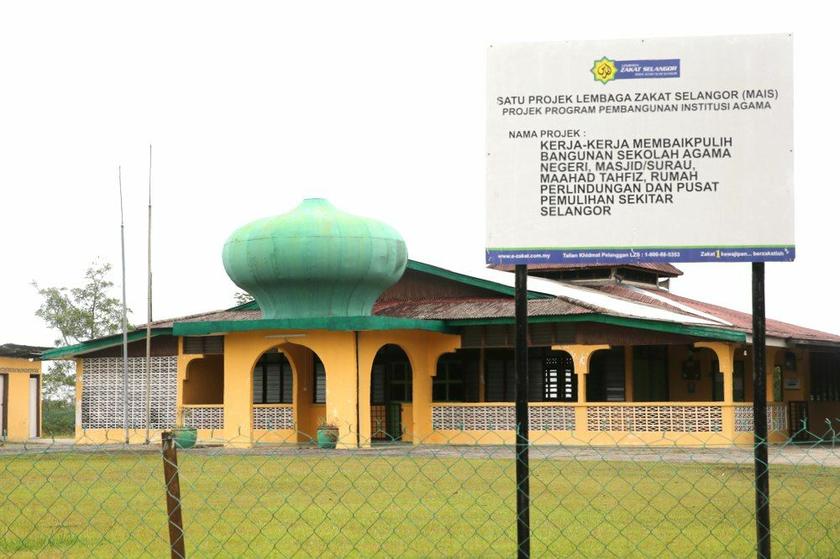
KUALA LUMPUR, Aug 17 — Amid a national debate on a growing Islamisation agenda, a local developer has mounted a court challenge against Selangor’s religious and land authorities to block the state from seizing control of 26 acres of its land in Batang Berjuntai.
In a court case to be heard next month, Selangor-based builder United Allied Empire Sdn Bhd (UAE) has accused the state of hiding its real intent to compulsorily acquire its private property behind a government gazette for a mega mosque that would dwarf the nation’s largest, as a front to hide the construction of a fully-integrated Islamic school with hostel, shelter and rehabilitation centre.
To add fire to the court case, the Chinese-owned company has also accused the state authorities of purported racial oppression and violation of its constitutional rights, alleging they had abused their powers to compulsorily acquire the large swathe of land without fair compensation to shore up the state religious bodies’ property asset for future development.
The 26.281 acres of land that is about 1.5km by car from the Universiti Selangor (Unisel) campus in Batang Berjuntai, is roughly the size of 20 international football fields, or nearly the size of the 1.5 million square feet Suria KLCC shopping mall that anchors the iconic Petronas Twin Towers, if all six floors of its retail space were to be laid flat.
“I state that this action is also made to avoid the payment of fair compensation because the acquisition of this Land was made ostensibly in the name of a religious project for a public purpose,” UAE director, Chew Han Poh, said in his affidavit dated April 22.
“The reality is the authorities had abused APT 1960 to acquire private land to create a land bank for their future development,” he added, referring to the National Land Acquisittion Act 1960 by its Malay initials.
In a self-described act of last resort to protect its rights as the legitimate landowner, UAE filed for a judicial review on April 22 at the Shah Alam High Court to revoke the compulsory acquisition of its privately-owned land.
In court documents made available to The Malay Mail Online, UAE’s Chew said the company had planned a mixed commercial development on the 26.281-acre plot and an adjoining 7.956-acre of land, both located in Bestari Jaya — an area formerly known as Batang Berjuntai — in the Kuala Selangor district.
But its plans were abruptly disrupted when the Selangor Islamic Religious Department (JAIS) initiated a process under the Land Acquisition Act 1960 to take full ownership over the 26 acres of land.
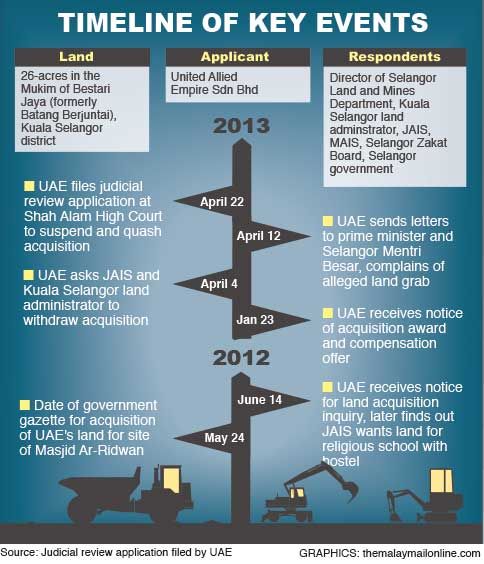 UAE claimed it was kept in the dark over JAIS’s real intent to acquire the whole parcel despite the company’s attempts to get information of the state body’s development plans, adding that the religious department had actively hidden the plan’s details.
It was only during a land acquisition inquiry in which UAE was asked to attend in June 2012 that JAIS disclosed its intent to build a “full integration agama (religious) school with hostel”, Chew said in his affidavit.
He said UAE had found a signboard on the site that had been jointly put up by JAIS, the Selangor Islamic Religious Council (MAIS) and the Selangor Zakat Board, which gave notice of a MAIS project to carry out various works, including for a state religious school building and a mosque.
But after conducting a search, the company discovered a government gazette dated May 24, 2012, in which JAIS had declared that it wanted to acquire the land as a site for the “old” Masjid Ar-Ridwan.
UAE expressed its suspicions after highlighting what it said was JAIS’s contradicting declarations of intention in the gazette and the signboard.
“Therefore, the actual intention of that acquisition is suspect. It is not impossible that the Third Respondent wants to make it a land bank for the purposes of future development,” Chew said, referring to JAIS’s actions.
“If so, this acquisition is against the legal provisions and is an abuse of power,” he added.
UAE argued that the acquisition had breached its rights as the legitimate landowner, saying: “The Third Respondent oppressed the Applicant purely because the Applicant is a Chinese-owned company”.
“The acts of the respondents in oppressing by using the ends to justify the means under the name of religion, namely a ‘mosque site’, should not happen in a plural community of diverse races and religions like Malaysia,” Chew said in his affidavit.
UAE expressed its disappointment at JAIS’ push for the compulsory acquisition to go ahead even though the company had already set aside 0.85 acres, or 37,026 square feet, in its original commercial development plans for the extension of the existing Masjid Ar-Ridwan.
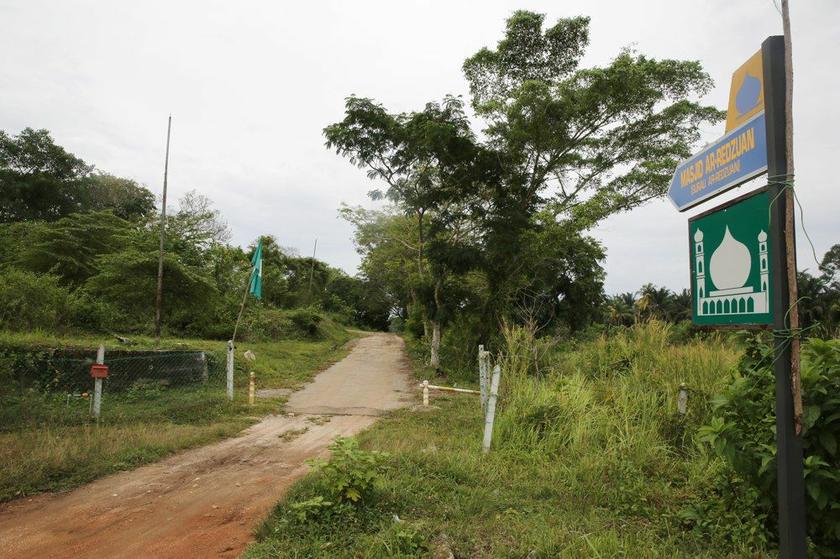
In his affidavit, Chew argued that the state authorities had acted in “mala fide” (Latin for bad faith) in pushing the compulsory acquisition of the land, citing Article 13 of the Federal Constitution and the Land Acquisition Act.
According to the developer, the state can only push for compulsory acquisition of private land if it benefited the public under Article 13, which also includes the provision that property owners should receive adequate compensation for the compulsory acquisition or use of their property.
In a typical compulsory acquisition process, property owners can expect to be paid lower than the market value, or lower than the sum they may have received if they had sold the property.
To pad up its arguments that the state acquisition of 26 acres of land had exceeded the public’s needs, the developer highlighted that mosques in rural areas typically occupied only a plot of land measuring between 0.5- and one acre.
The developer further argued that Batang Berjuntai’s small population did not warrant the construction of a “giant mosque”, and pointed out that the existing Masjid Ar-Ridwan was not even filled to capacity during prayer times.
According to a 2010 census of Selangor that UAE had tendered to court as part of its supporting documents, Bestari Jaya, or Batang Berjuntai as it is still popularly called today, has a population of 24,584 people, a figure which includes 2,739 non-Malaysians.
Almost half of that total figure is Bumiputeras at 11,801, with 11,663 of them being Malays, an ethnic group which is defined in the Federal Constitution as those professing the faith of Islam.
In its judicial review application, UAE named the director of Selangor’s Land and Mines Department, the Kuala Selangor land administrator, JAIS, MAIS, Selangor Zakat Board and the Selangor government as its first to sixth respondents repectively.
The developer argued that the land authorities’ decision to allow the acquisition amounted to an “unreasonable exercise of power” for failing to ensure the process’s legal compliance, while also saying that their action had unjustly affected UAE’s rights and interests in the land.
UAE also argued that the Selangor government had a “vicarious liability”, explaining that it was responsible for all the other five respondents under it.
The Selangor government had a fiduciary duty to ensure the land authorities complied with the provisions and processes under the law, as well as to ensure the five state bodies kept to the spirit of the law, UAE said.
The Malay Mail Online understands from UAE’s lawyer, Rosli Dahlan that the court has suspended temporarily the land acquisition process pending the judicial review hearing on September 25.
“UAE has managed to get the court to suspend the land acquisition process until after the hearing of judicial review,” Rosli said.
UAE has also written to Prime Minister Datuk Seri Najib Razak and Selangor Mentri Besar Tan Sri Abdul Khalid Ibrahim on April 12 to seek their help, just a week after formal pleas to JAIS and the Kuala Selangor land administrator to cancel the compulsory acquisition appeared to have failed.
JAIS’s director has yet to reply to The Malay Mail Online’s request for comment.
Khalid told The Malay Mail Online recently that he was aware of the case but stated that he would leave it to be adjudged in court.


